Skip to content
 cust@legendarchery.com
 302 503 5767
 Westfield IN 46074



The arrows you shoot in practice sessions have a direct impact on how quickly you develop consistency, form, and confidence. Many archers spend considerable time choosing their bow but treat arrows as an afterthought. That approach creates problems that compound over time — poor groupings, inconsistent feedback, and wasted sessions. Here is what you actually need to know before you start shooting.
Why Your Practice Arrows Shape Your Progress
Every arrow you send downrange during a training session is giving you feedback. If that arrow is mismatched to your bow, your draw length, or your shooting style, the feedback is corrupted. You can train for months and build bad habits rooted in poorly matched equipment rather than genuine form errors.
This matters especially for newer archers because they are still calibrating their proprioception — the internal sense of where the body is positioned in space. Inconsistent equipment introduces a second variable into what should be a single-variable learning process. The goal of practice is to isolate technique, not troubleshoot gear mid-session.
Experienced archers understand this well. They often maintain a dedicated set of training arrows that are durable, consistently spined, and matched precisely to their bow's draw weight and their own draw length. These arrows do not need to be the most expensive in the range, but they do need to be appropriate.
Core Principles of Selecting Practice Archery Arrows
Spine Rating and Why It Dominates Everything
Arrow spine is the single most important specification to get right. Spine refers to the stiffness of the shaft — how much it bends when force is applied. Every arrow manufacturer publishes a spine chart that maps draw weight and draw length combinations to a recommended spine rating. Shooting an arrow that is too stiff or too weak for your setup causes the shaft to flex incorrectly through the paradox phase as it leaves the bow, sending it off course regardless of your form.
- Underspined arrows (too flexible) will kick right for a right-handed archer and produce a weak, fishtailing flight path.
- Overspined arrows (too stiff) tail left for a right-handed archer and group inconsistently.
- Point weight affects effective spine — heavier points make an arrow act weaker; lighter points make it act stiffer. Always account for point weight when reading a spine chart.
Shaft Material for Training Sessions
Arrows are manufactured from four primary materials, each with trade-offs that matter during heavy practice volume.
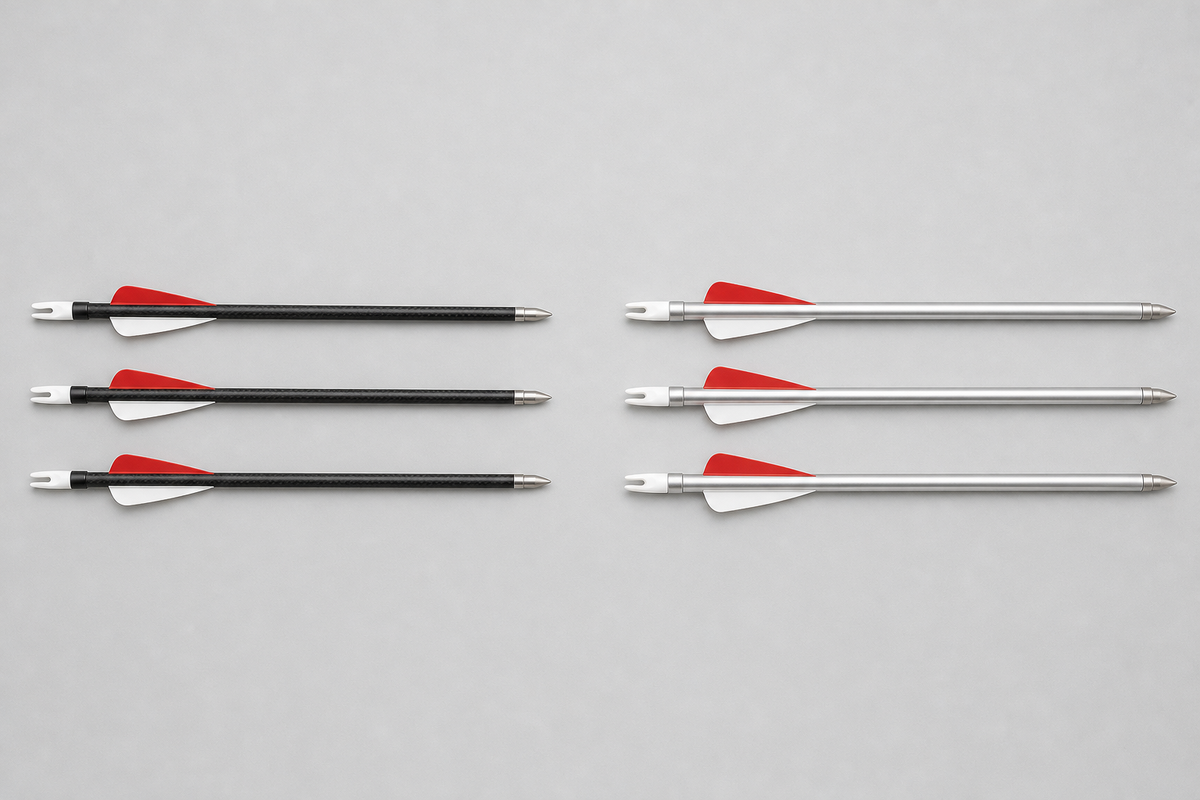
- Aluminum: Affordable, consistent, and easy to work with. They bend rather than break, which means you can inspect and straighten them. A good choice for indoor range practice and high-volume repetition at close to mid distances.
- Carbon: Lighter and faster than aluminum at comparable spine ratings. Carbon shafts do not bend — they either survive or they shatter. For training, inspect carbon arrows carefully after any hard impact. Splintered carbon is dangerous and must be retired.
- Aluminum-carbon composite: Combines some of the consistency of aluminum with the speed advantages of carbon. Used across competitive and recreational shooting at multiple distances.
- Fiberglass: Primarily found in entry-level and youth setups. Heavy and inconsistent across individual shafts, but durable enough for casual range sessions on low draw weights.
For most archers training regularly, carbon or aluminum shafts offer the best balance of performance feedback and long-term value. Understanding the differences between arrow types is worth the time — the archery arrows overview covers additional context on how shaft characteristics influence flight and selection, and our breakdown of carbon, aluminum, and wood arrows goes deeper on how each material behaves under practice-level shot volume.
Length and Nock Fit
Practice arrows must be cut to the correct length for your draw. The standard guidance is to cut the shaft so the point sits just beyond the front of the arrow rest at full draw. Shooting arrows that are too short is genuinely dangerous — the point can drop behind the rest at full draw and cause serious injury on release. Always measure your draw length with a trained eye or use an overdraw arrow on a safe setup before committing to a cut length.
Our nock fit guide covers this in detail, but it is often overlooked in practice setups. The nock must snap onto the string with light, consistent resistance — not so tight it affects the release, not so loose it risks a dry fire from a dropped arrow. Replace nocks whenever they show cracking, play, or inconsistent seating.
Fletching Choices for Training
Practice arrows are most commonly fletched with plastic vanes rather than natural feathers. Vanes are more durable, moisture-resistant, and cost-effective for high-volume shooting. The trade-off is that vanes require a small helical or offset to generate adequate spin stabilization. Straight-fletched vanes provide minimal rotation and suit only very short distances where stabilization requirements are low.
For indoor practice at 18 to 20 meters, shorter vanes with a slight offset are a practical standard. For outdoor sessions at longer distances, a more aggressive helical or longer vane surface helps stabilize the arrow against wind drift and inconsistent release.
Practical Guidance for Setting Up Your Practice Arrow Set
How Many Arrows Do You Need?
A minimum of six arrows is the practical floor for a meaningful training session. Twelve is a better working set. With fewer than six, you spend too much time walking to the target relative to time actually shooting. Fatigue also distorts form — six to twelve arrows per end gives you enough volume to identify patterns without pushing into the territory where tiredness corrupts your mechanics.
Tuning Before You Train
Before committing to a practice arrow set, verify the arrows are flying cleanly through a simple paper tune or walk-back tune. Paper tuning involves shooting through paper stretched across a frame at close range. A perfect tear is a round hole. Tears that are elongated up, down, left, or right indicate tuning issues in the bow or a mismatch between the arrow and the setup. Sorting this out before logging hundreds of practice reps prevents deeply ingrained compensations in form.
Organizing and Caring for Your Practice Arrows
Mark your arrows individually — a numbering system using a paint marker works well. Tracking individual arrows lets you identify if one shaft consistently prints differently from the others. If arrow number three always lands two inches low, that shaft has likely been damaged or is poorly spined. Pull it from the set rather than let it mislead your training feedback.
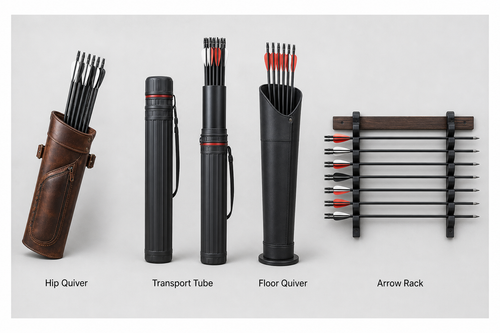
Transporting arrows safely between the range and home matters more than many archers realize. A durable arrow tube or structured archery backpack keeps shafts protected from knocks, moisture, and pressure that can bend aluminum or micro-crack carbon. Bent or damaged arrows should never be shot.
Common Mistakes Archers Make With Practice Arrows
- Using competition arrows for all practice: Competition arrows are often finely tuned and expensive. Heavy training volume accelerates wear, impacts, and loss. Many archers maintain a separate, slightly lower-cost practice set to extend the life of their match arrows.
- Ignoring spine charts: Selecting arrows by price or appearance rather than running the numbers leads to persistent grouping problems that are misattributed to form.
- Skipping arrow inspection: Every arrow should be flexed and rotated before shooting. A cracked carbon shaft that passes visual inspection may still fail on release. Spin the arrow between your fingers and listen for any creak or feel for any flex irregularity.
- Mixing different arrow models in one practice set: Even if two arrow models share the same nominal spine rating, minor differences in weight, balance point, and stiffness create inconsistent feedback across the set.
- Cutting arrows too short: Under-length arrows are a safety risk and should never be shot. Always verify length before cutting — the cut cannot be undone.
- Neglecting nock and vane condition: Broken vanes change arrow flight significantly. A cracked or loose nock affects release consistency and can cause dry fires in some setups. Replace worn components rather than continuing to shoot them.
Frequently Asked Questions
Do practice arrows need to match my competition arrows exactly?
They do not need to be identical, but they should be close enough in spine, length, and weight that the feedback from your training sessions transfers accurately to competition. If your practice set flies very differently from your match arrows, you may inadvertently train compensations that hurt you when it matters.
How often should I replace my practice arrows?
There is no fixed timeline — it depends entirely on shooting volume and how the arrows are treated. Inspect your arrows before every session. Replace individual shafts when they show bending that cannot be straightened, visible cracking in carbon shafts, or significant straightness deviation. Aluminum arrows can last years with proper care; carbon arrows should be retired at the first sign of structural compromise.
What mistakes do beginners typically make when buying arrows for practice?
The most common error is buying arrows without knowing their own draw length and the bow's draw weight at that length. Spine selection depends on both numbers. Beginners also frequently buy arrows that are too short, drawn by lower price points, without realizing the safety implications. Getting measured by a knowledgeable staff member at an archery shop before purchasing is always worthwhile.
Can I use the same arrows for both indoor and outdoor practice?
Yes, in many cases. However, fletching choice matters more outdoors where wind is a factor. Many archers keep two sets — one with shorter vanes optimized for indoor distances and one with longer or more aggressively offset vanes for outdoor sessions. If you only own one set, a moderate helical vane setup is a reasonable all-around compromise.
Building a Smarter Practice Setup
Choosing the right arrows for training is one of the higher-leverage decisions an archer can make early in their development. Matched spine, appropriate material, correct length, and consistent inspection habits remove equipment noise from your feedback loop and let you focus on what actually matters: building repeatable, sound technique. If you are also looking to extend your training kit with accessories that protect and organize your gear, archery accessories designed for transport and field use are worth exploring alongside your arrow selection.