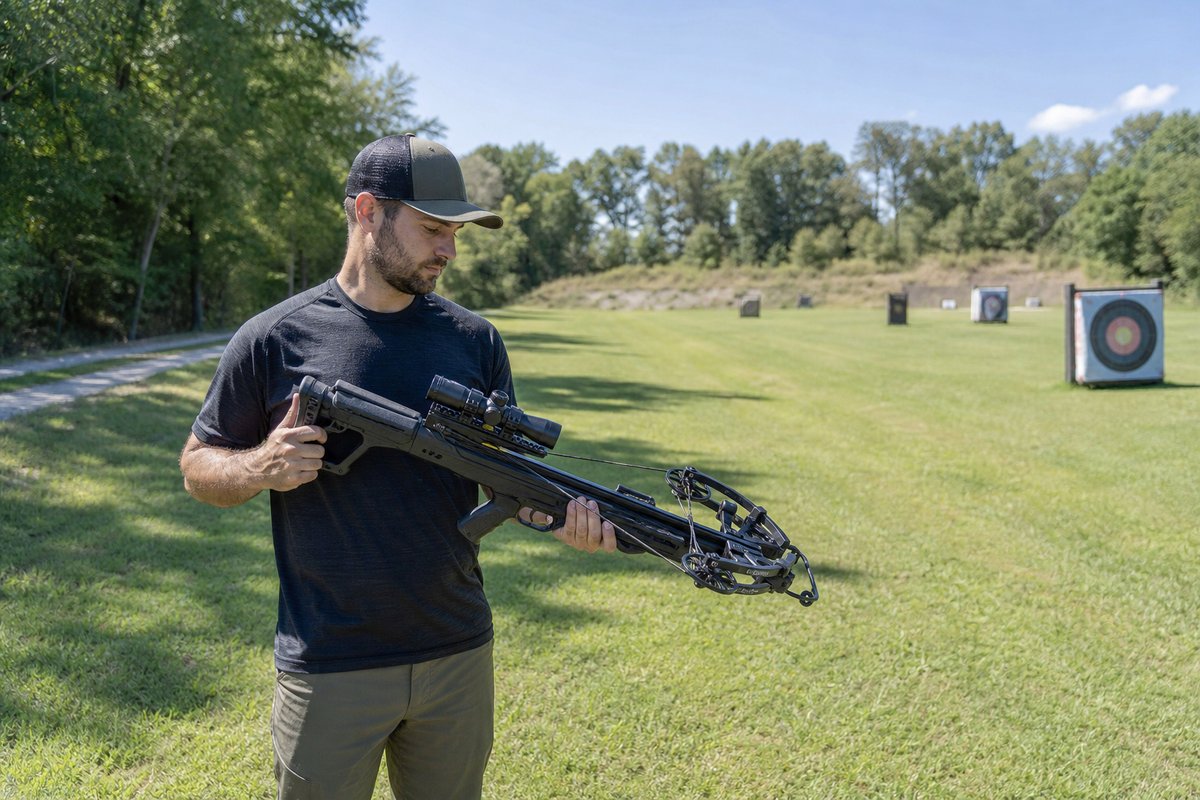
Knowing the parts of a crossbow is the first step toward using one confidently and safely. Whether you've just picked up your first crossbow or you're helping a newer shooter get started, a solid understanding of crossbow anatomy clears up a lot of confusion, prevents common mistakes, and makes every session at the range more productive. This guide breaks down every major component in plain language.
Core Concepts: How a Crossbow Works
A crossbow is essentially a horizontal bow mounted on a stock, designed to be held and aimed like a firearm while still releasing energy through limbs and a string — just like a traditional bow. The key difference is that a crossbow holds the drawn string in place mechanically, allowing the shooter to aim without holding tension. That locked, cocked state is what makes crossbow anatomy slightly more complex than a vertical bow, and why understanding each part matters for both safety and performance.
To dig deeper into how crossbows are categorized and defined, the crossbow glossary page is a useful starting point for newer shooters.
Main Parts of a Crossbow and What They Do
Stock
The stock is the main body of the crossbow — the part you hold and shoulder. It houses or connects to nearly every other component. Stocks are typically made from wood, composite, or reinforced polymer. The shape and length of the stock affect how naturally the crossbow fits against your shoulder, how steady your hold is, and how the crossbow balances when you're aiming.
Riser
The riser sits at the front of the stock and is the central mounting point for the limbs. On a compound crossbow, the riser also supports the cams and axles. It's usually machined from aluminum or molded from reinforced polymer. A stiff, well-made riser contributes directly to consistency because it keeps the limb geometry stable shot after shot.
Limbs
The limbs are the two flexible arms attached to the riser. When you cock the crossbow, you bend the limbs back against their natural spring, storing potential energy. When the trigger releases the string, the limbs snap forward and transfer that stored energy into the bolt. Limb design — length, material, and curvature — determines how much energy the crossbow can store and how efficiently it delivers that energy.
Rail (Flight Groove)
The rail, sometimes called the flight groove or barrel, runs along the top of the stock from the riser back toward the trigger. The bolt sits on the rail, and the string travels along it during the shot. A clean, properly lubricated rail is critical for consistent bolt flight and for protecting the crossbow string from premature wear.
String and Cables
On a recurve crossbow, a single string connects both limb tips. On a compound crossbow, the system includes a string plus one or two cables routed through the cams. The string is what contacts the bolt and drives it forward. String condition affects both performance and safety — a frayed or dry string is a liability. Regular waxing and inspection are essential maintenance habits.
Cams (Compound Models)
Cams are the wheel-like, often egg-shaped pulleys mounted at the ends of compound crossbow limbs. They create a mechanical advantage that reduces the peak draw weight the archer feels while still storing a high amount of energy. Cam timing — how the two cams rotate in sync — has a direct impact on accuracy and string wear.
Trigger Mechanism
The trigger assembly is one of the most important parts of a crossbow from both a safety and accuracy standpoint. It holds the cocked string under full limb tension and releases it when you pull the trigger. Inside the housing, a series of precisely fitted parts — the sear, trigger bar, and anti-dry-fire mechanism — work together. A quality trigger breaks cleanly without excessive creep or overtravel, which helps prevent shooter-induced errors during the shot.
Safety Mechanism
Almost every modern crossbow includes an automatic safety that engages when the bow is cocked. The safety physically blocks the trigger from releasing the string until it is manually disengaged. Never remove or bypass a crossbow safety, and always treat a cocked crossbow as loaded regardless of the safety position.
Anti-Dry-Fire Device
Many crossbows include a secondary safety specifically designed to prevent dry firing — releasing the string without a bolt in place. Dry firing a crossbow can cause catastrophic limb or string failure and is dangerous to anyone nearby. If your crossbow has an anti-dry-fire feature, understand how it works before shooting.
Foregrip and Stock Grip
The foregrip is where your support hand holds the front of the stock. The stock grip or pistol grip is where your trigger hand sits. Proper hand placement on both is important for consistent hold and, critically, for keeping fingers below the rail path during the shot to avoid string contact.
Stirrup
The stirrup is a metal loop or foot brace at the front of the crossbow. You place your foot in it to stabilize the crossbow against the ground while pulling the string back during cocking. It's a small part but essential for safe, controlled cocking — especially on higher draw-weight crossbows.
Scope Rail and Optics Mount
Most crossbows feature a Picatinny or similar rail on top of the stock for mounting a scope or red-dot sight. Because crossbows are shot from a supported, shouldered position, optics are common and practical. The rail must be solid and properly aligned with the bore axis for accurate shot placement.
Bolt Retention Spring
The bolt retention spring is a small but important component that holds the bolt in position on the rail before the shot. Without it, the bolt could shift or fall during aiming. It applies just enough tension to keep the bolt in place without interfering with its flight.
Beginner Mistakes and Misunderstandings
- Placing fingers above the rail: This is one of the most common and dangerous errors. During the shot, the string travels at high speed along the rail. Any finger above that path will be struck with significant force.
- Ignoring rail lubrication: A dry rail increases friction on the string, accelerates string wear, and can subtly affect bolt velocity. Use only crossbow-specific rail lube, not bow string wax.
- Skipping string inspection: String wear happens gradually and isn't always obvious at a glance. Build the habit of checking for fraying, separation, or serving damage before every session.
- Misidentifying the nock: The crossbow bolt must be loaded with the correct nock type for the crossbow's string. Using an incompatible nock can cause misfires or bolt damage.
- Assuming cams are maintenance-free: On compound crossbows, cams and axles benefit from occasional inspection for wear and proper alignment. Out-of-sync cams affect both accuracy and string life.
- Dry firing intentionally or accidentally: Even once can destroy a crossbow and injure nearby people. Always verify a bolt is properly seated before pulling the trigger.
How Crossbow Anatomy Affects Performance
Understanding how the components interact helps you diagnose problems rather than guessing at solutions. For example:
- Inconsistent groupings are often traced to rail wear, cam timing issues, or a trigger with excess creep — not the shooter's form.
- Velocity loss over time frequently comes from string stretch, limb fatigue, or a dry rail increasing friction during the shot.
- Loud or unusual sounds at the shot can indicate string contact with the stock, a loose component, or a cams-and-cable system that needs adjustment.
- Bolt fishtailing or erratic flight sometimes points back to rail alignment, bolt retention issues, or a nock that isn't seating fully against the string.
Crossbow performance is a system — every part is connected. When one component is worn or misaligned, the effect ripples through the rest of the system.
Storing and Transporting Your Crossbow
Once you understand your crossbow's components, protecting them during storage and transport becomes a natural priority. A well-fitted case shields the limbs, rail, optics mount, and trigger housing from impact and moisture. The Heron Crossbow Case features a rugged nylon exterior, dense EVA foam padding, and a waterproof design that protects your crossbow and accessories during travel. It includes a spacious main compartment and additional pockets for bolts, quivers, and other gear. If you're comparing options, browsing the full range of crossbow cases is a good place to start.
Frequently Asked Questions
Is a crossbow bolt the same as an arrow?
No. Crossbow bolts are shorter and typically stiffer than arrows designed for vertical bows. They are matched to the crossbow's power stroke and rail design. Using the wrong projectile type can be unsafe and will affect accuracy.
Which parts of a crossbow need the most regular maintenance?
The string, rail, and trigger assembly need the most attention. The rail should be lubricated regularly, the string should be waxed and inspected for wear, and the trigger housing should be kept clean and free of debris. On compound models, cams and axles also benefit from periodic checks.
How does the trigger affect accuracy?
Significantly. A trigger with a lot of creep — the distance it travels before releasing — makes it harder to break the shot cleanly without disturbing your aim. A crisp, predictable trigger release allows the shot to go off without unwanted movement.
Can I upgrade individual crossbow components?
Some components, like scopes, bolts, and strings, are commonly upgraded or replaced. Major structural parts like limbs, cams, and trigger assemblies should be sourced from the manufacturer or a qualified technician to ensure compatibility and safety.
Conclusion
Crossbow anatomy isn't just trivia — it's the foundation for safe handling, accurate shooting, and effective maintenance. Once you can identify each component and understand what it does, troubleshooting becomes intuitive and your time at the range becomes more productive. Take that knowledge out to the field, keep your gear clean and well-protected, and your crossbow will reward you with consistent, reliable performance.