Skip to content
 cust@legendarchery.com
 302 503 5767
 Westfield IN 46074


Most archers focus on form, equipment, and repetition. But underneath every clean release is a layer of physics and calculation that quietly governs where your arrow lands. If you want to nerd out with archery math, you are in the right place — this guide breaks down the numbers that matter most, without turning it into a university lecture.
Why the Math Behind Archery Actually Matters
Archery is a sport that rewards consistency, and consistency is built on understanding cause and effect. When you tune a bow or select an arrow, you are making decisions that physics will judge whether you understand them or not. Knowing the relevant calculations gives you a framework for troubleshooting. Instead of guessing why your arrows are grouping left or why your broadheads are flying differently from your field points, you can reason through the problem.
This is especially useful for archers who shoot outdoors at varied distances, hunters dealing with real-world wind and angle, and competitive target shooters trying to squeeze out every advantage. The math does not replace feel and practice, but it makes your practice more intentional.
Core Archery Calculations Every Shooter Should Know
Arrow Spine: Matching Stiffness to Your Setup
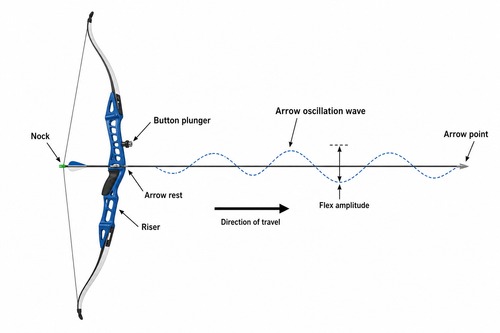
Arrow spine is the measurement of how much an arrow flexes under load. When you release a bowstring, the arrow bends around the riser before it straightens out in flight — this is called the archer's paradox. Choosing the wrong spine causes inconsistent arrow flight, poor groups, and in some cases, dangerous arrow behavior.
Spine is expressed as a deflection measurement. The lower the number, the stiffer the arrow. Most manufacturers publish spine charts that account for your draw weight, draw length, and arrow length. The key variables in any spine calculation include:
- Peak draw weight of the bow — heavier draw weight requires a stiffer spine
- Arrow length — longer arrows are effectively weaker in spine
- Point weight — heavier tips increase effective draw weight on the arrow
- Cam aggressiveness — faster cams impart more energy and demand stiffer arrows
There is also a concept called dynamic spine, which accounts for the real forces acting on an arrow during a shot rather than the static deflection test. Dynamic spine is influenced by brace height, arrow rest type, release aid vs. fingers, and even draw length relative to your bow's specifications.
Kinetic Energy and Momentum
Two numbers get thrown around a lot in hunting archery: kinetic energy (KE) and momentum. They are related but measure different things.
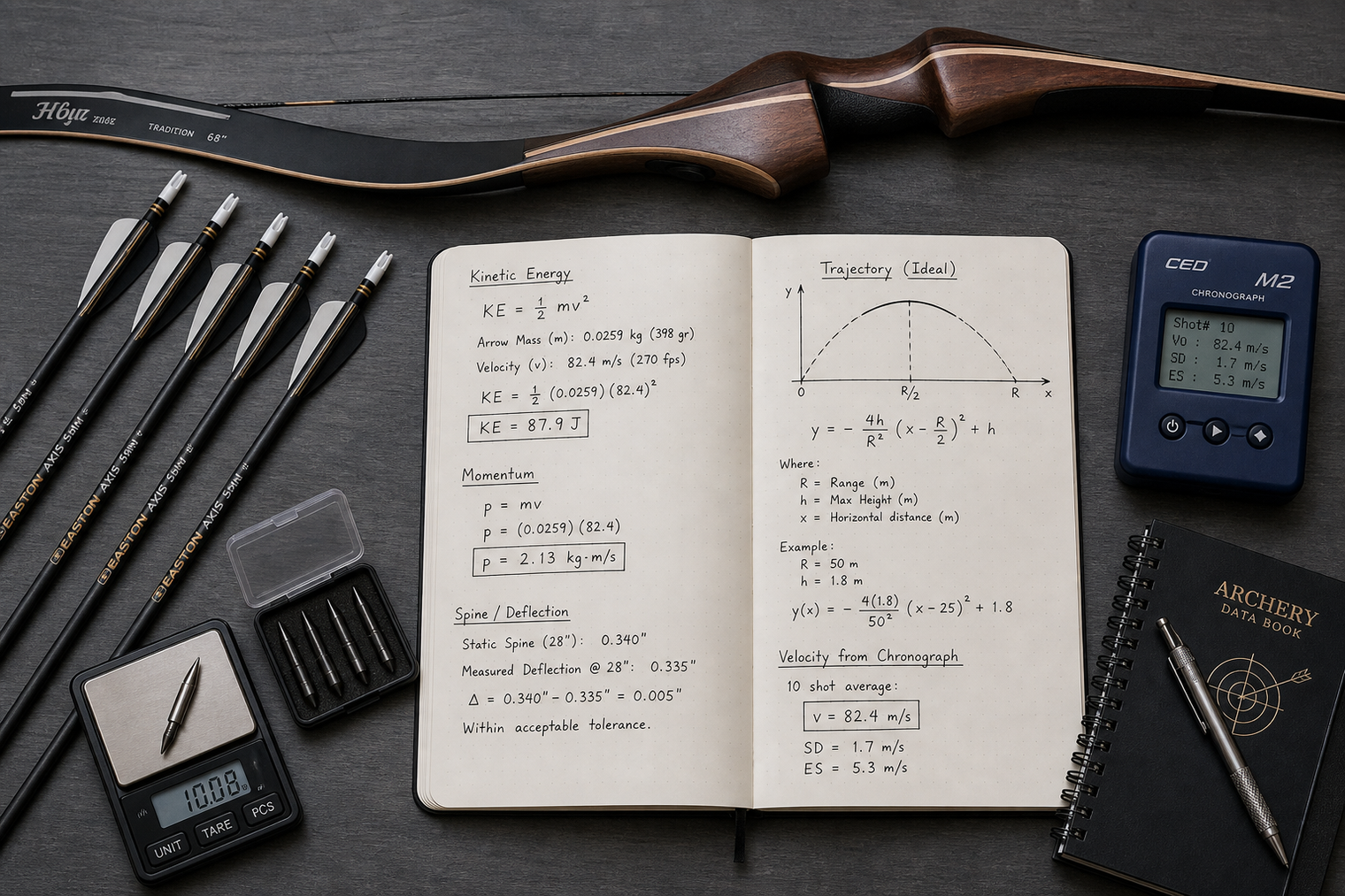
Kinetic energy is calculated as: KE = (arrow weight in grains × arrow speed in fps²) ÷ 450,240. This tells you how much energy is available at impact. Higher KE generally means better penetration potential, though other factors — broadhead design, shot angle, target resistance — all play a role.
Momentum is calculated as: momentum = (arrow weight in grains × arrow speed in fps) ÷ 225,400. Momentum is sometimes considered a better predictor of penetration through tough material because it represents how much the arrow resists slowing down, not just how fast it starts.
The practical takeaway is that a heavier arrow at moderate speed often carries more momentum than a light arrow at high speed, even if their kinetic energy numbers are similar. Hunters targeting larger game often prioritize momentum for this reason.
Arrow Trajectory and Drop
An arrow begins dropping the moment it leaves the bow due to gravity. Understanding trajectory helps archers set up their sight pins accurately and manage long-distance shots. The key factors that determine how steeply an arrow drops are:
- Initial arrow velocity — faster arrows drop less over a given distance
- Arrow weight — heavier arrows slow down faster and drop more over distance
- Ballistic coefficient — how aerodynamically efficient the arrow is, affected by vane size, shape, and arrow diameter
- Distance to target — drop increases non-linearly with distance
Archers shooting outdoors at distances beyond 50 yards will notice that trajectory management becomes a genuine skill. This is one area where using a chronograph to measure your actual arrow speed — rather than relying on manufacturer estimates — gives you much more useful data for calculating your real-world sight marks.
Bow Efficiency
Bow efficiency describes how much of the stored energy in the limbs is actually transferred to the arrow. A bow storing 60 ft-lbs of energy that launches an arrow carrying 50 ft-lbs of kinetic energy has roughly 83% efficiency. Factors that reduce efficiency include heavier string and cable systems, brace height, limb design, and accessories added to the string.
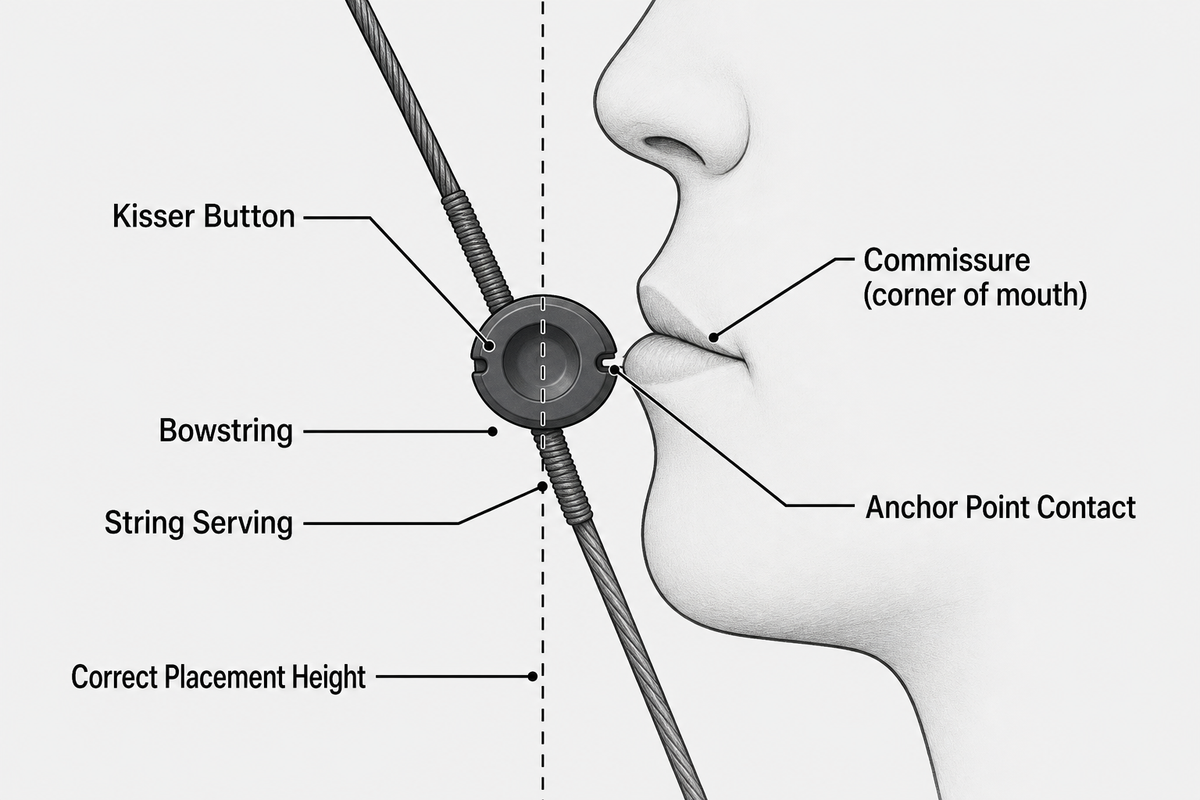
Understanding efficiency helps explain why two bows with identical draw weights can produce noticeably different arrow speeds. It also explains why adding heavy accessories to a bowstring — like a kisser button or large peep — can measurably reduce performance.
Practical Guidance: Putting the Numbers to Work
Knowing the formulas is one thing. Using them to make better decisions is another. Here is a practical workflow for applying archery math to your setup:
- Measure your actual draw length and draw weight using a draw board or scale — do not rely solely on bow specs
- Use your confirmed draw weight and arrow length to cross-reference manufacturer spine charts before purchasing arrows
- Chronograph your setup with the arrows you intend to shoot, not a generic test arrow
- Calculate KE and momentum based on your real measured speed and actual arrow weight (weigh arrows on a grain scale)
- Map your trajectory at key distances using a simple ballistics calculator, then verify with range sessions
- Adjust point weight incrementally and re-measure to understand how it shifts your effective spine
If you are selecting new equipment and want a wide range of arrows, rests, and accessories to experiment with, exploring new archery products at Legend Archery is a practical starting point for building a tunable setup.
Common Mistakes Archers Make When Applying the Math
Even archers who take the technical side seriously fall into predictable traps. Watch out for these:
- Using manufacturer speed ratings as real numbers. IBO and ATA speed ratings are measured under specific ideal conditions that rarely match your actual setup. Always chronograph your own rig.
- Ignoring point weight in spine selection. Switching from 100-grain to 125-grain broadheads changes the effective spine of your arrow. Run the calculation again.
- Confusing spine charts across arrow brands. A 340 spine from one manufacturer is not necessarily the same stiffness as a 340 from another. Check the actual deflection specifications, not just the number.
- Overlooking arrow length when cutting shafts. Every inch you cut off an arrow affects its dynamic behavior. Cut only after you are confident in your draw length measurement.
- Assuming high KE equals better penetration in all cases. Shot placement, broadhead design, and angle matter enormously. The math provides context, not guarantees.
- Neglecting fletching aerodynamics. Vane size, helical angle, and arrow diameter all affect how the arrow stabilizes and how much drag it produces. These interact with your spine choice.
How to Keep Building Your Technical Understanding
The best way to internalize archery math is to apply it actively rather than read about it passively. Keep a shooting log that records your setup variables — arrow weight, speed, point weight, distances, and environmental conditions. Over time, patterns emerge that no formula can predict on its own.
Connecting with other technically minded archers, reading equipment manuals carefully, and experimenting with systematic changes (one variable at a time) will sharpen your intuition in ways that complement the calculations. For archers who shoot outdoors regularly and want equipment suited to varied conditions, browsing outdoor archery supplies can help you identify gear worth testing in your setup.
Frequently Asked Questions
Do I actually need to understand archery math to shoot well?
No, many skilled archers shoot purely by feel and experience. But if you are troubleshooting inconsistency, selecting new equipment, or shooting at longer distances, having even a basic grasp of spine selection and trajectory will save you significant time and frustration.
How does draw length affect the math on arrow spine?
Draw length directly affects arrow length, which in turn affects how the arrow flexes. A longer arrow is effectively weaker in spine for a given draw weight. If your draw length is measured incorrectly, your spine selection will be off, which cascades into tuning problems throughout your setup.
What do beginners get wrong most often when trying to use archery calculations?
The most common mistake is using unverified inputs — relying on the bow's labeled draw weight or a manufacturer's speed claim instead of measuring their own setup. Garbage in, garbage out. The formulas are only as useful as the accuracy of the numbers you feed into them.
Is there an easy way to get started with arrow ballistics without doing all the math manually?
Yes. Several free online spine calculators and ballistics tools exist that do the heavy lifting once you provide your measurements. The key is still to input accurate, measured data. Think of these tools as calculators, not substitutes for understanding what the numbers mean.
Wrapping Up
Archery math is not about turning a physical skill into a spreadsheet exercise. It is about understanding why things happen so you can make smarter decisions at the range and in the field. Start with spine selection and chronographed speed, then build from there. The numbers reward the curious archer.