Skip to content
 cust@legendarchery.com
 302 503 5767
 Westfield IN 46074


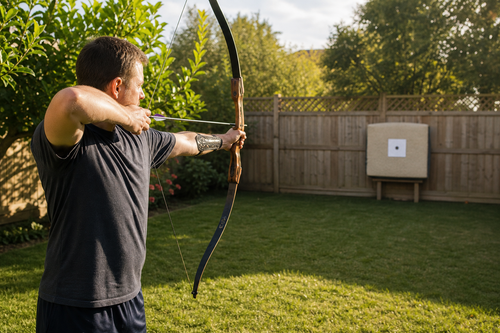
Most archers spend hours fine-tuning their draw length, grip, and anchor point — then completely overlook what their lower body is doing. Ankle reaches refer to the positioning and alignment of the ankles relative to the hips and shoulders during the shot cycle. Get this wrong, and even a textbook upper-body form breaks down under pressure. Get it right, and you gain a stable, repeatable platform that holds up in the field and on the range.
Why Ankle Reaches Matter in Archery
Archery is a precision sport built on repeatability. Every shot should feel the same — same grip pressure, same draw, same release. But that consistency starts from the ground up. Your ankles are the first point of contact with the earth, and they set the chain of alignment that travels through your knees, hips, spine, and shoulders.
When your ankle position is off — whether too far forward, rolled inward, or misaligned relative to your target — your centre of gravity shifts. That shift forces compensations higher up the kinetic chain. You might lean at the waist, tighten your shoulder, or unconsciously cant the bow. These adjustments feel invisible in the moment but show up in the group on the target.
For bowhunters especially, this matters in uneven terrain. Standing on a hillside, near a treestand, or on loose ground means your ankle mechanics are constantly challenged. Understanding how your ankles contribute to a stable shot helps you adapt quickly rather than guessing why your arrows are drifting.
Core Principles of Proper Ankle Alignment
Ankle reaches in archery aren't about a single rigid position. They describe the relationship between your foot placement and how your ankle loads and supports weight during the draw and release. Here are the foundational principles:
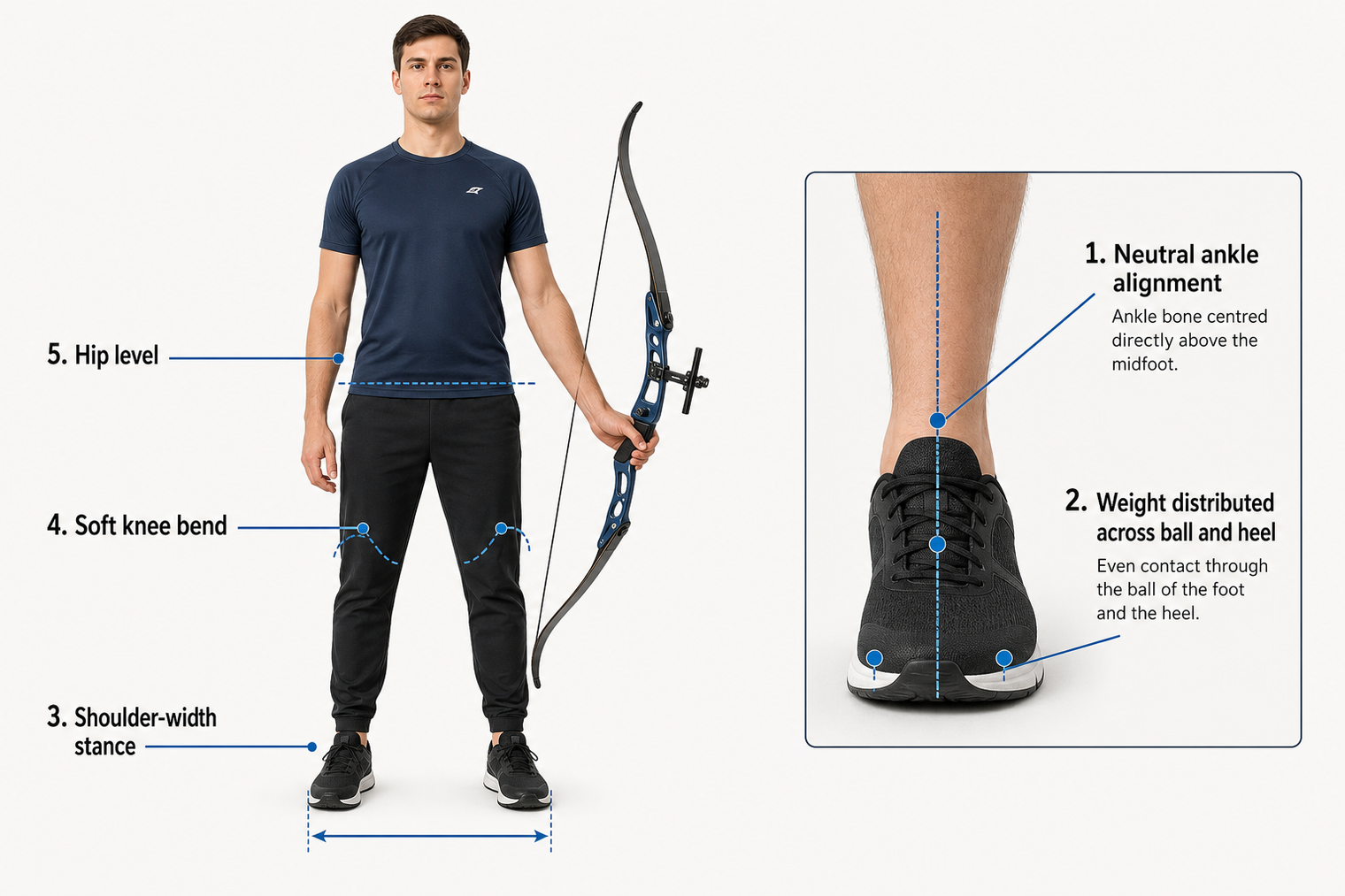
- Weight distribution matters: Your weight should sit evenly across the ball of the foot and the heel. An archer who leans forward onto the toes or rocks back onto the heels introduces unwanted movement at full draw.
- Ankle width and stance width are connected: A wider stance naturally pushes the ankles further apart. For most archers, shoulder-width spacing keeps the ankles in a neutral, supported position without over-extending the hips.
- Neutral ankle position reduces sway: Ankles that are rolled inward (pronation) or outward (supination) create lateral instability. A neutral ankle — where the ankle bone sits directly above the centre of the foot — provides the most stable base.
- Soft knees unlock the ankles: Locking the knees stiffens the entire lower chain. A slight bend at the knee allows the ankle to remain relaxed and responsive, which is critical when shooting on uneven ground.
- Terrain awareness changes everything: On flat ground, ankle mechanics are easy to ignore because the surface compensates. On a slope, in a treestand, or kneeling in a blind, proper ankle habits become the difference between a controlled shot and a rushed miss.
Practical Guidance for Developing Better Ankle Awareness
Building good habits around lower-body alignment takes deliberate practice. These steps can help you develop a more consistent foundation:
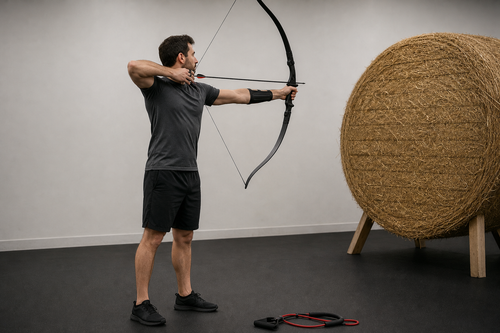
- Start every session with a stance check: Before you nock an arrow, set your feet consciously. Feel whether your weight is balanced front-to-back and side-to-side. A moment of awareness before the first shot builds a habit that carries into every session.
- Use a mirror or video: Filming yourself from the front and side reveals ankle roll, weight shift, and stance irregularities that feel completely invisible during the shot.
- Practice on uneven surfaces: Deliberately shooting on grass, gravel, or mild slopes trains your ankle stabilisers and exposes weaknesses in your stance that flat ground hides.
- Pair lower-body drills with shot routine: Balance drills — like single-leg stands or controlled weight shifts — improve proprioception in the ankle, which translates directly to shooting stability.
- Check your footwear: Worn-down soles, heavily cushioned trainers, or boots with excessive ankle lock can all interfere with natural ankle positioning. Many experienced archers prefer flat-soled footwear for range practice.
If you hunt from elevated positions, the dynamics shift considerably. When you're seated or standing on a platform, your ankles act more as anchor points than load-bearing joints. Understanding how your footing changes from ground to platform — and practising both — closes a gap many bowhunters don't know they have. If you use elevated setups, exploring quality ladder tree stands designed for stability can reduce the variables you're working against.
Common Mistakes Archers Make with Ankle Position
Most of these errors are subtle, which is exactly why they persist for years without being identified:
- Ignoring the lower body entirely: Many beginners focus exclusively from the waist up. They develop strong upper-body habits while their lower body drifts into lazy, inconsistent patterns that undermine everything above.
- Copying a stance without understanding it: Seeing an elite archer shoot with a particular foot angle doesn't mean that angle is right for your body. Ankle positioning is influenced by individual anatomy, so copying without adapting often creates misalignment.
- Using a fixed stance in all conditions: The same foot position that works on a flat range may not work on a hillside. Archers who rigidly maintain one stance regardless of terrain limit their adaptability.
- Ignoring tension cues: Tightness in the calf, knee, or hip during the shot is often a sign that ankle positioning is compensating for something. Instead of pushing through discomfort, treat it as diagnostic feedback.
- Overlooking fatigue effects: After a long day in the field, ankle stabilisers tire. Shots that felt solid at the start of a hunt may drift late in the day if lower-body conditioning is neglected.
Pairing solid technique with the right outdoor archery supplies — including footwear suited to your terrain and appropriate accessories — gives your form the best environment to perform in.
How Ankle Mechanics Connect to the Full Shot Cycle
It helps to think of a shot in archery as a chain reaction. The anchor points of that chain are the hands, the anchor point at full draw, and the feet. Ankle alignment is one of the least visible links, but it influences every other link above it.
When ankle positioning is consistent, your hips stay level. Level hips keep the spine neutral. A neutral spine allows the shoulders to sit in their correct rotational position. From there, the draw arm and bow arm follow natural paths, the release is clean, and the follow-through is stable.
Disrupt the ankles, and you introduce a lean or twist that forces the shoulder to compensate. That compensation often shows up as string slap, inconsistent arrow flight, or groups that drift in one direction without an obvious cause. Fixing the symptom at the shoulder level without addressing the ankle source is one of the most common diagnostic errors in archery coaching.
Frequently Asked Questions
What exactly are ankle reaches in archery?
Ankle reaches describe how an archer's ankles are positioned and loaded during the shot. Specifically, they refer to the alignment and weight distribution through the ankle joint relative to the rest of the stance, and how that positioning supports balance and consistency throughout the draw and release cycle.
How much does ankle position actually affect my accuracy?
More than most archers expect. Because the lower body forms the base of your shooting platform, any instability or misalignment there sends compensating tension up through the hips, spine, and shoulders. Over a long shooting session or in field conditions, even minor ankle issues compound into noticeable accuracy problems.
What are the most common beginner mistakes with ankle alignment?
The most common errors are ignoring the lower body entirely, using the same rigid stance regardless of terrain, and wearing footwear that limits natural ankle movement. Beginners also tend to copy advanced stances without adapting them to their own body structure, which creates misalignment rather than fixing it.
How can I actually improve my ankle awareness for archery?
Start by filming your shots from the front and side. Look for inward or outward ankle roll, forward lean, or weight shifts during the draw. Then add deliberate stance checks before every session, practise on uneven ground, and consider balance-focused conditioning drills off the range to build ankle stability over time.
Building Form from the Ground Up
Strong archery form is built in layers, and the lowest layer starts at your feet. Developing awareness of how your ankles position and load during a shot is one of the more direct ways to eliminate unexplained inconsistencies in your groups. It requires attention and some honest self-assessment — but it's a skill that improves with deliberate practice, not just volume of shooting.
If you're investing time in refining your form, it's worth equipping yourself with gear that supports your development. Browse new archery products at Legend Archery to find tools and accessories that complement your training on and off the range.