Skip to content
 cust@legendarchery.com
 302 503 5767
 Westfield IN 46074


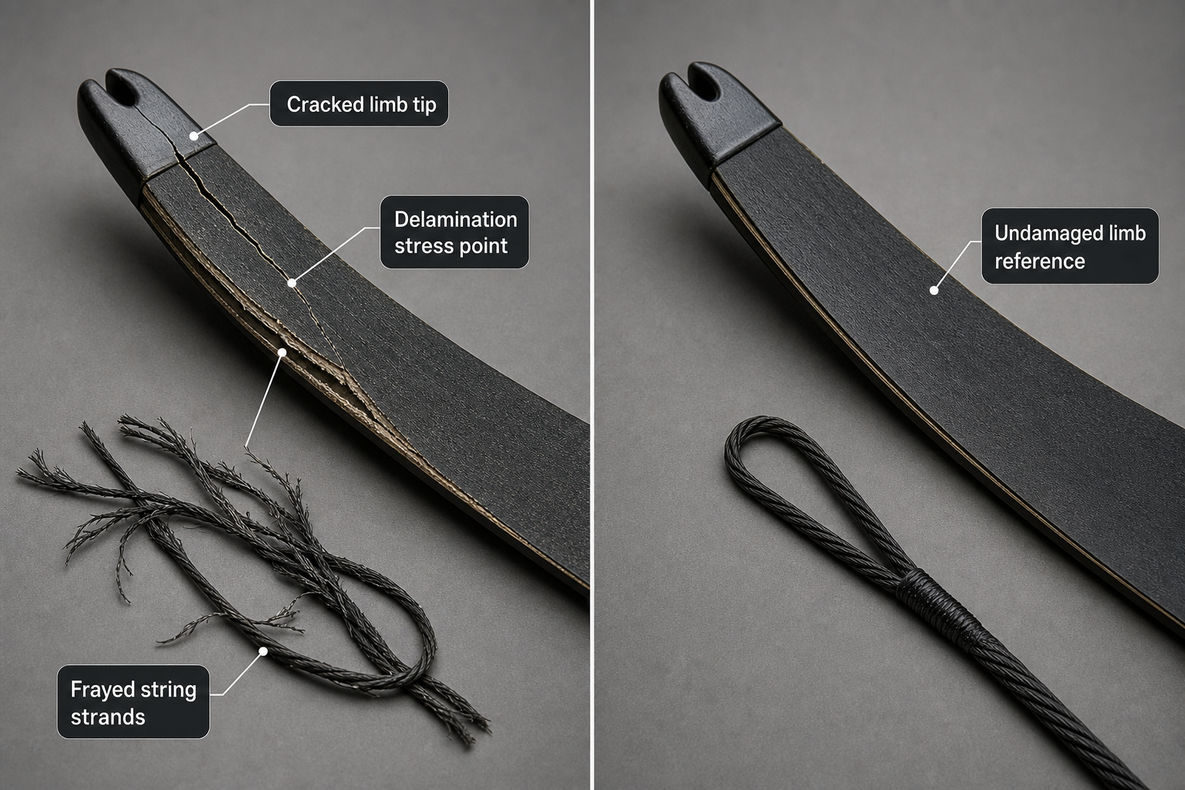
Dry firing a bow means releasing the string without an arrow nocked. It sounds like a small mistake, but the consequences can be severe — broken limbs, snapped strings, shattered cams, and real injury risk to the person holding the bow. Whether you shoot a compound, recurve, or traditional longbow, understanding everything you should know about dry firing bows is essential before you ever pick one up.
What Actually Happens When You Dry Fire a Bow
When you draw a bow, you are storing a significant amount of energy in the limbs. Under normal circumstances, that energy is transferred to the arrow at the moment of release. The arrow acts as a controlled release valve, absorbing the energy and carrying it downrange.
Without an arrow, that stored energy has nowhere productive to go. Instead of traveling forward, it violently reverberates back through the bow's limbs, riser, string, and cam system (on compound bows). The result is a rapid, uncontrolled vibration that the bow was never engineered to handle.
The physical effects can include:
- Cracked or shattered limbs — especially on fiberglass and carbon-composite limbs under high draw weights
- Broken or frayed bowstrings — particularly on older or worn strings
- Damaged cam systems — on compound bows, cams can crack, warp, or separate entirely
- Riser stress fractures — less common but possible on aluminum and especially wood risers
- Peep sight and accessory damage — scopes, stabilizers, and arrow rests can all suffer collateral damage
On recurve bows, the limbs take the brunt of the stress. If you shoot a take down recurve bow, the limb pockets and limb tips are especially vulnerable points during an accidental dry fire.
Why Recurve and Compound Bows React Differently
Not all bows respond to a dry fire in the same way, and understanding the difference helps you appreciate the risks specific to your setup.
Recurve Bows
Recurve bows are relatively simpler in construction, but they store a large amount of energy in their limbs relative to their mass. A dry fire on a recurve can send a violent shockwave through both limbs simultaneously, and because recurve limbs are often thin at the tips, they are particularly prone to cracking or delaminating at those points. The bowstring itself can snap or jump off the string grooves.
If you are using a Dacron bowstring for your recurve, it is worth knowing that Dacron has some natural stretch, which gives it slightly more tolerance to shock than higher-modulus materials — but no string material is dry-fire proof.
Compound Bows
Compound bows are mechanically complex. Cams, cables, and a let-off system all work together under tension. During a dry fire, this system can catastrophically fail. Cams have been known to explode off the axle, cables can snap, and the energy release is often violent enough to send parts flying. Compound bow dry fires are statistically more likely to cause injury to the shooter because of how close all those components are to the archer's face and bow arm.
Traditional Longbows
Longbows made from natural wood are arguably the most vulnerable of all. Wood does not handle sudden stress reversal well. A dry fire on a wood longbow can cause immediate delamination or a complete limb break, and the structural damage may not always be visually obvious — which creates a hidden safety hazard for future shots.
The Injury Risk to the Archer
Bow damage is expensive. Personal injury is far worse. When a bow fails during a dry fire, the failure is often explosive rather than gradual. Limb fragments, cam shards, or a snapping string can travel at significant speed toward the archer's face, bow arm, or draw hand.
Common injuries reported from dry fire incidents include:
- Lacerations to the bow hand or arm from string or limb fragments
- Eye injuries from debris — a key reason why eye protection is recommended during early training
- Bruising or contusions from the bow handle snapping back
- Wrist and finger injuries if the string releases unevenly
Even if no visible injury occurs immediately, the shock of an unexpected dry fire can cause a flinch reflex that affects shooting form for weeks afterward.
Common Situations That Lead to Accidental Dry Fires
Most dry fires are not the result of carelessness alone — they often happen in specific, predictable situations. Knowing these helps you build habits that prevent them.
- Arrow falls off the rest during draw: If you are not paying attention, you may complete the draw and release before noticing the arrow is no longer nocked properly.
- Distraction at full draw: Conversations, noise, or target anxiety can cause a shooter to release before confirming the arrow is seated.
- Demonstrating to a newcomer: Well-meaning archers sometimes dry fire to show someone how the bow feels without thinking through the consequences.
- Improper nocking technique: Arrows that are not properly indexed on the string can slip free during the draw cycle.
- Children or untrained users handling the bow: Unsupervised access to a strung bow is one of the most common causes of accidental dry fires.
What to Do After an Accidental Dry Fire
If a dry fire happens, resist the urge to immediately draw and shoot again. Follow these steps:
- Stop shooting immediately and set the bow down safely.
- Visually inspect the entire bow — limbs, string, cam system, riser, and all accessories — for visible cracks, fraying, or deformation.
- Check the string carefully along its full length for broken or separated strands.
- Have the bow inspected by a qualified bow technician before shooting again, even if you cannot see obvious damage. Micro-fractures in limbs are not always visible to the naked eye.
- Do not shoot a bow that has been dry fired until it has been cleared by a professional.
A bow that looks fine after a dry fire may still have internal structural compromise. Shooting it without inspection is gambling with your safety.
How to Prevent Dry Firing
Prevention is straightforward once you develop consistent habits:
- Always visually confirm the arrow is nocked and seated on the rest before drawing.
- Use a consistent nocking routine every single time — no exceptions.
- Never hand a strung bow to someone who has not been briefed on safe handling.
- Keep strung bows out of reach of children and untrained individuals.
- Use arrow rests with a good hold on the arrow to reduce the risk of it falling free mid-draw.
- If you lose an arrow mid-draw, let down slowly rather than releasing.
Frequently Asked Questions
Can a single dry fire destroy a bow?
Yes, it can. Depending on the bow's construction, draw weight, and condition, a single dry fire may be enough to crack limbs, snap a string, or damage a cam system beyond repair. Lower draw weight bows may survive a dry fire with less visible damage, but no bow should be treated as safe to shoot without inspection afterward.
How do I know if my bow was accidentally dry fired before I bought it used?
Look closely at the limb tips for hairline cracks or delamination, check the string for broken strands or unusual wear near the loops, and examine the cam axles and cables on compound bows for any bending or cracking. If you are unsure, have a bow technician inspect it before shooting.
Is it safe to dry fire a bow at a low draw weight?
No. Even low draw weight bows are not designed to handle the energy recoil of a dry fire. The risk of damage and injury scales with draw weight, but it never drops to zero. There is no safe draw weight for intentional dry firing.
Does everything you should know about dry firing bows apply to crossbows too?
Yes, and in some cases more so. Crossbows are designed with even less tolerance for dry fires because of their higher draw weights and short, stiff limbs. Most crossbow manufacturers explicitly state that dry firing will void the warranty and may cause immediate mechanical failure.
Final Word
Dry firing is not a minor technical issue — it is one of the most serious safety risks in archery. Build a consistent pre-shot routine, supervise new shooters carefully, and always inspect your equipment if an accidental dry fire occurs. These habits are the difference between a long, enjoyable time in the sport and an avoidable injury. If you are just getting started and want to understand your bow's components before you shoot, taking time to learn your setup thoroughly is always the right first step.