Skip to content
 cust@legendarchery.com
 302 503 5767
 Westfield IN 46074


Arrow fletching is one of the most overlooked variables in archery setup, yet it has a direct impact on how well your arrow stabilises, steers, and arrives at the target. Whether you shoot recurve, compound, or traditional longbow, the fins at the back of your arrow are doing serious aerodynamic work. Here is what you need to know before making a purchase.
Why Arrow Fletching Matters More Than You Think
The primary job of fletching is to create drag and sometimes lift at the rear of the arrow, which corrects the natural wobble introduced at the moment of release. Without adequate stabilisation, even a well-tuned bow will produce inconsistent groups. The size, shape, material, and orientation of your fletching all influence how quickly the arrow recovers and how much speed it sacrifices to do so.
Different disciplines demand different priorities. A target archer shooting indoors at 18 metres needs minimal drag and a forgiving vane profile. A bowhunter pushing through brush at close range needs aggressive stabilisation that can handle broadhead planing. Getting this wrong costs you accuracy — and in a hunting context, it can cost you a clean shot.
[product-tabs]
Fletching Materials: Feathers vs Plastic Vanes
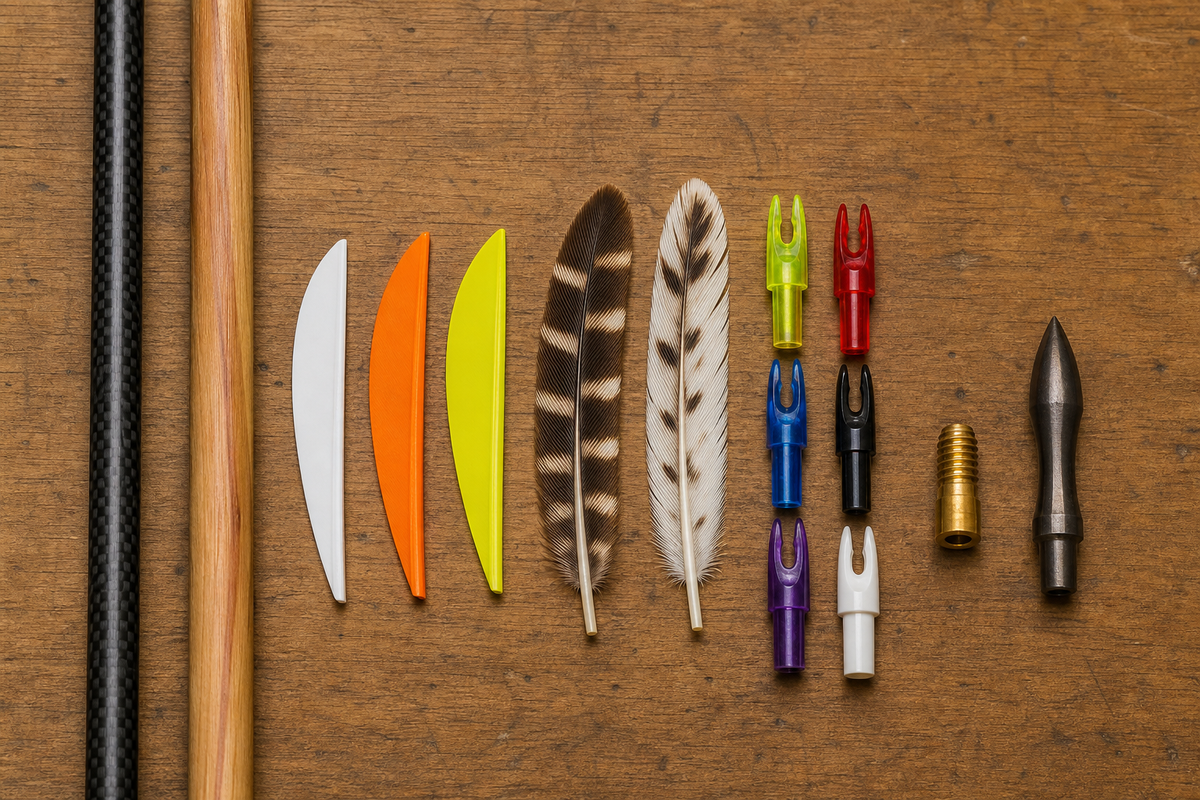
The two dominant materials are natural feathers and synthetic plastic vanes. Both work, but they suit different situations.
Natural Feathers
Feathers are the traditional choice and still preferred by many recurve and longbow archers. They are lightweight, compress on contact with an arrow rest, and produce a very forgiving flight — particularly useful with a shelf rest or finger shooting where the arrow flexes as it leaves the bow. Their main weakness is moisture sensitivity. Wet feathers collapse and lose their shape, which degrades performance noticeably. You can find more context on material characteristics on the Legend Archery arrow feathers guide.
Plastic Vanes
Modern plastic vanes are durable, weather-resistant, and consistent from shot to shot. They dominate compound archery and competitive target shooting. Vanes come in a wide range of stiffness levels — stiffer vanes stabilise faster but add more drag, while flexible low-profile vanes are faster through the air and suit well-tuned setups with mechanical rests. For a broader overview of how vanes and feathers compare in practical use, the Legend Archery fletching overview page is a useful reference.
Fletching Profiles and Sizes
The shape of a vane or feather determines how much surface area interacts with the airstream. Common profiles include:
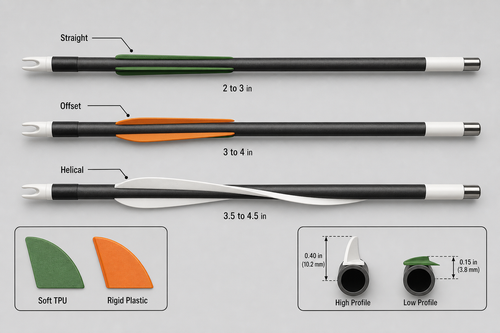
- Low-profile vanes (1.5" to 2"): Minimal drag, very fast flight, best suited for long-distance target shooting with a well-tuned arrow and mechanical rest.
- Mid-size vanes (2" to 3"): The most versatile choice. Stable enough for most field conditions, fast enough for most distances, and compatible with a wide range of arrow weights.
- Large vanes and feathers (4" to 5" and above): High drag, quick stabilisation. Preferred for traditional archery, flu-flu arrows used in roving or aerial shooting, and situations requiring short-distance accuracy over speed.
- Helical or Shield cut profiles: Shaped to maximise spin from a small surface area. Effective with broadheads and hunting arrows where planing would otherwise occur.
Fletching Orientation: Straight, Offset, and Helical
How the fletching is attached relative to the arrow shaft changes arrow behaviour significantly.
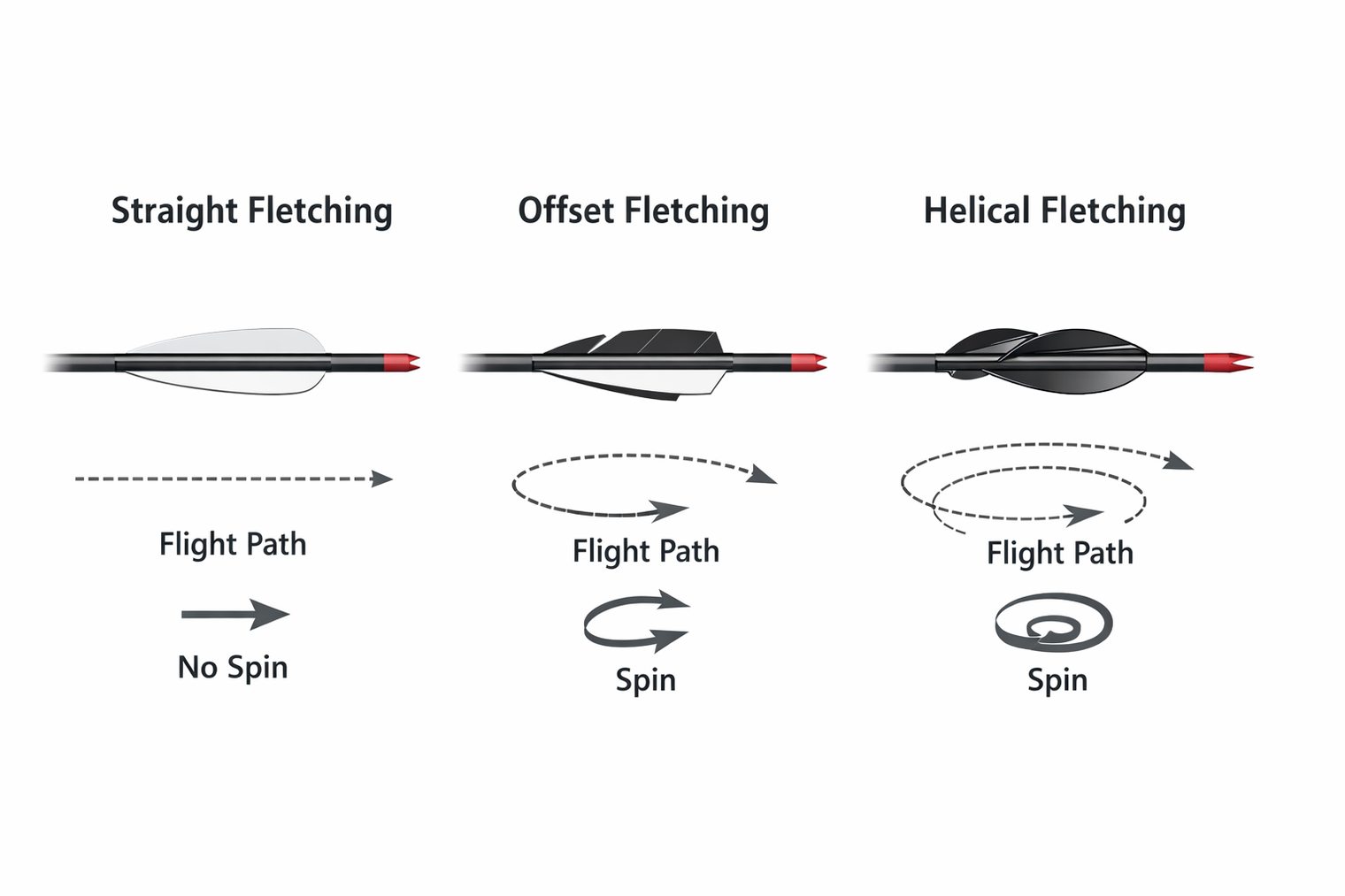
- Straight: Vanes run perfectly parallel to the shaft. This produces the least drag and is common on competition arrows where speed matters. It provides less spin and less self-correction.
- Offset: The vane is glued at a slight angle, typically two to four degrees. This introduces a mild spinning motion and improves stabilisation without a significant speed penalty. A good default for most archers.
- Helical: The vane is twisted as it is applied, creating a pronounced corkscrew spin. This is the most effective at taming broadheads and correcting unstable arrows, but it also produces the most drag. Best suited for hunting or bowhunting distances rather than long-range target work.
How to Choose the Right Fletching for Your Setup
The right choice depends on several factors working together rather than one single criterion. Work through these in order:
- Your bow type and draw weight: Higher draw weights produce faster arrows that may need more aggressive fletching to stabilise in time. Lighter draw weights can often get away with smaller vanes.
- Your arrow rest: If you use a shoot-through rest or drop-away, stiff plastic vanes work well. If you shoot off the shelf or use a traditional setup, feathers are worth serious consideration because they compress on contact.
- Your arrow tip: Field points are aerodynamically simple. Fixed-blade broadheads create planing forces that require more helical or offset orientation and a larger vane surface to counteract.
- Your shooting distance: Indoor target at short range? Go low-profile and fast. Field archery or 3D at varying distances? A mid-size offset vane is a reliable starting point. Hunting in dense cover? Prioritise stabilisation over speed.
- Weather conditions: If you shoot outdoors frequently in wet conditions, feathers require treatment or replacement. Plastic vanes are far more resilient.
Once you have settled on a fletching setup, good arrow storage matters too. Vanes can be crushed or deformed in a packed quiver. Keeping arrows in a proper arrow quiver that separates shafts will extend the life of your fletching considerably.
Common Mistakes Archers Make With Fletching
Even experienced archers make avoidable errors when selecting or maintaining their fletching. Watch out for these:
- Choosing vanes by look rather than function: Brightly coloured or aerodynamic-looking vanes are not automatically the best choice for your setup. Match the vane to your bow type and use case first.
- Ignoring the arrow rest interaction: Attaching stiff plastic vanes and then shooting off a shelf rest causes the vane to clip the rest on the way through, introducing unpredictable flight. Always check clearance.
- Mixing fletching profiles mid-set: Using different vane sizes or shapes across your arrows, even subtly, produces inconsistent tuning results. Keep your set uniform.
- Gluing over a dirty shaft: If you are reflitching at home, any oil, wax, or residue on the shaft will prevent the adhesive from bonding properly. Clean the shaft with alcohol before applying new fletching.
- Skipping the spin test: After fletching, roll the arrow on a flat surface or use a spinner to check for straightness. A poorly attached vane will cause a visible wobble before you even shoot it.
- Underestimating feather deterioration: Feathers that have been rained on, compressed in storage, or simply aged lose their profile. Inspect them before competition or hunting season, not during.
Frequently Asked Questions
What does arrow fletching actually do?
Fletching stabilises the arrow after it leaves the bow by creating aerodynamic drag at the rear of the shaft. This corrects the fishtailing and oscillation that occurs during the paradox phase — the brief moment when the arrow flexes and wobbles as it clears the bow. Without fletching, most arrows would tumble well before reaching the target.
Does the size of the vane really make a difference at short distances?
Yes, but the difference narrows at very short ranges. At 10 to 18 metres, even undersized fletching may produce acceptable groups because the arrow has not had time to destabilise badly. At longer distances or with broadheads, inadequate fletching becomes clearly visible in your shot spread.
What mistakes do beginners usually make when buying fletching?
The most common mistake is buying the same fletching used by a more advanced archer without considering differences in bow type, draw weight, rest style, and shooting distance. Fletching is not universal — what works on a 70 lb compound with a drop-away rest is unlikely to be optimal on a 35 lb recurve with a shelf rest.
Can you refletch arrows yourself at home?
Yes. A fletching jig, appropriate adhesive, and clean shafts are all you need. The process takes patience rather than technical skill. The key steps are cleaning the shaft, using the correct jig angle for your intended orientation, allowing full cure time for the adhesive, and checking arrow straightness after each vane is applied.
Choosing With Confidence
Arrow fletching is a small component with an outsized influence on consistency. Understanding the relationship between material, profile, size, and orientation gives you a genuine framework for making the right call rather than guessing. Start with your bow type and rest style, narrow down by use case, and test before committing your whole arrow set to one configuration.