Skip to content
 cust@legendarchery.com
 302 503 5767
 Westfield IN 46074


Why the Origin Stories of Elite Archers Actually Matter
Most archers assume world-class competitors started with expensive gear, private coaches, and purpose-built ranges. The reality is almost always simpler and more encouraging than that. When you look closely at how five top archers got their start, a consistent pattern emerges: modest beginnings, deliberate repetition, and a willingness to stay uncomfortable long enough to improve. These stories are not just inspiring — they are instructional.
Five Elite Archers and What Their Early Years Reveal
1. Brady Ellison — Compound Roots, Recurve Career
Brady Ellison, one of the most dominant recurve competitors in American archery history, began shooting a compound bow as a teenager in Arizona. His early experience was informal — shooting with family, developing feel for the draw cycle and anchor point before he ever set foot in a structured program. When he transitioned to recurve, those foundational motor patterns accelerated his development significantly.
Lesson: Format-switching is not wasted time. Compound shooting builds strength, timing, and shot discipline that transfers directly to recurve. If you are curious about recurve archery, starting on any platform builds usable fundamentals.
2. Ki Bo-Bae — Structure From Day One
South Korean Olympic gold medalist Ki Bo-Bae entered the Korean school archery system as a child, a program known for high volume, strict technique instruction, and early mental conditioning. She was not singled out as a prodigy. She was one of many students following a rigorous process. Her early training emphasized blank-bale shooting — drawing and releasing at close range with no target face — until form was automatic.
Lesson: High-volume repetition at close range, before chasing distance or score, builds the neuromuscular consistency that separates serious archers from casual ones. Many Western beginners skip this phase entirely, and it costs them later.
3. Levi Morgan — Self-Taught, Then Coached
Compound 3D and target legend Levi Morgan grew up hunting and shooting in Tennessee, largely self-taught through trial and error. He watched other archers, read everything available, and adjusted obsessively. Only later did he seek structured coaching input. His background gave him a strong intuitive feel for equipment tuning and arrow flight that formally trained archers sometimes lack.
Lesson: Self-directed learning is not inferior, but it benefits enormously from periodic outside feedback. If you are progressing on your own, getting a single session with a qualified coach every few months can correct drift you cannot see in yourself.
4. Deepika Kumari — Resource-Limited, Result-Unlimited
Indian recurve star Deepika Kumari famously began shooting with a bamboo bow made from branches before she ever touched manufactured archery equipment. She was selected for the Tata Archery Academy in Jharkhand after demonstrating raw natural ability. Her early training was not about gear — it was about developing an instinct for the shot process that many equipment-rich beginners never acquire.
Lesson: Equipment quality matters less in the early stages than most beginners believe. Developing a consistent shot routine and learning to read your arrows honestly matters far more. Do not wait for better gear before practicing with real intention.
5. Jake Kaminski — Club Culture as the Foundation
Olympic recurve archer Jake Kaminski began through a local archery club program as a young teenager. Club culture gave him regular access to coached practice, peer competition, and structured progression through skill levels. He has spoken publicly about how the social environment of club archery kept him engaged during the early years when progress is slow and frustration is high.
Lesson: Community matters in archery more than most individual sports. A training environment with peers at similar levels, experienced shooters to observe, and a coach who knows your name dramatically increases retention and long-term development.
Core Principles Shared Across All Five Journeys
Despite wildly different backgrounds, equipment, and geography, these five archers share several early-stage habits worth noting:
- Consistency over intensity: None of them burned out from overpracticing early. Short, focused sessions beat marathon days of sloppy repetition.
- Form before distance: Every one of them, regardless of format, built technical fundamentals at close range before extending their shooting distance.
- Feedback loops: Whether through a coach, a training partner, or video review, each archer had some mechanism for identifying errors they could not self-diagnose.
- Patience with plateaus: Development in archery is not linear. Every elite archer has described extended periods where scores stagnated before a breakthrough.
- Equipment matched to stage: None of them started with advanced competition gear. Equipment was scaled to their physical and technical development.
Practical Guidance for Archers at Any Level
If you are early in your own archery journey, there are direct takeaways from these stories:
- Find a club or structured program if one is accessible. Even attending monthly, the feedback and peer exposure speeds development significantly.
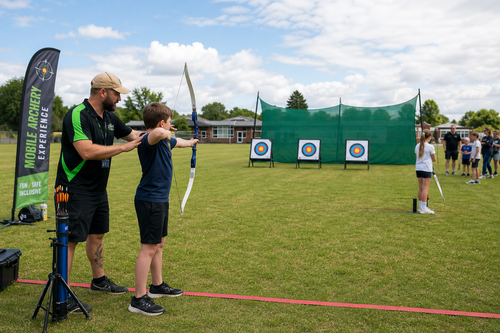
- Invest in blank-bale practice. Set a target at five to ten meters and shoot for form, not score. This is where technique actually gets built.
- Film your own shots periodically. A phone on a tripod captures things no mirror can show. Review your footage the same day so corrections are timely.
- Keep a short training log. Note your draw weight, distances, and any adjustments you made. Elite archers track data; beginners who do the same develop faster.
- Source quality equipment suited to your current stage. Browsing outdoor archery supplies with a specific skill level in mind helps avoid gear that is either too advanced or too limiting.
Common Mistakes Beginners Make When Following Pro Examples
Learning from elite archers is valuable, but there are several traps beginners fall into when applying those lessons:
- Copying advanced technique before building base fitness: Draw weight, anchor position, and back tension engagement all require specific physical development. Mimicking a professional's form without the underlying strength produces inconsistent and sometimes injury-prone results.
- Over-investing in equipment too early: Seeing what a professional shoots and immediately buying the same setup is a common and expensive mistake. Equipment that suits an elite archer's draw length, anchor, and style may actively hinder a beginner.
- Skipping the boring phases: Blank-bale work, form drills, and repetitive close-range shooting look unglamorous. Many beginners skip straight to scoring rounds and then wonder why they plateau quickly.
- Training alone indefinitely: Self-teaching has a ceiling. Every archer in this list, at some point, incorporated external feedback into their training. Solo practice without any coaching check is one of the most common reasons capable archers stall.
- Measuring progress only by score: In the early stages, technical improvement in your shot process is more meaningful than score improvement. A better process eventually produces better scores — but not always immediately.
Frequently Asked Questions
Did most professional archers start with expensive equipment?
No. Several of the most accomplished archers in the world began with minimal or improvised equipment. Deepika Kumari used a handmade bow. Brady Ellison started with a basic compound setup. Equipment quality matters more as technique develops, not at the beginning. Starting with appropriate, entry-level gear is widely considered better than jumping into high-specification equipment before you can use it effectively.
How young do you need to start archery to compete at a high level?
There is no universal answer. Some elite archers started in childhood through school programs, while others picked up the sport in their mid-teens or even later. The Korean system favors early starts with high structure, but Western archers routinely develop competitive ability starting at fourteen, fifteen, or older. Consistency and quality of training matter more than the age at which you begin.
What is the single most common thread in how top archers developed?
Consistently, it is the quality of their feedback loop — some mechanism for identifying and correcting errors. This might be a full-time coach, a training partner, video review, or a combination of all three. Archers who progress quickly are almost always archers who can identify what they are doing wrong and make adjustments efficiently.
Is it worth joining an archery club as a beginner?
For most people, yes. Club environments offer peer learning, structured practice, access to more experienced shooters, and accountability that solo training rarely provides. Many archers who started in clubs credit that community with keeping them in the sport during early frustrating periods. If club access is limited, online communities and periodic coaching sessions can partially fill that role.
Building Your Own Foundation
The paths taken by elite archers look very different on the surface. But the underlying habits — close-range fundamentals, honest feedback, patience with slow progress, and equipment matched to current ability — appear in nearly every story. If you are exploring where to go next in your own training, checking out new archery products suited to your current level is a practical starting point. The best gear is the gear you can actually use well right now.