Skip to content
 cust@legendarchery.com
 302 503 5767
 Westfield IN 46074


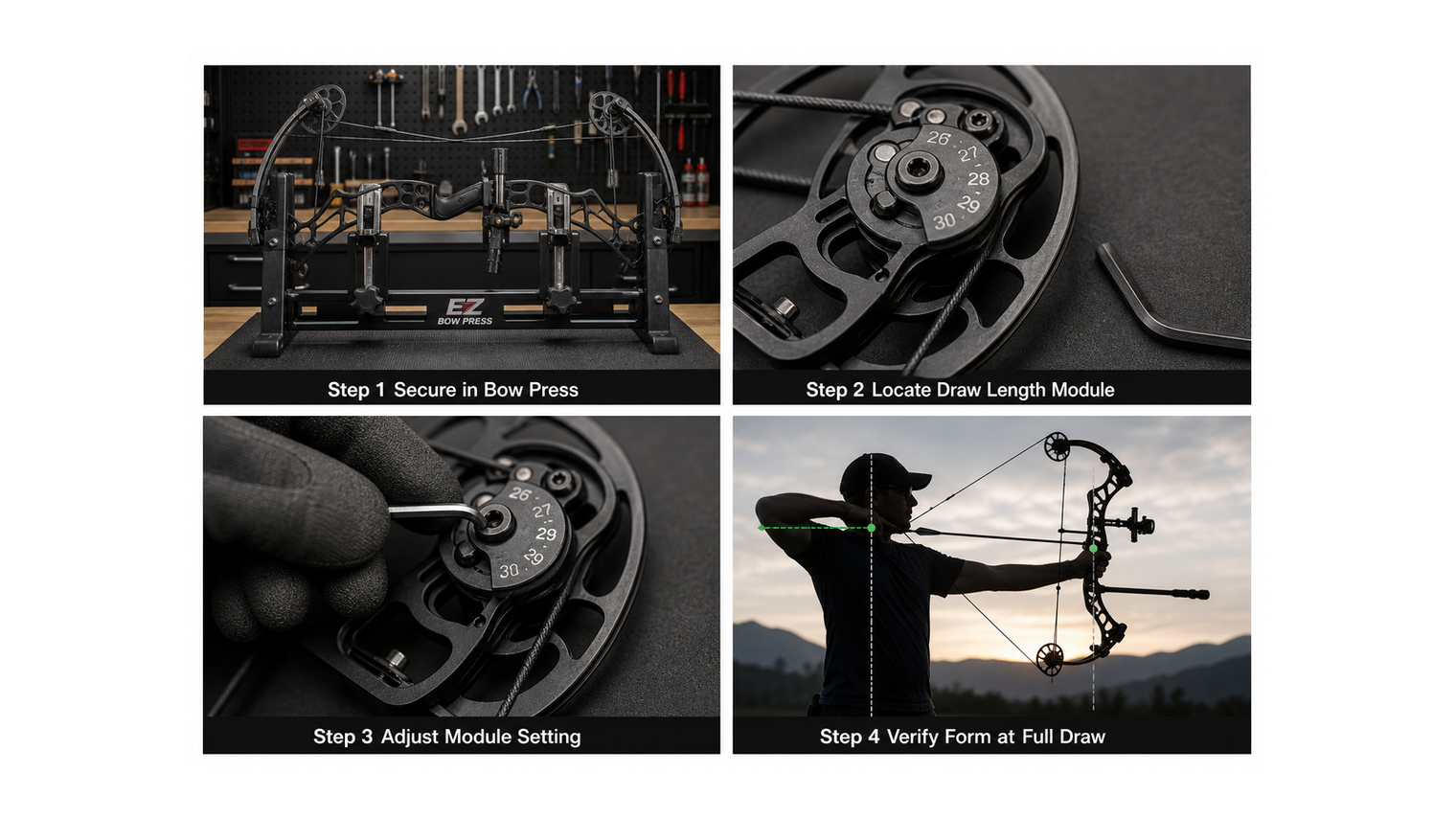
If your shots feel strained, your anchor is inconsistent, or your groups are wider than they should be, an incorrect draw length is often the culprit. This guide is written for compound bow shooters — beginner through intermediate — who want to adjust their draw length themselves or at least understand the process before handing the bow to a technician.
Why Draw Length Matters More Than Most Shooters Realise
Draw length determines your body's relationship to the bow at full draw. Too short and you'll collapse your form, losing power and accuracy. Too long and you'll overextend, straining your shoulder and forcing your bow arm elbow into an unnatural position. Neither extreme is safe or effective.
Even a half-inch of difference can affect your anchor point, your peep sight alignment, and how consistently you can hold at full draw under pressure. Getting this measurement right is not optional — it is foundational.
What You Need Before You Start
Before touching anything on the bow, gather the right tools and information. Going in unprepared is the fastest way to damage a cam or strip a module screw.
- A bow press: Most draw length changes on modern compound bows require you to put the bow in a press to safely relieve cable tension. Do not attempt to swap modules under tension.
- Allen key set (hex wrenches): Module screws are typically 3/32" or 1/8" hex, but check your bow's manual for the exact sizes.
- Your bow's owner manual: Every cam system is different. Some bows use rotating modules, others use interchangeable module sets, and a few allow draw length changes through the draw stop alone.
- A draw length measurement: If you haven't confirmed your actual draw length yet, use the wingspan method as a starting estimate — measure your wingspan fingertip to fingertip and divide by 2.5. Then refine from there by shooting and checking your form.
- Cam modules (if required): Some bows ship with a single adjustable module. Others require you to purchase or swap to a specific numbered module for your target draw length. Confirm this before ordering parts.
How to Adjust Compound Bow Draw Length: Step by Step
The exact method depends on your cam system, but the following process covers the most common scenario — a single or dual cam bow with adjustable or swappable modules.
Step 1: Confirm Your Target Draw Length
Before making any changes, know the number you're working toward. If you've never been professionally measured, a pro shop draw board is the most accurate method. The wingspan estimate is a reasonable starting point but should be treated as approximate. Most adults land between 26" and 32", with the average sitting around 28" to 29".
Step 2: Secure the Bow in a Bow Press
Place the bow in a suitable bow press and apply enough pressure to take tension off the cables and string. Never force a cam module to move while the cables are under load — this can crack the module or damage the limbs. Follow your press manufacturer's instructions for safe operation.
Step 3: Locate the Draw Length Module
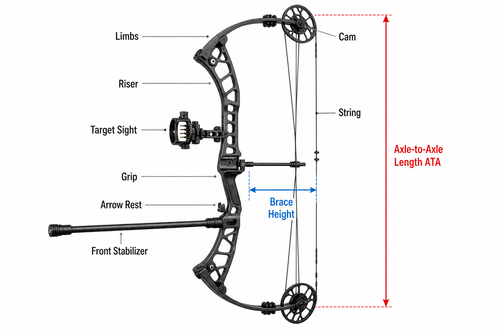
On most modern compound bows, the draw length module sits on the cam itself — either the bottom cam on single cam bows, or on both cams on binary and dual cam systems. It will usually have a series of numbers or letters stamped or engraved indicating draw length settings.
Step 4: Adjust or Swap the Module
If your bow uses a rotating module, loosen the module screws, rotate to the desired setting, and re-tighten firmly but without overtorquing. If your bow uses interchangeable modules, remove the current module entirely, fit the correct replacement, and secure it according to torque specs in your manual. On dual cam bows, you must make the same change to both cams — mismatched modules will cause timing and accuracy problems.
Step 5: Release the Bow Press and Check Timing
Once the module is set, carefully release the bow press. Before shooting, visually check that both cams are rolling over at the same point during the draw cycle. On dual cam bows, timing marks on the cam are your reference. If the cams are out of sync, you'll need to adjust the cable lengths or consult a technician.
Step 6: Check Nocking Point and Peep Sight Position
A draw length change shifts where your string hand sits at full draw, which often moves your peep sight out of alignment. After any draw length adjustment, re-verify your peep is at eye level when you're anchored. You may also need to re-tie or reposition the peep and check your nocking point height.
Common Mistakes to Avoid
- Skipping the bow press: Attempting to move a module under cable tension risks snapping the module or causing the bow to dry-fire unexpectedly.
- Only adjusting one cam on a dual cam bow: Both cams must reflect the same draw length setting. One cam off by a half-inch will throw your timing and your accuracy.
- Ignoring the peep sight after adjustment: A misaligned peep is one of the most common and most overlooked results of a draw length change.
- Setting draw length too long for comfort: More draw length does not mean more power in a meaningful way for most shooters. It usually means worse form and worse groups.
- Not re-checking after the first shooting session: Modules can settle slightly after initial shots. Confirm everything is still secure and correctly positioned after your first 20 to 30 arrows.
- Losing or stripping module screws: These small screws are easy to over-tighten or lose in grass. Keep spares, and use a magnetic parts tray when working outdoors.
How to Check That You Got It Right
Once you've made the adjustment and taken a few shots, use these indicators to confirm the fit is correct:
- Shoulder position: At full draw, your draw-side elbow should be roughly in line with the arrow, not winging out wide or torqued up behind the plane of the bow.
- Bow arm elbow: Your bow arm elbow should have a slight natural bend or be comfortably straight — not hyperextended or dramatically bent.
- String clearance: The bowstring should not touch your forearm or chest at full draw. If it does, draw length may still be too long, or your stance needs attention.
- Anchor consistency: Your string hand should return to the same anchor point — corner of the mouth, under the jaw, or whatever your chosen style — without having to stretch or compress your body to get there.
- Peep alignment: You should see cleanly through the peep without tilting your head or straining. If you're twisting to see through it, the peep position needs correcting.
If you're consistently struggling with any of the above after making your adjustment, it's worth booking a session at a pro shop to have a coach or bow technician observe your form at full draw. Sometimes what feels like a draw length problem is actually a form issue, and vice versa.
Frequently Asked Questions
Can I adjust draw length without a bow press?
On a small number of bows, particularly those with specific rotating module designs, the manufacturer allows minor adjustments without a press. Check your manual first. For the vast majority of compound bows, attempting to move modules without a press is risky and not recommended. A basic portable bow press is an inexpensive investment for anyone who tunes their own equipment regularly.
What tools do I actually need to adjust draw length at home?
At minimum: a bow press, a set of hex/Allen wrenches, and your bow's manual. Depending on the bow, you may also need replacement modules. A draw board or a knowledgeable shooting partner to observe your form is useful for confirming the result.
How do I know if my draw length is too long or too short?
Too long: your bow shoulder rolls forward at full draw, your string hand pulls away from your face, or the string contacts your chest or arm. Too short: your draw elbow is sharply bent, your bow arm is bent unnaturally, and the shot feels cramped or collapsing. Both issues hurt accuracy and can cause injury over time.
Does adjusting draw length affect draw weight?
Not directly in most cases, but changing draw length on some cam designs can shift the peak weight curve slightly. Always re-check draw weight with a scale after a draw length change if precision matters for your setup — particularly relevant for bowhunters with specific minimum weight requirements.
A Final Note on Setup and Storage
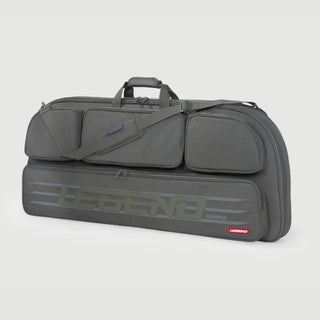
Once your bow is properly tuned and fitting correctly, protecting that setup becomes important. A well-fitting case keeps your cams, modules, and accessories safe between sessions and during transport. If you're looking for reliable protection, compound bow cases designed for field and travel use are worth considering before your next range day or hunt.