Skip to content
 cust@legendarchery.com
 302 503 5767
 Westfield IN 46074


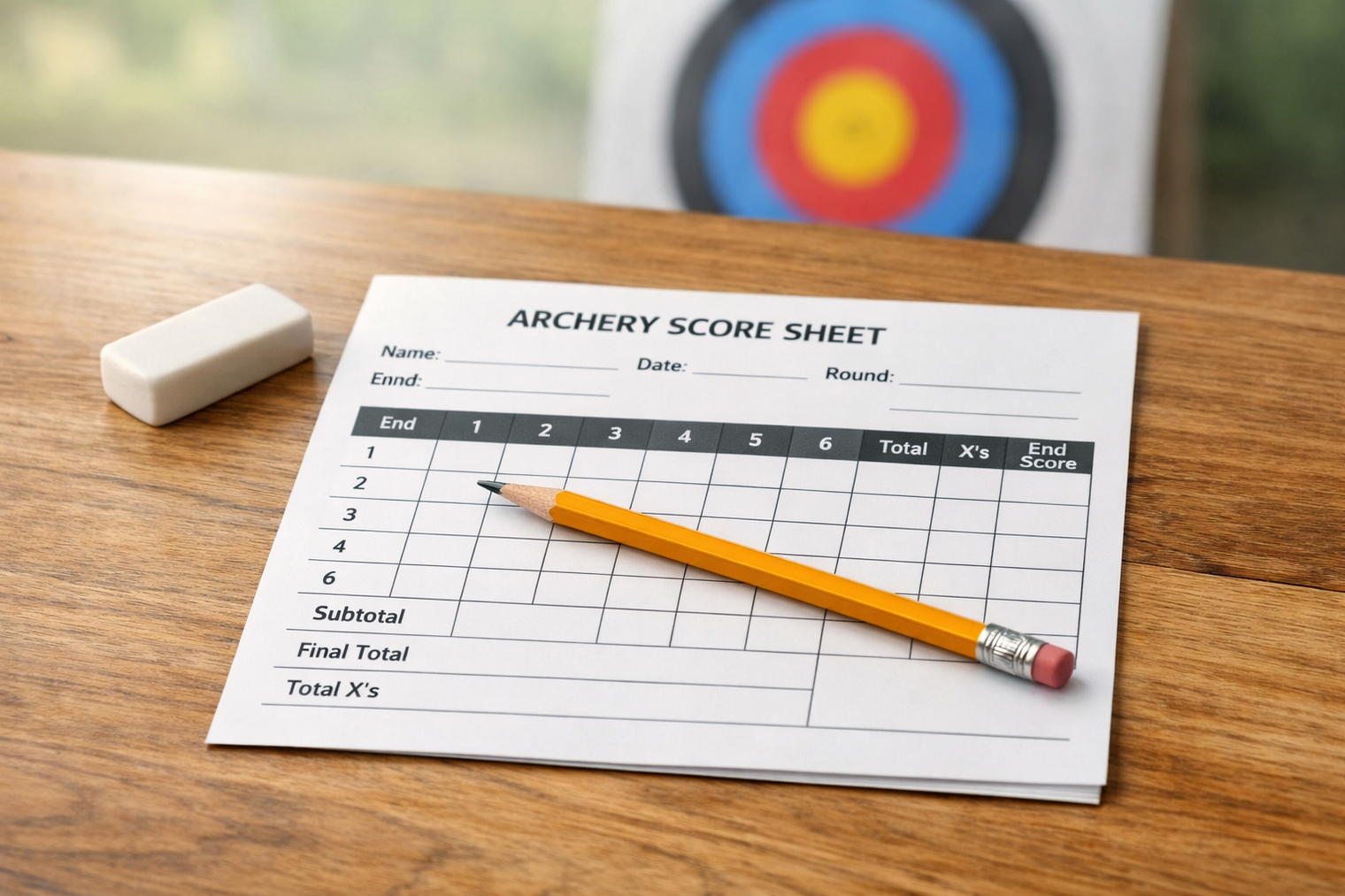
An archery score sheet PDF is a structured document used to record arrow values end by end during practice or competition. Whether you are shooting your first outdoor round or preparing for a club tournament, understanding how to fill one in correctly — and how to read what the numbers are telling you — makes a measurable difference in how fast you improve.
Why Accurate Score Recording Actually Matters
Most beginners treat scoring as an admin task. Experienced archers treat it as data. When you record your scores consistently and honestly, patterns emerge over time that bare shooting cannot reveal on its own. You might discover that your third end of every session is consistently your weakest, or that you drop points on a specific arrow position within the end. A blank score sheet gives you nothing. A completed one, filled in properly over weeks, becomes a performance log.
[product-tabs]
Score sheets also serve a practical function in competitions. Errors in recording — transposed digits, missed arrows, or unsigned totals — can result in score disqualification under most governing body rules. Getting comfortable with the format during practice means you will not be confused by it under pressure.
How Standard Archery Score Sheets Are Structured
While specific layouts vary between organisations and disciplines, most printable archery score sheets share a common structure worth understanding before you download or print one.
Ends and Arrows Per End
A typical sheet is divided into ends — groups of arrows shot before scoring takes place. In most target archery formats, each end consists of three or six arrows depending on the round being shot. Each arrow in an end has its own column for the value scored.
End Totals and Running Totals
After recording each arrow value, you add them across to produce an end total. The running total column accumulates these end by end throughout the round. This column is especially useful during long rounds like a 720 or a full FITA-style outdoor distance, where you need to track progress without mentally adding up hundreds of individual numbers.
Hits, Golds, and X Counts
Beyond pure score, most sheets include columns for hits (arrows that struck the target face), golds (arrows landing in the gold scoring zones), and in some formats an X count for the innermost ring. These tiebreaker columns are not decorative. In competition, when two archers finish a round with identical scores, the X count or gold count is used to separate placements.
Witness Signature
In competitive settings, score sheets must be signed by both the archer and a fellow competitor who witnessed the scoring. This is a formal requirement in most organised rounds, not a formality you can skip. Training yourself to always get a witness signature during practice keeps the habit natural on competition day.
Choosing the Right Score Sheet Format for Your Round
Not all score sheets suit all rounds. Using the wrong format creates confusion and can lead to recording errors. When looking for an archery score sheet PDF to print or use digitally, check that it matches the following:
- Number of arrows per end: Three-arrow ends and six-arrow ends require different column layouts.
- Number of ends in the round: A 36-arrow round and a 144-arrow round need very different sheet lengths.
- Scoring values in use: Metric rounds typically score from 1 to 10. Imperial and traditional rounds may use a different value scale such as 1, 3, 5, 7, 9.
- Distance or discipline labelling: Some rounds are shot at multiple distances. Make sure the sheet has clear sections for each distance if applicable.
Many governing bodies including World Archery, World Archery Europe-affiliated national associations, and USA Archery publish official score sheet PDFs on their websites. For club and recreational use, generic printable versions work well provided the column structure matches your round format.
Practical Tips for Filling In a Score Sheet Correctly
Knowing the layout is one thing. Filling it in consistently under real shooting conditions is another. These habits make score recording cleaner and more useful:
- Record arrow values in descending order within each end. If you shoot a 9, 7, and 10, write them as 10, 9, 7. This is a standard convention in most organised formats and makes verification easier.
- Use a pencil during practice so corrections are clean. In competition, most rule sets require pen, so build that habit before events.
- Call your arrows out loud at the target before writing anything down. This gives your witness the chance to verify each value before it is committed to paper.
- Check your end total before moving to the next end. Catching arithmetic errors end by end is far easier than finding a mistake after thirty ends.
- Mark misses as M, not zero. Most scoring formats treat a miss and a zero-value hit differently, and using M is the conventional notation.
Using Your Scores to Improve, Not Just Record
A filled-in sheet at the end of a session is only useful if you actually review it. Look for these patterns after each practice round:
- Which ends produced your lowest totals? Was there a fatigue factor, a wind change, or something mechanical happening?
- How consistent is your end-to-end variation? High variance between ends suggests inconsistency in execution. Low variance, even at a modest average, suggests a repeatable form that can be gradually refined.
- Are your golds evenly spread across the session, or clustered at the start? Many archers start warm and fade, and the score sheet will show this clearly.
- Track your scores across multiple sessions. A running personal best log beside your weekly sheets gives you a longer-term picture of genuine progress versus daily variation.
If you are working with a coach, bringing your score sheets to sessions gives them far more to work with than verbal impressions of how you felt on the day. Numbers do not lie the way memory does.
For archers who are starting to invest more seriously in their equipment and training tools, exploring what is available at outdoor archery supplies can help you build a complete practice setup alongside good scoring habits.
Common Scoring Mistakes to Avoid
These errors come up repeatedly, especially among archers in their first year of structured shooting:
- Recording in the wrong end: Losing track of which row you are on mid-session leads to misaligned totals that are hard to untangle later.
- Adding up the running total only at the end: Doing all the arithmetic at once increases the chance of cumulative errors. Update the running total end by end.
- Not recording misses: Skipping misses leaves the arrow count off and inflates the apparent score total.
- Using score sheets from the wrong round format: Printing a sheet designed for a 60-arrow round and using it for a 90-arrow round creates confusion halfway through.
- Forgetting to fill in the distance or round name: When you review old sheets weeks later, anonymous sheets tell you nothing useful about the conditions or context.
Digital vs. Printed Score Sheets
Digital scoring apps have become common at club level and some competition formats allow or require them. The advantage of apps is automatic arithmetic, immediate running totals, and easy session history. The advantage of a printed archery score sheet PDF is simplicity, no battery dependency, and universal acceptance in formal competition settings where electronics may not be permitted at the shooting line.
Many archers use both: a printed sheet during competition or formal rounds, and a digital app during solo practice for convenience. Either way, the underlying structure of what you are recording — arrow values, end totals, hits, and golds — remains the same.
If you are equipping yourself or your club for organised shooting, the archery shop at Legend Archery carries a broad range of equipment suited to both recreational and competitive archers.
Frequently Asked Questions
Where can I find a free archery score sheet to print?
Most national archery associations publish official score sheet PDFs on their websites at no cost. World Archery and affiliated national bodies typically provide downloads for all standard round formats. Generic versions are also freely available through club websites and archery forums.
Do I need a different score sheet for indoor and outdoor rounds?
Yes, in most cases. Indoor rounds are typically shorter with fewer ends and a different target face scoring system. Outdoor rounds often involve multiple distances and more arrows. Always match your sheet to the specific round you are shooting rather than using a one-size-fits-all layout.
What mistakes do beginners usually make when scoring for the first time?
The most common issues are forgetting to record misses, adding up totals only at the end of the session rather than end by end, and not noting the round name or distance on the sheet. These are easy habits to fix once you are aware of them.
Can I use a score sheet app instead of printing one?
For practice, absolutely. Most apps handle the arithmetic automatically and store session history, which is genuinely useful. For formal competition, check the rules of your specific event — some formats require a physical signed sheet regardless of what digital records exist.
How do I use old score sheets to track improvement?
Keep a simple log of your round total and personal best for each distance and format. Review sheets from a month or two ago and compare end-to-end variance, not just total score. Reducing variance is often a more meaningful indicator of progress than chasing a higher total.
Final Thoughts
A well-kept score sheet is one of the cheapest and most effective training tools available to any archer. The format is simple, the habit is easy to build, and the information it provides over time is genuinely useful. Start using one consistently at practice, not just at competitions, and the data will begin to do some of the coaching work for you.