Skip to content
 cust@legendarchery.com
 302 503 5767
 Westfield IN 46074



Most archers lose more ground in the off-season than they realise. Whether you shoot recurve, compound, or barebow, the physical and mental conditioning built up over a competitive season can fade surprisingly fast. Knowing how to stay in shooting shape — and acting on it consistently — is what keeps your draw smooth, your anchor repeatable, and your groupings tight when it counts.
Why Maintaining Shooting Condition Matters Year-Round
Archery looks deceptively passive from the outside, but it places real and specific demands on the body. The muscles responsible for scapular retraction, rotator cuff stability, and core bracing are all engaged on every shot. When those muscles are not regularly trained, they weaken. The neuromuscular patterns that make a clean release feel automatic also require repetition to stay reliable.
Beyond the physical side, archery is a skill sport with a strong mental component. Focus, shot routine, and the ability to manage pressure under competition conditions are all perishable skills. A few weeks of complete inactivity is usually enough to notice the difference in both feel and performance.
The archers who improve season over season are rarely those with the most natural talent. They are the ones who manage their training intelligently between events — doing enough to maintain adaptation without burning out.
Core Principles for Keeping Your Archery Fitness Sharp
1. Maintain Pulling-Specific Strength
The muscles used to draw a bow — primarily the rhomboids, middle trapezius, and rear deltoids — are not well targeted by most general gym routines. If you stop shooting regularly, these muscles will decondition faster than your legs or chest would from missing a few runs.
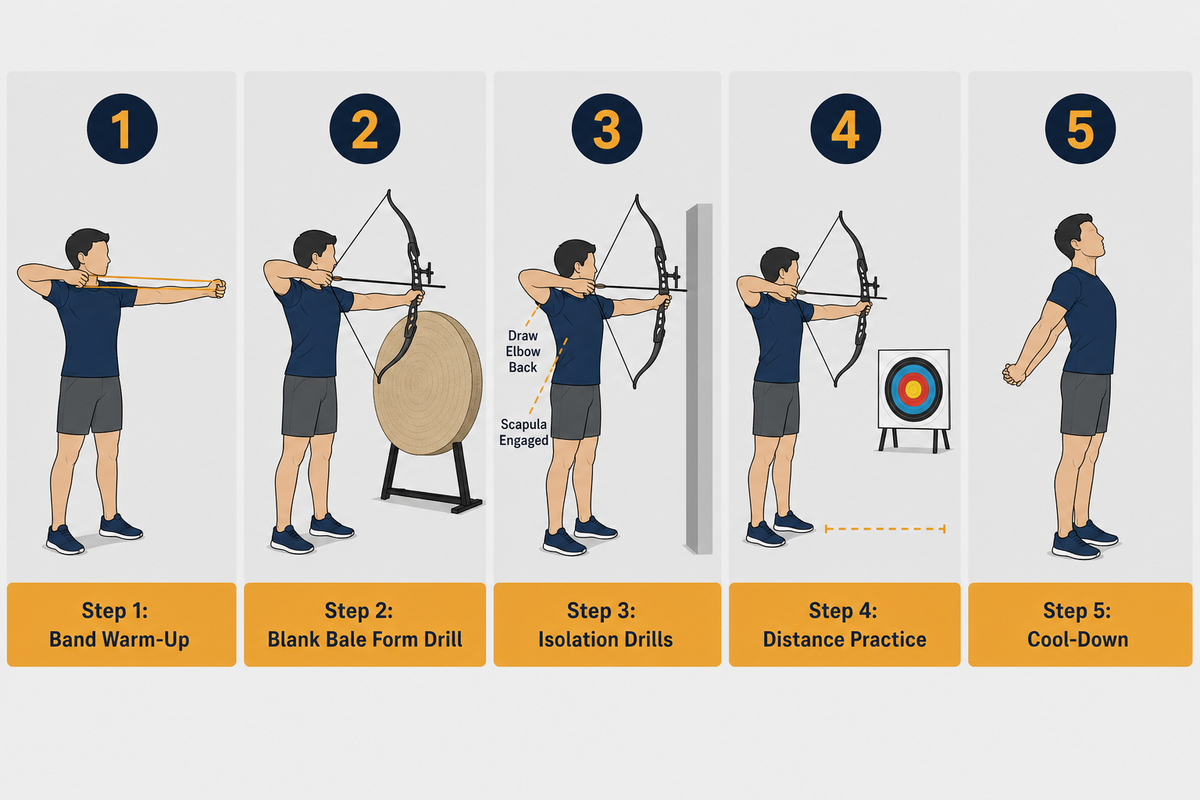
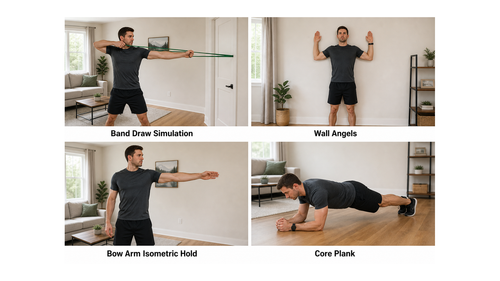
- Resistance band work: Theraband or similar resistance bands allow you to simulate the draw stroke and maintain the specific pulling pattern without needing a bow. Focus on slow, controlled retraction rather than speed.
- Rowing movements: Seated cable rows, single-arm dumbbell rows, and face pulls all recruit the same posterior chain muscles involved in drawing. Two to three sessions per week is plenty for maintenance.
- Isometric holds: Holding at full draw position — with a bow or with a band — for two to four seconds trains the muscles to stay stable at the point where most shots fall apart.
2. Keep Your Shot Routine Alive
Your shot routine is the foundation of repeatable accuracy. It is a sequence of mental and physical cues that leads from setup to release in the same way every time. Without regular reinforcement, that sequence becomes vague and inconsistent.
You do not need a full range session to maintain this. Mirror work, blank bale practice at very close distance, and mental rehearsal are all legitimate training methods used by high-level competitive archers. The goal is to run through the routine enough times that it stays ingrained at a motor level.
If you do have access to a bow, even twenty to thirty arrows shot with full attention to process — not score — is more valuable than a hundred arrows shot carelessly.
3. Address Grip, Posture, and Alignment Off the Range
A large part of archery performance comes down to how your body is aligned before you even begin to draw. Poor posture, tight hip flexors, and limited thoracic mobility all interfere with a clean shooting stance. These can be worked on entirely away from a bow.
- Daily mobility work targeting the thoracic spine and shoulders pays dividends for archers of all levels.
- Grip strength and hand stability can be maintained with simple tools like stress balls or grip trainers.
- Awareness of how you stand and hold tension in your body during daily life translates directly to the shooting line.
4. Train Your Focus and Mental Routine
Mental preparation is often the first thing archers drop when they step away from active training. But focus, pre-shot routine, and the ability to reset after a bad shot are skills that respond to deliberate practice just like physical ones.
Visualisation is one of the most accessible tools available. Spending ten minutes before sleep running through a perfect shot sequence — in vivid detail, including the feel of the shooting glove against your fingers or the position of your bow hand — activates many of the same neural pathways as physical practice.
Some archers also find that journaling about their training, reviewing competition footage, or studying form analysis videos keeps their mental engagement high during periods of reduced shooting.
Practical Off-Season and Low-Volume Training Habits
Consistency matters more than intensity when your goal is maintenance rather than peak development. A simple weekly structure might look like this:
- Two to three days: Resistance training focused on pulling muscles and core stability.
- One to two days: Technique work — either at a blank bale, in a mirror, or through visualisation.
- One day: A full range session with arrows if possible, prioritising form over volume.
- Rest days: Active recovery — walking, light stretching, or yoga — rather than complete inactivity.
Wearing your shooting gloves during practice sessions, even low-volume ones, helps maintain the tactile familiarity that contributes to a consistent release. Small details like this matter more than most archers acknowledge.
Common Mistakes Archers Make When Trying to Stay Match-Ready
Even well-intentioned archers make avoidable errors when managing their fitness between seasons or during training gaps.
- Going from zero to full volume too quickly: After a break, jumping straight back into high arrow counts leads to overuse injuries, particularly in the shoulder and elbow. Ramp volume gradually over two to three weeks.
- Only training what is comfortable: Most archers default to practising what they are already good at. Off-season periods are the right time to address weaknesses in technique or fitness without the pressure of upcoming competition.
- Neglecting the non-dominant side: Muscle imbalances between the drawing side and bow arm side are common and can affect posture and alignment. Include unilateral work on both sides in any conditioning routine.
- Treating rest as failure: Rest is part of training, not the absence of it. Scheduled rest periods and lower-volume phases are how adaptation actually occurs. Archers who train hard without rest tend to plateau or get injured.
- Skipping equipment checks: A bow that has drifted out of tune will undermine even well-maintained shooting form. Use quieter training periods to check timing, brace height, and arrow flight.
Frequently Asked Questions
What does it actually mean to stay in shooting shape?
It refers to maintaining the specific physical conditioning, technical skill, and mental habits needed to shoot accurately and consistently — even during periods when you are not competing or shooting high volumes. It is the difference between starting a new season from scratch and starting from where you left off.
How quickly do archers lose fitness and form if they stop training?
It varies by individual, but most archers begin to notice a drop in pulling endurance and shot consistency within two to four weeks of complete inactivity. Mental habits like focus and routine tend to fade more gradually, but they still require maintenance. Even light activity two or three times per week is usually enough to preserve most of what you have built.
Can I maintain shooting condition without access to a range?
Yes, to a meaningful degree. Resistance band training, mirror work, visualisation, and posture exercises all address real components of archery performance. You will not replace live shooting entirely, but you can preserve a significant portion of your physical and mental readiness until you have range access again.
What mistakes do beginners usually make when trying to keep their form between seasons?
Beginners most commonly either stop training entirely and lose most of their progress, or they return too aggressively and get injured. They also tend to focus only on shooting arrows rather than addressing the underlying physical and mental foundations that make good shooting possible. Building a simple, sustainable routine — even a short one — is far more effective than sporadic bursts of intense effort.
Keeping the Progress You Have Earned
Archery fitness and form are built slowly and lost faster than most archers expect. A modest but consistent approach to off-season and low-volume training — combining pulling strength work, routine maintenance, and mental practice — is enough to stay in shooting shape without burning out. When the season starts again, you will be ready to build from a solid base rather than spend the first weeks just recovering lost ground.