Skip to content
 cust@legendarchery.com
 302 503 5767
 Westfield IN 46074


Most archers only train when they're at the range. That's a mistake. The physical qualities that make you a better shooter — draw strength, scapular control, core stability, and muscle memory — can all be developed at home. Archery exercises in your living room aren't a substitute for live shooting, but they close the gap between range sessions and keep your body prepared for the moment you do draw a real bow.
Why Off-Range Training Actually Moves the Needle
Archery is a precision sport built on repeatable movement patterns. Unlike power sports, the limiting factor for most archers isn't raw strength — it's the ability to reproduce the same muscle engagement, anchor position, and release under varying conditions. That's a neurological and structural challenge, not just a fitness one.
When you train at home between range days, you're reinforcing motor pathways and building the postural endurance needed to hold steady through a full shooting sequence. Skipping this off-range work means your first few arrows after a week away are essentially warm-up arrows spent re-learning what your body already knew.
There's also a practical case: weather, work schedules, and range access don't always cooperate. A consistent 15 to 20 minute home routine keeps your conditioning from regressing during gaps.
The Muscles That Matter Most in Archery
Before picking exercises, it helps to understand which muscle groups drive archery performance. This keeps your home training targeted rather than generic.
- Rhomboids and mid-trapezius: These pull the shoulder blade back during the draw and are central to a clean back-tension release.
- Rotator cuff (especially infraspinatus and teres minor): They stabilise the shoulder joint under load, which matters on every single draw.
- Serratus anterior: Controls scapular positioning on the bow arm and prevents the shoulder from collapsing forward.
- Core (transverse abdominis, obliques): Provides the stable platform from which both arms operate. Weak core means torque bleeds into your shot.
- Forearm flexors and extensors: Manage grip pressure and string hand tension without gripping too hard.
Exercises that miss these groups — like heavy bicep curls or bench pressing — won't transfer meaningfully to archery performance.
Practical Exercises You Can Do Without Equipment
1. Band Pull-Aparts
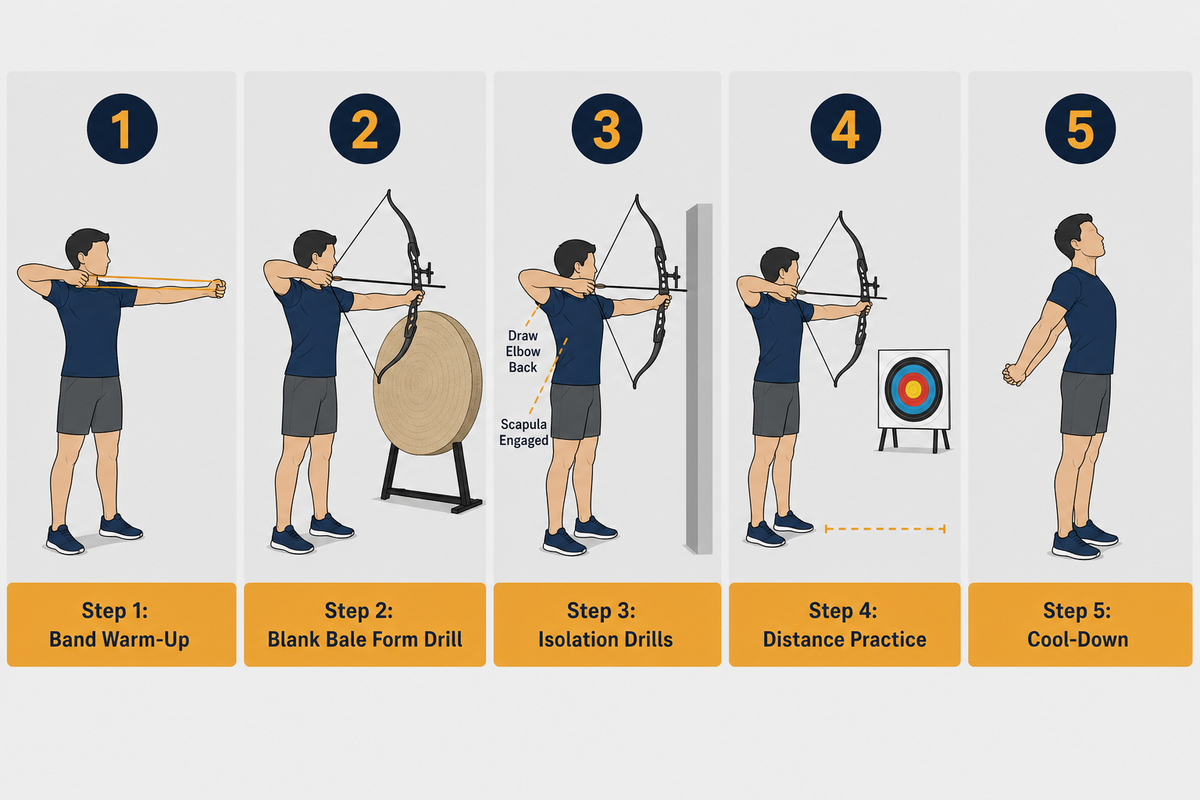
If you own a resistance band, this is the single most archery-specific exercise available without a bow. Hold the band at shoulder height with straight arms, then pull it apart until your hands reach your sides, squeezing your shoulder blades together. The motion mirrors the retraction phase of a draw. Perform 3 sets of 15 to 20 slow repetitions. Focus on scapular movement, not just arm movement.
2. Wall Angels
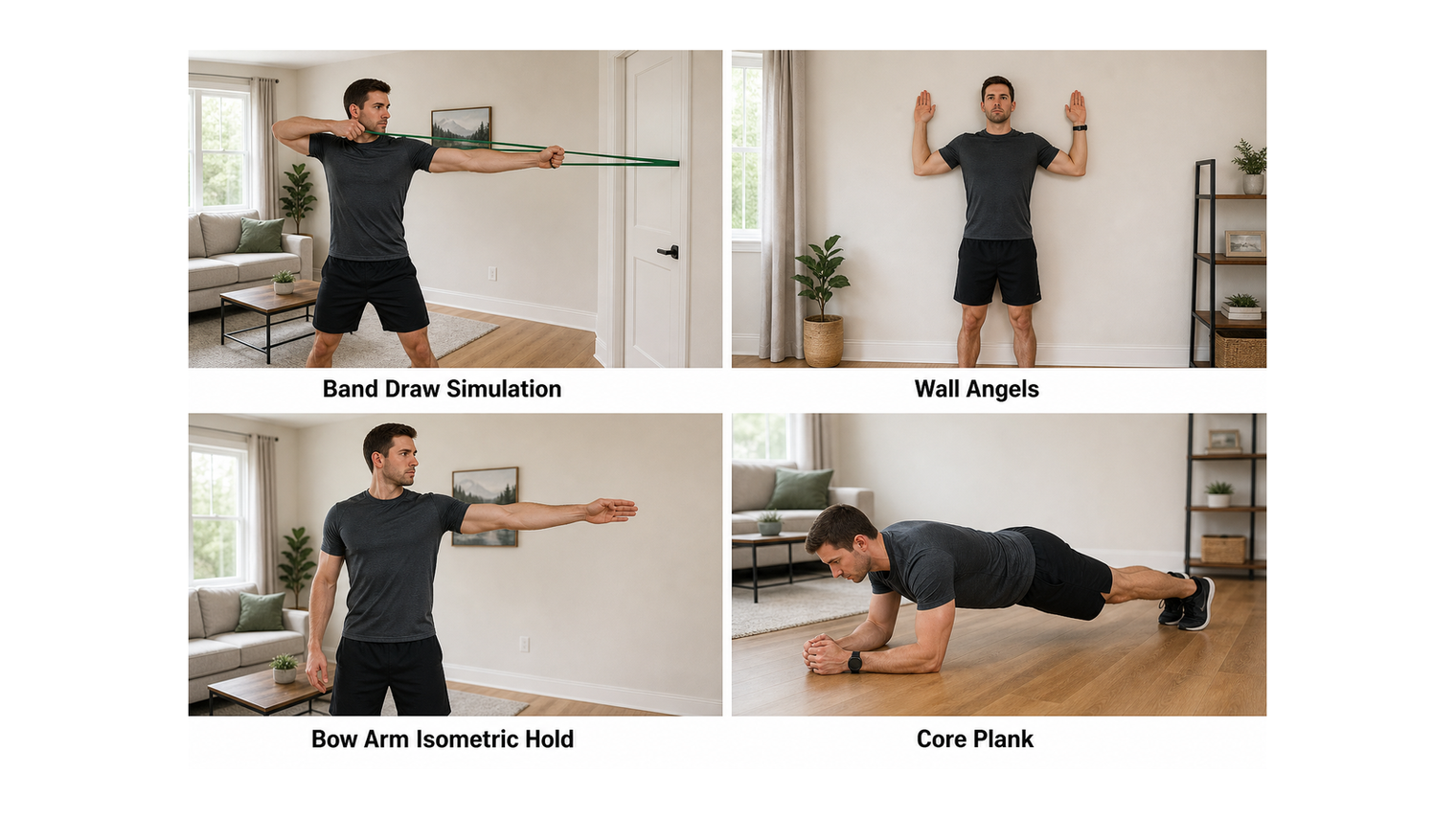
Stand with your back flat against a wall, arms raised in a goalpost position with elbows and wrists touching the surface. Slowly slide your arms upward without losing contact with the wall. This exercise reveals and corrects the rounded-shoulder posture that plagues many archers and directly improves bow arm alignment. It requires no equipment and takes two minutes.
3. Dead Hang or Scapular Pull-Ups
If you have a doorframe pull-up bar, hanging from it and performing small scapular depression movements (pulling the shoulder blades down without bending your elbows) builds the precise stabiliser muscles used at full draw. Even a passive dead hang for 20 to 30 seconds improves shoulder mobility over time.
4. Bow Arm Isometric Hold
Extend your bow arm forward as if holding a bow, with a slight bend at the elbow and your shoulder blade pressed down and back. Hold this position for 30 to 60 seconds while focusing on keeping the shoulder from riding up. This trains the postural endurance needed to keep your bow arm stable through a full set of arrows.
5. Drawing Simulation with a Resistance Band
Anchor a resistance band at shoulder height to a door handle or fixed point. Stand in your shooting stance, grip the band, and pull through your full drawing motion to your anchor point. Hold for three to five seconds with deliberate back tension, then release slowly. This is the closest thing to actual draw training without a bow. Keep the resistance light enough to focus on form over power.
6. Plank Variations for Shooting Stability
Standard forearm planks and side planks develop the core endurance that keeps your upper body quiet during the shot. Aim for three holds of 30 to 45 seconds each. As a progression, try lifting one arm during a standard plank — this closely mimics the asymmetrical load archery places on your torso.
7. Blind Bale Form Rehearsal
You don't need a target or arrows for this. Stand in front of a blank wall, assume your full shooting stance, and go through every phase of your shot sequence — stance, grip, set, draw, anchor, aim, hold, release, follow-through — using your actual bow or just your body. Slow-motion form rehearsal without the pressure of hitting a target is one of the most underused mental and physical training tools available. Even without arrows, this sharpens your shot routine into something automatic.
Structuring a Weekly Home Routine
You don't need to spend an hour on this. Three sessions per week of 15 to 20 minutes will produce noticeable improvement over four to six weeks. A simple structure to follow:
- Day 1: Band pull-aparts, wall angels, bow arm isometric hold (3 rounds)
- Day 2: Drawing simulation with band, plank hold, scapular dead hang (3 rounds)
- Day 3: Full shot sequence rehearsal (10 to 15 slow repetitions), wall angels, forearm stretching
Rest days between sessions allow the small stabiliser muscles to recover. Overtraining these muscles produces fatigue that actually degrades your form at the range.
Common Mistakes to Avoid
- Training through shoulder pain: Mild fatigue is expected. Sharp or pinching pain in the shoulder during any pulling movement is a signal to stop and assess — not push through.
- Using too much resistance too soon: Heavier isn't better in archery training. Excess resistance causes compensatory movement patterns that reinforce bad habits rather than good ones.
- Ignoring the bow arm: Most home training focuses on the draw side. The bow arm shoulder is equally important and equally undertrained by most archers.
- Skipping the shot sequence rehearsal: Physical strength without ingrained movement patterns doesn't transfer cleanly to better shooting. The mental simulation component is not optional.
- Training only one side: While archery is asymmetrical by nature, some bilateral work — especially for the core and posture muscles — prevents long-term imbalances.
If you're also reviewing your equipment setup alongside your training, exploring what's available at Legend Archery's online shop can help you identify gear that supports your current draw weight and discipline.
Frequently Asked Questions
Can I actually improve my archery by training at home without shooting?
Yes — meaningfully so. The physical qualities that drive accuracy, particularly scapular stability, draw-side strength, and core endurance, respond well to targeted off-range training. You won't develop aiming skill without shooting, but your physical readiness to shoot well will improve noticeably.
How long before I see results from a home training routine?
Most archers notice a difference in how their first session after a training break feels within three to four weeks of consistent home work. Muscle memory improvements in form rehearsal tend to show up faster than strength gains, often within two weeks.
What do beginners get wrong when training for archery at home?
The most common error is training the wrong muscles — doing generic upper body work that doesn't reflect the pulling and stabilising demands of archery. The second most common mistake is skipping the form rehearsal component entirely and treating the training as pure fitness rather than skill-adjacent preparation.
Do I need a resistance band, or can I train with no equipment at all?
Several effective exercises — wall angels, bow arm isometric holds, form rehearsal, and planks — require zero equipment. A light resistance band adds significant value for draw simulation, but it's not a hard requirement to start. If you're looking to expand your training tools, new archery training products can complement a home routine without needing a full setup.
Final Thought
The range is where you test your shooting. Home is where you build the foundation that makes good shooting possible. Treat these sessions as part of your archery practice, not a secondary activity, and your time on the range will reflect that investment.