Skip to content
 cust@legendarchery.com
 302 503 5767
 Westfield IN 46074


Archery rewards patience and structure more than raw athleticism. Whether you are picking up a bow for the first time or trying to break out of a performance plateau, the way you structure your training makes a bigger difference than how many arrows you shoot. This guide covers the complete process — from gear setup through building repeatable technique — so you can practice with purpose from day one.
Why a Structured Archery Training Approach Matters
Most archers who struggle with inconsistency are not struggling with talent. They are struggling with habits. Shooting a hundred arrows a week at random distances with no feedback loop mostly reinforces existing flaws. Structured training, by contrast, breaks the skill into manageable components — stance, draw, anchor, aim, release — and builds each one deliberately before combining them under pressure.
Physical conditioning also plays a larger role than beginners expect. The muscles used for drawing and holding — primarily the back, rotator cuff, and forearm — fatigue quickly in untrained archers. When they fatigue, form breaks down, and broken form printed into muscle memory is harder to correct later than if you had never developed it in the first place.
What You Need Before You Start Training
Before you commit to a regular practice schedule, make sure the following are in order:
- A correctly fitted bow: Draw length and draw weight must match your body. Drawing a bow that is too heavy leads to compensation movements that corrupt your form immediately.
- Arrows matched to your bow: Spine stiffness matters. An arrow that is too weak or too stiff for your setup will fly unpredictably regardless of how good your technique is.
- A safe and legal shooting space: Whether that is a club range, an outdoor field, or a dedicated backyard setup, you need consistent access to a place where you can shoot safely and regularly.
- Basic protective gear: An armguard and a finger tab or release aid are not optional. String contact on your forearm or fingers affects both safety and shot timing.
- A target rated for your bow type: Compound and recurve bows require different target densities. Using the wrong one damages your arrows and creates a retrieval frustration that shortens practice sessions.
If you are still assembling your setup, browsing Legend Archery's online archery shop is a practical starting point for finding bows, arrows, and accessories suited to your style and experience level.
Step-by-Step: How to Train for Archery
Step 1 – Build Your Foundation at Close Range
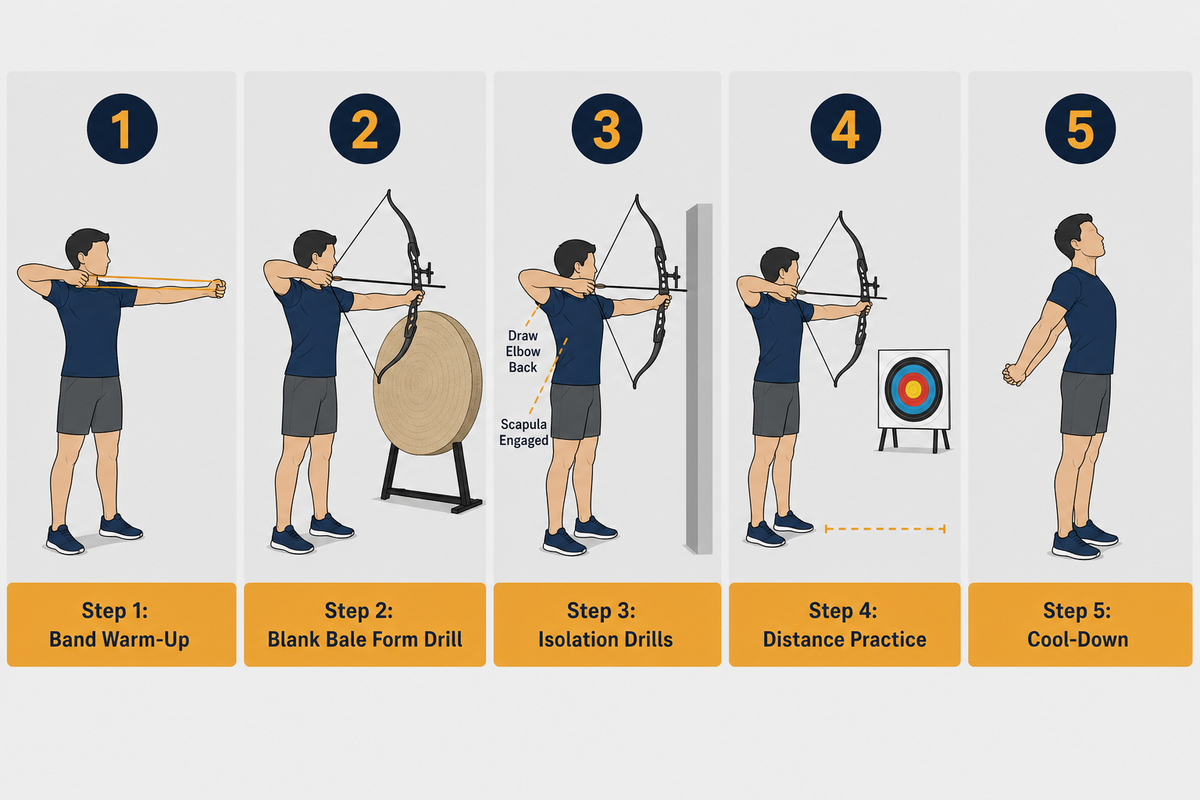
Start at five to seven metres. This is not a beginner distance — it is a technique distance. At close range, you can clearly see arrow groupings that tell you where your form is breaking down, without the added variable of aiming error. Shoot groups of three to six arrows and observe the pattern. Tight groups in the wrong place mean your aim needs adjusting. Scattered groups mean your execution is inconsistent.
Step 2 – Learn and Drill Each Phase of the Shot Cycle
The shot cycle is a sequence of body positions and movements, and each phase must be stable before the next one is added:
- Stance: Square or open stance, shoulder-width feet, body relaxed but upright.
- Grip: Low wrist pressure on the bow grip. A death grip torques the riser and moves your arrow left or right.
- Draw: Initiated from the back muscles, not the bicep. Lead with your elbow, not your hand.
- Anchor: Consistent contact point every time — corner of the mouth, under the chin, or wherever your style dictates. Inconsistent anchor is one of the most common causes of vertical stringing.
- Aim and hold: Natural aim oscillation is normal. Do not freeze and punch the trigger or tab — let the shot develop.
- Release and follow-through: The bow hand should stay up. The drawing hand should move back naturally. Any collapse here usually traces back to anticipation in the aim phase.
Step 3 – Introduce Blank Bale Shooting
Blank bale training — shooting at a plain, unmarked target from very close distance with eyes sometimes closed — is one of the most underused drills in recreational archery. It removes the aiming variable entirely and forces your nervous system to focus on the feel of the draw, anchor, and release. Five to ten minutes of blank bale work at the start of each session builds the proprioceptive awareness that makes consistent technique possible.
Step 4 – Add Distance Gradually
Only increase your shooting distance when your groups at the current distance are consistently tight — not when you feel bored. A common rule is to move back when you can place six arrows inside a dinner-plate-sized circle at your current distance without conscious effort. Jumping distance too quickly reintroduces aim pressure, which often leads to a flinch or shot anticipation reflex that is difficult to untrain.
Step 5 – Incorporate Physical Conditioning Off the Range
Archery-specific conditioning does not require a gym membership, but it does require consistency. The following are worth building into your weekly routine:
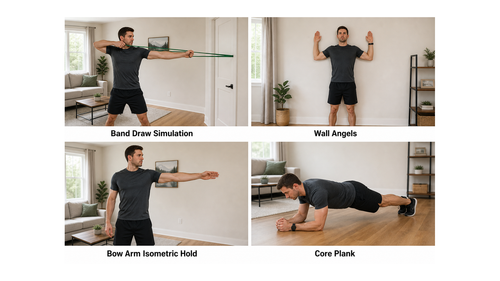
- Resistance band exercises: Simulate the draw motion against resistance to build scapular stability and rotator cuff endurance without fatigue-induced bad habits.
- Shoulder and upper back strengthening: Rows, face pulls, and scapular retractions target the muscles most critical to a stable, repeatable draw.
- Core stability work: Planks and rotational stability exercises reduce sway during the aiming phase, particularly at longer distances or in outdoor wind conditions.
- Grip and forearm endurance: Particularly relevant for recurve finger shooters who hold through the shot without a mechanical release.
Step 6 – Keep a Training Log
Record distance, number of ends, arrow groupings, and any notes about what felt different. Over weeks, patterns emerge — you may notice that your groups open up after thirty minutes (fatigue), or that your left-right consistency degrades outdoors (wind reaction habit). A log turns practice from repetition into deliberate analysis.
Common Mistakes to Avoid When Building an Archery Training Routine
- Shooting too many arrows too soon: Volume without quality locks in poor technique. Early sessions should prioritise execution over arrow count.
- Starting with too much draw weight: Ego-driven draw weight choices are the leading cause of shoulder injuries and collapsed form in new archers.
- Skipping the warm-up: Shooting cold shoulders leads to inconsistent early groups and increases injury risk in the rotator cuff.
- Ignoring mental routine: A pre-shot routine — even a simple three-breath reset — dramatically reduces shot-to-shot variability under pressure.
- Chasing scores too early: Scores are outcomes. Focus on process metrics instead, such as anchor consistency and follow-through, until your fundamentals are solid.
- Training in only one condition: If you only shoot indoors at a fixed distance, outdoor or competitive pressure will expose technique gaps that never appeared in familiar conditions.
How to Tell If Your Training Is Working
Progress in archery is not always linear, but there are reliable indicators that your training is moving in the right direction:
- Your groups are getting smaller at the same distance over several sessions.
- You can reproduce a tight group after a break or on a second session, not just when you are warmed up.
- Your blank bale shots feel consistent and effortless rather than muscled.
- You are less fatigued after the same volume of shooting compared to when you started.
- Your grouping centre moves predictably when you make a deliberate form change, rather than randomly.
If you have been practicing consistently for several weeks but are not seeing group improvement, it is worth checking whether your equipment is still properly tuned. Even well-matched equipment drifts — nocking points, rest alignment, and arrow spine all interact with your developing form in ways that may require small adjustments as your technique matures.
For archers training outdoors regularly, having reliable outdoor archery supplies that suit your terrain and weather conditions can make a meaningful difference to how productive those sessions feel.
Frequently Asked Questions
How do you actually train for archery correctly as a beginner?
Start close, shoot slowly, and prioritise one element of the shot cycle at a time. Most beginners benefit from fewer arrows per session with a strong focus on anchoring and back tension during the draw. Getting your draw weight right from the start is more important than anything else — it sets the ceiling for how clean your technique can become early on.
What mistakes do most archers make when they first start training?
The most common are: shooting too much draw weight too soon, skipping blank bale work, and increasing distance before groups are consistent. Many archers also neglect the pre-shot routine, which becomes significant once competitive or outdoor pressure is introduced.
What equipment do you actually need to train properly?
At minimum: a correctly fitted bow, spine-matched arrows, an armguard, a finger tab or mechanical release, and an appropriate target. A resistance band for off-range conditioning is a worthwhile addition early on. As your training develops, a simple arrow puller and a notepad for logging sessions are more useful than most gadget upgrades.
How can you tell if your form is actually improving or just varying randomly?
The clearest sign is reproducibility — whether you can shoot the same group on a second day or after a rest, not just when warmed up and focused. A training log helps here enormously. If your groups are tight on good days but scattered on normal days, your technique is not yet consistent; it is mood-dependent. True improvement shows up as a raised floor, not just occasional peaks.
Building the Habit That Makes Everything Else Work
Good archery training is mostly about showing up consistently with a clear focus for each session. You do not need to shoot hundreds of arrows per week — you need to shoot with intention, record what you see, and adjust. Equipment that fits properly and targets designed for your setup remove unnecessary friction from the process. If you are still selecting or upgrading your gear, exploring new archery products at Legend Archery is a useful way to compare what is available across different bow types and training stages.