Skip to content
 cust@legendarchery.com
 302 503 5767
 Westfield IN 46074


Who This Guide Is For
If you are setting up a recurve bow for the first time, switching from a shelf rest, or upgrading after noticing inconsistent arrow flight, this guide is for you. We cover rest types, how to match one to your setup, and the fitting process from start to finish. Experienced shooters who have never formally gone through this process will also find it useful.
Why the Arrow Rest Matters More Than People Think
The arrow rest is the last contact point before an arrow leaves the bow. A rest that is too high, too low, or too stiff directly affects arrow clearance and introduces contact that throws groups off centre. Many archers blame their form or their arrows when the actual problem is a poorly chosen or poorly positioned rest. Getting this decision right early saves a lot of frustrating tuning later.
What You Need Before You Start
Before selecting or fitting a rest, gather the following:
- Your bow's riser measurements – specifically the sight window depth and the shelf position. These affect which rest styles physically fit.
- Your arrow spine and diameter – a stiffer or thicker arrow shaft behaves differently at the rest and requires different clearance.
- A nocking point or nocking point pliers – rest height is set relative to nocking point position, so you need both in place together.
- A bow square or T-square – for measuring brace height and confirming rest height numerically.
- Adhesive or mounting screws – depending on the rest type, you will need either double-sided tape or a threaded fitting tool.
If you are still deciding on the bow itself, browsing a wide range of recurve bows first can help you understand which risers have which mounting options before you commit to a rest type.
Step-by-Step: How to Choose an Arrow Rest for a Recurve Bow
Step 1 – Identify Your Shooting Style
Your shooting style determines the rest category you should be looking at. There are three main categories used on recurve bows:
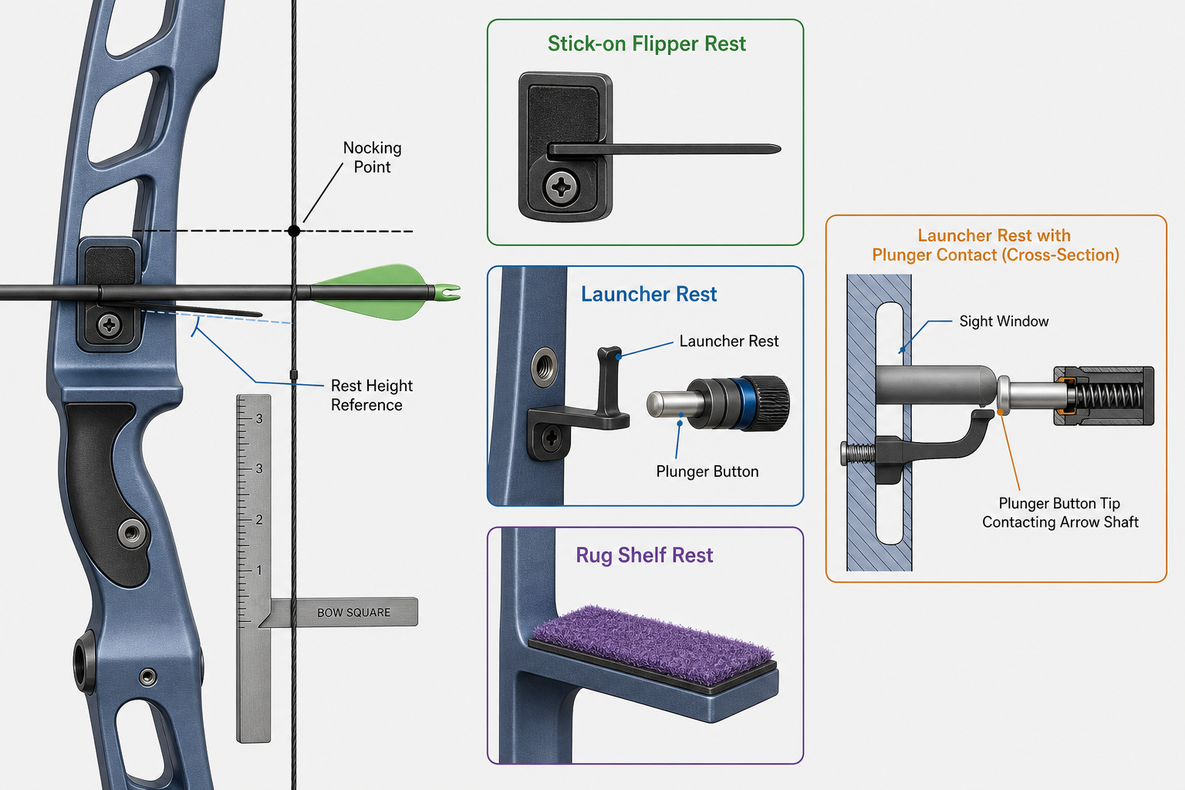
- Stick-on flipper rests (magnetic or plastic blade) – the most common choice for beginners and intermediate target archers. They attach to the sight window with adhesive and support the arrow on a small horizontal arm that flips out of the way on release. They are forgiving of minor form inconsistencies.
- Pressure button rests or launcher rests – used alongside a pressure button (also called a plunger). The rest itself is minimal, often just a short launcher arm, and the plunger provides the lateral resistance. This combination is the standard for Olympic-style recurve shooting.
- Shelf or rug rests – a simple cushioned shelf applied directly to the arrow rest shelf on the riser. These are typical for traditional recurve bows where no sight window hardware is used. They suit instinctive and barebow styles.
Step 2 – Check Riser Compatibility
Not every rest fits every riser. Check two things:
- Does the riser have a pre-drilled plunger hole? If yes, a pressure button rest is viable. If not, you are limited to stick-on options or shelf rests.
- How deep is the sight window cutout? A very shallow window may not allow enough clearance for a flipper arm to fold properly.
Step 3 – Match the Rest to Your Arrow Spine
A rest that works well with a 500-spine carbon arrow may cause problems with a heavy wooden shaft. Consider:
- Heavier or wooden arrows – need a rest with more support surface, such as a wider rug rest or a solid flipper arm. They are less forgiving of minimal contact surfaces.
- Light carbon or aluminium arrows – suit flipper or launcher rests because the arrow recovers quickly and clearance is easier to achieve.
- Arrow diameter – thicker arrows sit differently on a narrow launcher arm. Confirm the rest arm width is appropriate for your shaft diameter.
Step 4 – Set the Rest Height
This is where most fitting errors happen. Rest height should position the arrow so that, when nocked, it sits at a very slight downward angle toward the tip — roughly 1 to 3 millimetres below perfectly horizontal at the rest. This is measured against a level nocking point using a bow square.
- Nock an arrow and hang a bow square from the string at the nocking point.
- The arrow should sit slightly below the 90-degree mark on the square, not above it.
- Adjust the rest arm height until this relationship is correct before permanently fixing the adhesive or tightening screws.
Step 5 – Set Lateral Position
The centre of the arrow should align vertically with the bowstring when viewed from directly behind the bow. For barebow and traditional setups, this is judged visually. For setups using a plunger button, the button tip protrudes through the riser and makes contact with the side of the arrow shaft, so the rest arm just needs to position the arrow close enough for the button to do its job. Follow the specific plunger manufacturer's guidance for the initial lateral setting.
Step 6 – Do a Paper Tune Test
Once the rest is positioned and fixed, shoot through a sheet of paper at close range (around two to three metres). A clean bullet hole or a small tear indicates good clearance and alignment. Large tears tell you which direction the rest or nocking point needs adjusting. Repeat until the tear is acceptably small. This confirms your choice before you commit to shooting dozens of arrows with a misaligned setup.
Common Mistakes to Avoid
- Fitting the rest without a nocking point in place – height measurements mean nothing if there is no reference nocking point to measure against.
- Using the wrong adhesive thickness – some stick-on rests rely on very thin tape. Adding thicker tape moves the rest laterally away from the sight window and throws off arrow alignment.
- Choosing a rest purely by price – a very cheap rest with a weak flipper arm will fatigue and deform quickly, affecting consistency. A mid-range rest of appropriate type will outlast a budget option by a large margin.
- Ignoring rest arm stiffness – a stiffer arm suits heavier draw weights because a light arm can deflect under load. Match arm stiffness to your draw weight, not just your arrow spine.
- Over-tightening on a threaded riser insert – this is an easy way to strip a plastic riser or crack a carbon riser around the insert. Finger-tight plus a quarter turn is usually sufficient.
How to Check Your Result
A correctly chosen and fitted arrow rest will show several positive signs:
- Arrows group consistently at distance without unexplained horizontal spread.
- The paper tune result is clean or shows only a very slight tear that tunes out with minor nocking point adjustment.
- The flipper arm or launcher returns cleanly to its rest position between shots without bending or sticking.
- No audible or visible contact between the arrow fletching and the rest arm during the shot.
If you are seeing fletching contact on the rest arm, your arrow spine may be too weak for your draw weight, or the rest arm needs to be angled or positioned differently. Fletching contact is one of the most common causes of poor groups and it is worth diagnosing before assuming the rest itself is the wrong choice.
For more detail on rest types and how they compare, the arrow rest reference pages at Legend Archery provide additional technical context alongside available product options.
Frequently Asked Questions
How do I actually know which rest type is right for my bow?
Start with your riser. If it has a plunger hole, a launcher rest with a pressure button is the most versatile long-term option for target shooting. If it does not, a stick-on flipper rest is the most practical and forgiving choice for most setups. Traditional risers without a sight window are best served by a rug or shelf rest.
Can I just use the moulded shelf that comes on the riser?
Some risers do come with a moulded shelf, but shooting directly off bare plastic or wood increases fletching contact and wear. Even a basic rug rest or stick-on rest improves arrow clearance significantly. It is worth the modest investment.
What tools do I actually need to fit a rest properly?
At minimum: a bow square to set nocking point and rest height together, double-sided tape appropriate for the rest, and a nocking point. For threaded rests you also need a small Allen key or the appropriate fitting tool. Paper for a paper tune test is helpful but not strictly required for basic setup.
How do I know if I got it wrong?
The clearest sign is horizontal grouping inconsistency that does not match your aiming variation. Arrows striking consistently left or right regardless of your form usually points to lateral rest position or plunger tension. Arrows that group vertically but not horizontally often point to a nocking point height issue rather than the rest itself. Run a paper tune test to isolate the problem quickly.
Final Thoughts
Choosing a rest is a practical decision based on your riser, your shooting style, and your arrow setup — not on brand loyalty or price alone. Take the time to set height and lateral position properly before permanently fixing anything, and validate with a paper tune. A well-fitted rest requires almost no maintenance and will quietly support consistent arrow flight for years.