Skip to content
 cust@legendarchery.com
 302 503 5767
 Westfield IN 46074


Before you buy a recurve bow or choose your first set of arrows, you need to know one number: your draw length. Get it wrong and you'll fight your form, struggle with accuracy, and risk developing bad habits that are hard to undo. Get it right and everything else becomes easier. Here's how to find it reliably.
Why Draw Length Matters More Than Most Beginners Realise
Draw length is the distance from the throat of the grip to the bowstring at full draw — essentially how far back you pull the string before anchoring. On a recurve bow, this measurement doesn't lock you into a fixed position the way a compound bow's let-off does, but it still governs almost every other decision you make as an archer.
- Arrow length and spine selection depend directly on your draw length. An arrow that's too short is a safety hazard; one that's too stiff or too weak will fly inconsistently.
- Bow length selection is partially guided by draw length. Longer bows tend to suit archers with longer draws, reducing string angle and improving stability.
- Anchor point consistency is easier to maintain when you're drawing to your natural length rather than over- or under-drawing.
- Injury prevention is a genuine concern. Consistently over-drawing strains the shoulder and elbow; under-drawing creates poor posture and collapses form at full draw.
In short, draw length is the foundation of your archery setup. Everything from the bow you choose to the arrows you shoot should be matched to this number.
How to Measure Your Draw Length Accurately
There are two reliable methods used by coaches and bow technicians. Use both and compare — they should land within half an inch of each other.
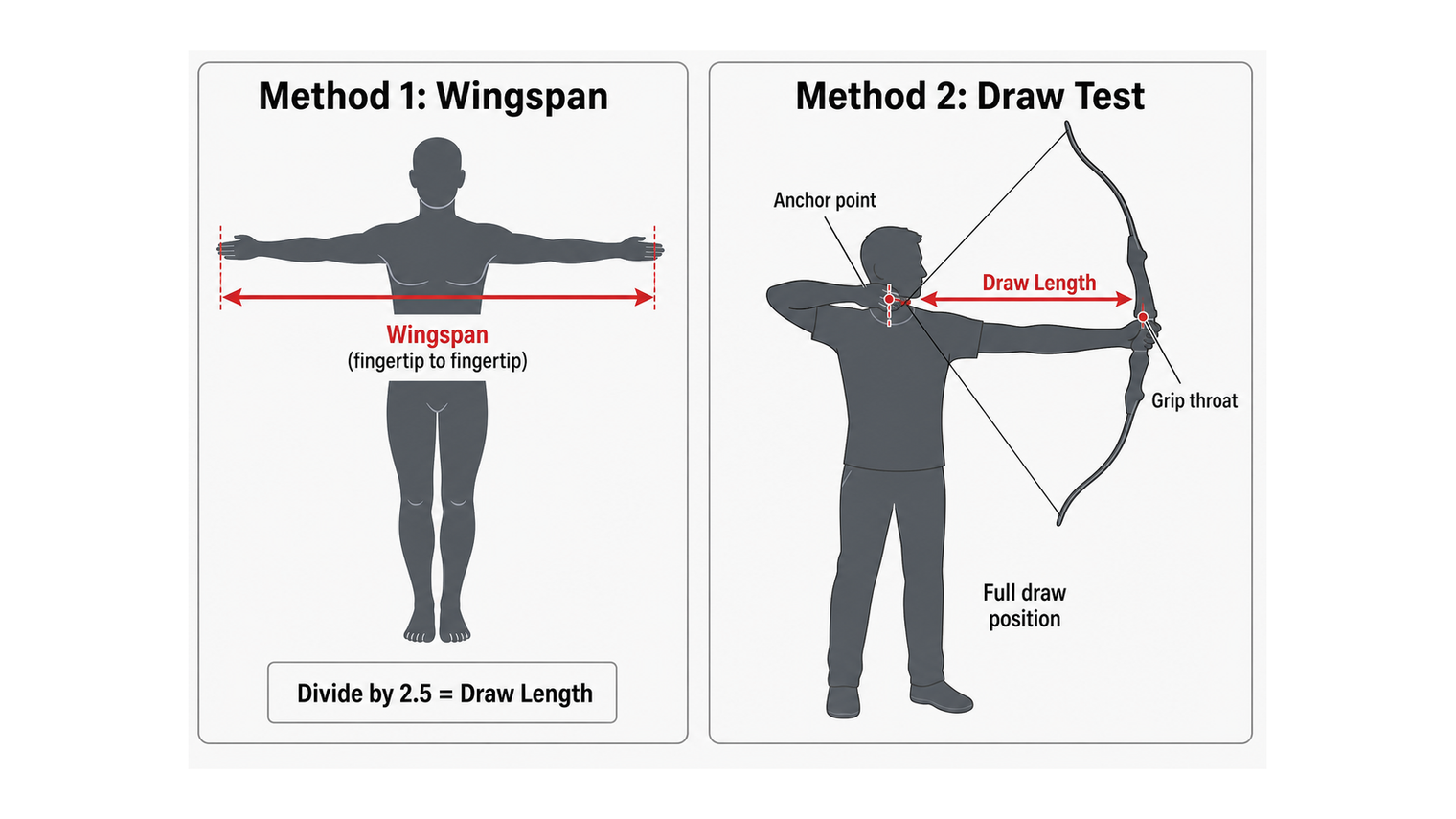
Method 1: The Wingspan Method
This is the most widely used starting point and works well for most people.
- Stand relaxed with your arms stretched straight out to the sides, parallel to the floor.
- Have someone measure the total span from the tip of your middle finger on one hand to the tip of the middle finger on the other.
- Divide that number by 2.5.
For example, a 70-inch wingspan divided by 2.5 gives a draw length of 28 inches. This is a benchmark, not a definitive answer, but it's a reliable starting point before you've ever touched a bow.
Method 2: The Actual Draw Test
This method is more accurate because it accounts for your specific shooting form.
- Use a long, lightweight arrow or a dedicated draw length arrow marked in inches.
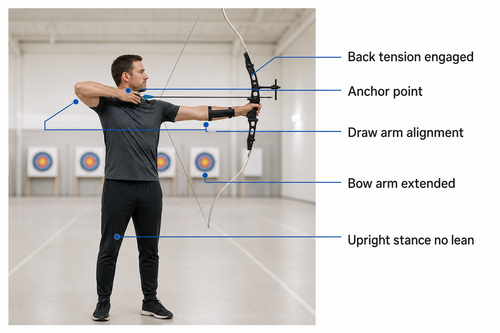
- With a bow in hand (or a bow training aid), draw back using your proper shooting form and anchor at your natural anchor point — typically the corner of the mouth, under the chin, or against the cheekbone depending on your style.
- Have someone note where the arrow crosses the front of the bow's riser or the back of the hand on your bow arm.
- That measurement, read from the mark on the arrow, is your actual draw length.
This method captures real-world draw length under actual shooting conditions. It's especially useful once you've established a consistent anchor point with a coach.
Which Method Should You Trust?
For complete beginners buying their first bow, the wingspan method gives a good enough estimate to start with. Once you've had even a few coaching sessions and your form is taking shape, use the draw test to dial in the number. The two methods rarely disagree by more than half an inch.
Draw Length and Choosing the Right Recurve Bow
Unlike compound bows, most recurve bows don't have an adjustable draw stop, so your draw length directly informs which bow length and limb combination suits you. As a general guide:
- Draw length under 26 inches: a 62–64 inch bow is typically appropriate.
- Draw length of 26–28 inches: a 66–68 inch bow is the most common fit.
- Draw length over 28 inches: a 68–70 inch bow is generally recommended.
These are starting guidelines, not rules. A shorter bow at a longer draw creates a more acute string angle, which can pinch the fingers on a three-finger Mediterranean grip and affect arrow flight. A longer bow is more forgiving in this regard. If you're exploring your options, browsing a wide range of recurve bows with different riser and limb configurations can help you visualise how bow length maps to different shooter profiles.
For archers drawn to classic aesthetics and one-piece designs, a traditional recurve bow may appeal — though the same draw length principles apply regardless of whether the bow is takedown or solid.
How Draw Length Affects Arrow Selection
This is where the practical consequences become very concrete. Your arrow length should typically be your draw length plus one to two inches — enough overhang past the rest to be safe, while keeping the arrow from being unnecessarily heavy.
Arrow spine — the stiffness rating — is calculated using your draw length and draw weight together. A longer draw with the same bow weight effectively increases dynamic arrow spine requirements. If you measure your draw length incorrectly and buy arrows spined for a shorter draw, those arrows will likely fly weak (too flexible), causing fishtailing and poor groupings at distance.
This is why getting draw length right before ordering arrows isn't just good practice — it's the difference between arrows that fly well and arrows that become expensive mistakes.
Common Mistakes Beginners Make When Measuring Draw Length
- Measuring with poor posture. Slouching or raising the shoulders during the wingspan measurement skews the result. Stand naturally against a wall if needed.
- Anchoring inconsistently. If your anchor point changes shot to shot, your draw length will appear to vary. Establish a consistent anchor with coaching before relying on the draw test method.
- Confusing draw length with draw weight. These are different measurements entirely. Draw length is a distance; draw weight is a force (measured in pounds). They interact, but they are not the same thing.
- Assuming the wingspan formula is exact. The divide-by-2.5 rule is a starting estimate. Body proportions vary — some people have longer arms relative to their height, others shorter. Always confirm with a physical draw test.
- Ignoring form changes over time. As your technique improves, your anchor point and therefore your effective draw length may shift slightly. It's worth rechecking after your first few months of consistent training.
- Over-drawing to increase power. Pulling past your natural draw length to gain extra speed strains the shoulder rotator cuff and destroys consistent form. Power in archery comes from technique and appropriate equipment, not forcing a longer draw.
Frequently Asked Questions
How do I measure my draw length at home without a bow?
The wingspan method works well at home. Measure your full arm span fingertip to fingertip, then divide by 2.5. This gives a reasonable estimate you can use when comparing bow specifications online. For a confirmed measurement, visit an archery shop or club where a coach can watch your form during an actual draw.
Does my draw length change if I switch from a finger release to a thumb ring?
Yes, it can. Different release styles and anchor points produce slightly different draw lengths. A thumb ring anchor (common in traditional Asian archery) typically results in a longer draw than a three-finger Mediterranean release anchoring at the corner of the mouth. If you change your release style significantly, remeasure.
What mistakes do beginners make that affect their draw length measurement?
The most common are poor posture during measurement, an inconsistent anchor point, and confusing draw length with draw weight. Another frequent error is assuming the wingspan formula is precise enough to skip the physical draw test — it's a useful estimate, not a substitute for measuring under real shooting conditions.
Will using the wrong draw length actually affect my accuracy?
Yes, noticeably. If you're under-drawing, your form collapses before full extension and your release becomes inconsistent. If you're over-drawing, you're fighting the bow's geometry and likely torquing the string. Both problems show up as horizontal spread in your groups and frustrating inconsistency at distance.
Getting It Right Before You Buy
Measuring your draw length takes less than five minutes, but it shapes every equipment decision that follows — your bow length, arrow spine, arrow length, and even the style of shooting that suits you best. Use the wingspan method to get a working estimate, then confirm it with a physical draw test once you're in front of a bow. If you're ready to start comparing options, exploring the full range of available recurve bows with your draw length in hand gives you the context to choose confidently rather than guessing.