Skip to content
 cust@legendarchery.com
 302 503 5767
 Westfield IN 46074


Stabilizers are one of the most impactful accessories you can add to a recurve bow, yet they're often misunderstood or purchased on guesswork. If you're working through a buyer's guide to recurve stabilizers for the first time, the sheer number of options — different lengths, weights, materials, and mounting systems — can feel overwhelming. This guide cuts through that noise with practical, experience-based advice so you spend money on gear that actually helps your shooting.
What a Stabilizer Actually Does
Before shopping, it helps to understand the mechanics. A stabilizer does three things: it adds mass weight to shift the bow's balance point forward, it reduces torque caused by grip inconsistencies, and it dampens vibration after the shot. These aren't marketing claims — they're physics. A heavier front end resists rotation, which means small grip errors have less influence on where the arrow goes.
Vibration dampening matters too, especially for shooters who spend long sessions on the range. Less felt vibration reduces hand fatigue and keeps your bow feeling clean shot after shot. Most modern stabilizers use internal dampening rods, rubber bushings, or weights with dampener inserts to achieve this.
The Main Components of a Recurve Stabilizer System
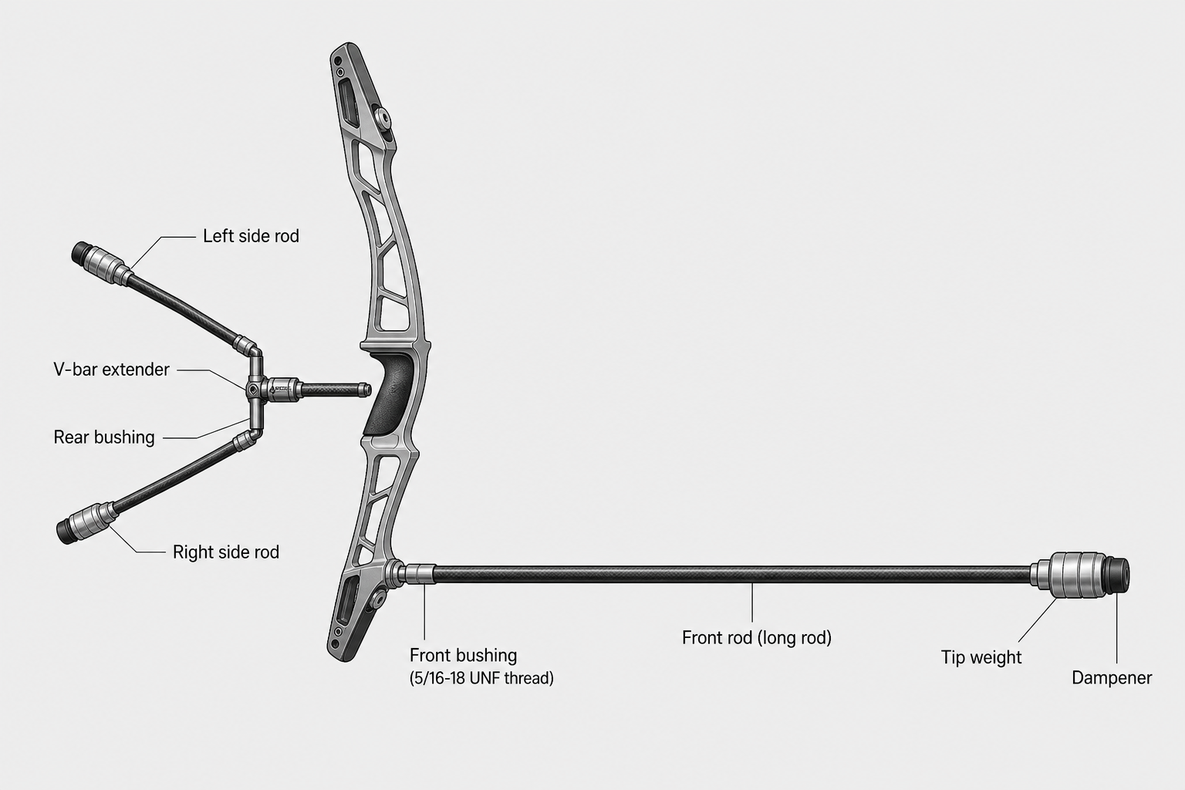
A full stabilizer setup for a recurve bow typically includes more than one rod. Here's how each piece works:
- Front (long rod): The primary stabilizer, mounted at the front of the riser. Usually 26 to 34 inches long. It provides forward balance and is the most influential rod in the system.
- Side rods (V-bars or short rods): Mounted via a V-bar extender at the rear of the riser. They counterbalance the front rod and allow you to fine-tune left-right and up-down tilt.
- Short front stabilizer: Sometimes used instead of a long rod for 3D or field archery, or as a minimalist setup for recurve hunters and barebow shooters.
- Dampeners and end weights: Removable weights at the tip of each rod let you adjust balance without replacing the whole rod. Dampeners absorb residual vibration at the rod tips.
Length and Weight: What to Prioritise
Two variables define most of a stabilizer's effect: length and weight.
Length
Longer front rods create more leverage against torque and push the balance point further forward. Olympic-style target archers typically use front rods in the 28–34 inch range. Shorter rods (18–26 inches) suit archers who need mobility, shoot in tight spaces, or prefer a lighter overall bow weight. If you're just starting out, a mid-length rod in the 27–30 inch range is a sensible starting point.
Weight
More weight amplifies the stabilizing effect but also increases the total draw effort and strain on your bow arm over a session. Heavier isn't always better — it needs to match your physical strength and shooting volume. A common beginner mistake is loading up weights immediately and then struggling with hold consistency because the system is too heavy to manage comfortably.
Start lighter, shoot a full practice session, and only add weight once you've confirmed the balance feels natural and your bow arm stays steady at full draw.
Materials: Carbon vs Aluminium
The rod material affects both weight and vibration characteristics.
- Aluminium: More affordable, durable, and widely available. Slightly heavier than carbon, which can actually be useful for beginners building a balanced setup without buying extra tip weights.
- Carbon fibre: Lighter and stiffer, which means more efficient vibration transfer to the dampeners and less dead weight in the rod itself. Preferred at competitive level. Higher cost is the trade-off.
For most recreational and club-level archers, aluminium or aluminium-carbon hybrid rods offer excellent performance at a sensible price point.
Setting Up Your Stabilizer System
Once you have your rods, the setup process matters as much as the equipment itself. Follow this process:
- Start with the front rod only. Shoot a session, note how the bow feels at full draw and at the shot.
- Add side rods gradually. Side rods affect how the bow tilts at rest and through the shot. Adjust the angle using the V-bar mount — most have an adjustable pivot point.
- Balance check: Hold the bow loosely by the grip with an open hand. The bow should sit roughly upright or tilt slightly forward. If it falls hard to one side, your side rods need adjustment.
- Fine-tune with tip weights. Add or remove small weights at the rod tips rather than replacing rods when making minor adjustments.
Most experienced coaches recommend keeping a notebook during setup. Track what you change, how many grams you added, and what effect it had. Stabilizer tuning is iterative — small adjustments compound over time into a well-dialled system.
Choosing a Setup by Shooting Discipline
Your discipline should heavily influence what you buy:
- Target archery (Olympic-style): Full long rod and V-bar side rod system. Prioritise consistency and adjustability. Carbon rods worth the investment at this level.
- Field and 3D archery: Often a shorter front rod or single-rod setup to navigate terrain and reduce snagging. Balance portability with performance.
- Barebow recurve: Rules often restrict or prohibit certain stabilizer configurations. Check your governing body's equipment rules before purchasing.
- Traditional and instinctive shooting: Most traditional recurve bow styles are shot without stabilizers at all, or with a minimal short rod. Know your discipline before buying.
Common Buying Mistakes to Avoid
- Buying the most expensive system first. High-end stabilizers are tuned for archers who already understand their preferences. Beginners benefit more from a mid-range adjustable setup while they develop their form.
- Ignoring thread compatibility. Most recurve risers use a standard 5/16–18 UNF thread, but always confirm before purchasing. Adapters exist but add complexity.
- Skipping the V-bar extender. Side rods used without an extender sit too close to the riser, limiting adjustment range and defeating much of their purpose.
- Matching stabilizers to a bow that isn't properly tuned. A stabilizer won't fix poor arrow spine, incorrect brace height, or a badly fitted arrow rest. Sort the fundamentals first.
- Buying for looks rather than function. Colour-matching your stabilizer to your riser is fine once the system works — don't let aesthetics drive the initial purchase decision.
Budget Expectations
A functional entry-level stabilizer system — front rod, V-bar mount, and two short side rods — can be put together for a modest budget. Mid-range systems with carbon rods and adjustable dampeners sit in a higher bracket and suit archers shooting regularly at club or regional level. Full competition-grade carbon systems with machined components are a significant investment and are best considered once you're committed to the sport at a serious level.
If you're still building out your whole recurve setup, browse the full range of equipment available for recurve archers to see what fits your current stage.
Frequently Asked Questions
Do I need a stabilizer as a complete beginner?
Not immediately. Focus first on developing consistent form — anchor point, grip, release, and follow-through. Once your technique is repeatable, a stabilizer will reinforce good habits. Introduced too early, it can mask underlying form issues rather than correct them.
Can I use any stabilizer on any recurve bow?
Most recurve risers share a standard front stabilizer thread, but not all have side rod bushings pre-fitted. Check your riser's specifications. Some entry-level bows have limited or no mounting points for a V-bar system.
How do I know if my stabilizer setup is balanced correctly?
Hold the bow loosely at the grip and let it settle naturally. A well-balanced setup will sit slightly forward and upright. If it tilts sharply to one side, adjust your side rod angle or add a small counterweight to the opposing rod tip.
Is a longer stabilizer always better for accuracy?
Not necessarily. A longer rod increases the lever arm against torque, which helps — but only if you have the physical strength and technique to hold it steadily. An overly long or heavy system you can't control confidently will hurt your scores, not help them.
Final Thoughts
A stabilizer system is one of the few pieces of archery equipment that genuinely compounds with your skill development — the better your form becomes, the more a well-tuned setup rewards you. Start practical, build incrementally, and prioritise adjustability over prestige in the early stages. The right system for you is the one that matches your current level, your discipline, and your bow.