Switching between fixed blade and mechanical broadheads on a crossbow often means your point of impact shifts — sometimes dramatically. Understanding why that happens isn't just academic; it directly affects how you tune your setup and how confident you can be at distance. This guide breaks down the aerodynamic and mechanical reasons these two head styles behave differently in flight.
Why Broadhead Design Affects Flight So Strongly
A field point is a simple, symmetrical projectile. A broadhead is not. The moment you add cutting surfaces that extend beyond the shaft diameter, you introduce aerodynamic forces that a bare shaft or field point never encounters. The design of those cutting surfaces — whether they are always exposed or only open on impact — determines how much those forces affect your bolt's trajectory.
Crossbows compound this challenge compared to vertical bows. Crossbow bolts are shorter and stiffer than most compound arrows, which means they have less dynamic flex to self-correct in flight. Any asymmetry in a broadhead's blade alignment or surface area has a more immediate and pronounced effect on where the bolt goes.
How Fixed Blade Broadheads Behave in Flight
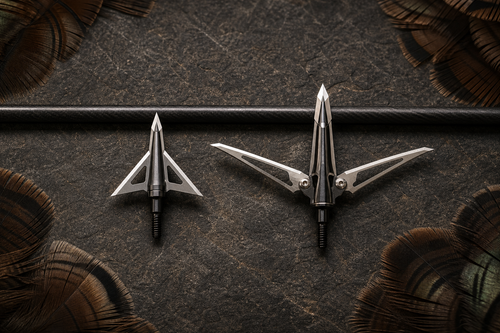
A fixed blade broadhead exposes its full cutting surface from the moment it leaves the rail. Those blades act like small wings or rudders, and they respond to airflow constantly throughout the shot. This creates two primary challenges.
Surface Area and Planing
The exposed blades increase the total surface area of the projectile significantly. If those blades are not perfectly aligned with the bolt's vanes — a condition called indexing — the broadhead will catch air unevenly. That uneven lift, known as planing, pushes the bolt off its intended path. The effect grows with distance and becomes especially noticeable beyond 40 yards.
Sensitivity to Wind and Crosswinds
Because fixed blades present continuous aerodynamic surface area, they are more sensitive to crosswinds than field points or mechanicals with closed profiles. Even a light breeze that you might ignore with field points can shift a fixed blade's impact point by several inches at hunting distances.
The Upside: Consistency Once Tuned
When a fixed blade head is properly tuned and correctly indexed to the bolt's vanes, its flight can be very predictable. There are no moving parts to malfunction mid-flight, and the aerodynamic forces acting on a well-tuned head are consistent from shot to shot. Many experienced crossbow hunters favor fixed blades precisely because that consistency is repeatable once the setup work is done.
How Mechanical Broadheads Behave in Flight
A mechanical broadhead — sometimes called an expandable — keeps its blades folded or tucked against the ferrule during flight, then deploys them on impact through kinetic energy or a cam-and-blade mechanism. This design philosophy prioritizes aerodynamic similarity to a field point.
Closed Profile and Reduced Drag
Because the blades are retracted during flight, the frontal profile of a mechanical head is close to that of a standard field point. This dramatically reduces the aerodynamic disruption described above. As a result, mechanicals typically fly closer to your field point zero without requiring significant re-tuning. For hunters or shooters who have dialed in a field point load and don't want to re-establish their zero from scratch, this is a meaningful practical advantage.
Deployment Reliability and Energy Cost
The trade-off is mechanical complexity. The blades must deploy reliably at the moment of impact. Deployment requires kinetic energy drawn from the bolt itself, which means some energy that would otherwise contribute to penetration is redirected into opening the head. At the high velocities most crossbows generate, this energy cost is relatively small, but it is a real consideration when hunting larger, tougher game where deep penetration matters.
Blade Retention at High Velocity
Crossbows shoot at higher velocities than most vertical bows, and that creates a specific concern with mechanicals: pre-deployment. If a blade retention system — whether rubber O-rings, collars, or other mechanisms — is not robust enough for the bolt's speed and the vibration of the shot, blades can partially open in flight. Even slight pre-deployment defeats the aerodynamic advantage of the closed profile and introduces the same planing issues that poorly indexed fixed blades cause. Always confirm that any mechanical head you choose is rated for crossbow velocities, and keep up with the inspection and O-ring checks in our mechanical broadhead safety and maintenance basics guide so blade retention doesn't degrade over time.
Front-of-Center and Its Role in Broadhead Stability
One concept that applies to both head styles is front-of-center (FOC) balance. FOC describes how much of the bolt's total weight is concentrated toward the front. A higher FOC generally improves flight stability because the heavier front end reduces the tendency to fishtail or plane. When shooters struggle to get fixed blade heads to fly cleanly, adding a heavier broadhead or heavier insert to push FOC forward is often part of the solution. For mechanicals, adequate FOC still matters, but the closed blade profile makes the bolt less sensitive to slight FOC imbalances.
Understanding how crossbow bolt construction — spine, weight, and balance point — interacts with broadhead design is essential before you commit to a broadhead style. The bolt and the head work as a system, not as independent variables.
Practical Guidance for Tuning Each Style
- Always start with a bare shaft or field point zero. Establish your baseline accuracy before introducing any broadhead. This isolates whether flight problems come from your bow or the head itself.
- Index fixed blade heads carefully. The blade should align with the bolt's vanes so that the blade edges split the airflow the vanes are already managing. Many hunters use a broadhead alignment tool to confirm this before every shot.
- Test mechanicals at your crossbow's actual velocity. Shoot a few at close range into a suitable target to confirm the blades are deploying fully and symmetrically before trusting them at distance.
- Shoot broadheads at distance before the season. Even mechanicals that fly like field points at 20 yards may show small but meaningful point-of-impact differences at 50 or 60 yards. Confirm your zero at the distances you intend to shoot.
- Keep blades sharp and undamaged. A bent or nicked blade on a fixed head creates asymmetric drag. A damaged blade retention system on a mechanical creates unpredictable deployment. Inspect every head before use.
- Consider vane size. Larger vanes provide more steering authority and can partially compensate for the aerodynamic disruption that fixed blades introduce. If you are determined to shoot large fixed blades, slightly larger or higher-profile vanes often improve consistency.
Common Mistakes Shooters Make
- Assuming mechanicals need no tuning. While mechanicals are more forgiving than fixed blades, a poorly tuned crossbow will still produce inconsistent groups. Mechanicals reduce the tuning burden; they do not eliminate it.
- Ignoring blade indexing with fixed heads. This is the single most common reason hunters find that their broadheads shoot differently from their field points. Random blade-to-vane alignment produces random results.
- Using mechanicals not rated for crossbow speeds. Crossbow velocities often exceed what mechanicals designed for vertical bows are built to handle. Blade retention failures at high velocity are a real risk.
- Not re-zeroing after switching head styles. Even a small point-of-impact shift that seems insignificant at 20 yards becomes a miss or a wounding shot at 50 yards. Always re-verify your zero when changing broadhead types.
- Blaming the broadhead before checking the crossbow. Timing issues, loose components, and limb inconsistencies all affect bolt flight. Rule out equipment problems before concluding that your broadhead choice is the issue.
Frequently Asked Questions
Why do my fixed blade broadheads hit in a completely different spot than my field points?
This almost always comes down to the aerodynamic drag and planing that exposed blades create. Field points have no extended cutting surfaces, so they cut through air symmetrically. Fixed blades add surface area that responds to airflow, and if the blades aren't indexed to align with your vanes, that response is uneven. Proper indexing, adequate vane size, and sometimes adjusting your FOC can close that gap significantly.
Are mechanical broadheads actually more accurate than fixed blades for crossbows?
Mechanicals tend to be easier to get flying close to a field point zero because their closed profile during flight reduces aerodynamic disruption. That doesn't mean they are inherently more accurate — a well-tuned fixed blade setup can be extremely consistent. The practical difference is that mechanicals require less tuning effort to achieve field-point-like flight, while fixed blades reward careful setup work with equally reliable performance.
Can a beginner crossbow shooter get fixed blade broadheads to fly well?
Yes, but it requires patience with the tuning process. The key steps — indexing blades to vanes, verifying FOC, and shooting at distance to confirm zero — are learnable skills. Beginners who skip those steps often conclude that fixed blades are inaccurate, when the real issue is setup. Starting with a mechanicals during the learning curve is a reasonable approach, then transitioning to fixed blades once you understand your crossbow's tuning baseline.
Does crossbow speed make a bigger difference with one head style over the other?
Speed affects both styles but in different ways. Higher velocity reduces the time a fixed blade spends in flight, which slightly reduces the total drift that planing can cause — but it also means any tuning errors happen faster and with less time for the vanes to self-correct. For mechanicals, higher velocity is generally positive for deployment reliability, but it demands better blade retention systems to prevent pre-opening during the shot. Always match your head choice to what the manufacturer specifies for the velocity your crossbow produces.
Putting It All Together
The core difference between how these two broadhead styles fly comes down to one principle: exposed surface area during flight creates aerodynamic forces that must be managed through tuning, while a closed profile minimizes those forces at the cost of mechanical complexity. Neither design is universally superior — each has a logical place depending on your priorities, your crossbow's specifications, and how much tuning work you are willing to invest. The shooter who understands these principles will get better results from either style than one who simply switches heads and hopes for the best.
Keeping your crossbow and its accessories protected and organized between sessions is part of consistent performance. If you are looking for a purpose-built storage solution, the Heron Crossbow Case offers padded interior protection and additional pockets for bolts and accessories, making it easier to keep your gear in range-ready condition.