Skip to content
 cust@legendarchery.com
 302 503 5767
 Westfield IN 46074


Picking up a bow for the first time is genuinely exciting. But a few foundational pieces of knowledge can be the difference between building good habits from day one and spending months unlearning bad ones. Here are the 10 things you should know before shooting your first arrow — covering safety, equipment, and technique in plain language.
1. Safety Is Non-Negotiable
Archery is a remarkably safe sport when the rules are followed, but an arrow carries serious energy. Before anything else, internalize the four range safety basics:
- Never point a bow — loaded or empty — at anything you wouldn't want to hit.
- Only nock an arrow when you are on the shooting line and ready to shoot.
- Know what is beyond your target, not just in front of it.
- Only retrieve arrows when all archers have finished shooting and the range is declared clear.
These are not suggestions. Treat them as hard rules every single session.
[product-tabs]
2. Choose the Right Draw Weight
New archers consistently overestimate the draw weight they can handle comfortably. A bow that is too heavy to draw smoothly causes poor form, muscle fatigue, and frustration. A good starting point for most adult beginners is between 20 and 30 pounds for recurve bows, or 40 to 50 pounds for compound bows with generous let-off. Children and younger teens should start even lower.
The goal at the beginning is consistency, not power. You can always move up in draw weight once your form is solid.
3. Dominant Eye Matters More Than Dominant Hand
Most people assume they should shoot the same side as their dominant hand. In reality, your dominant eye determines which direction you should shoot. If you are right-eye dominant, you will naturally shoot a right-handed bow. If your dominant eye and hand are on opposite sides — called cross-dominance — you may actually shoot more accurately shooting from your non-dominant hand side. Test your eye dominance before you buy a bow.
4. Stance and Posture Are the Foundation
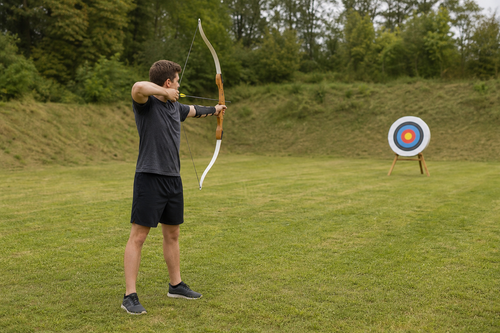
Every shot begins from the ground up. A stable, repeatable stance makes everything else easier:
- Square stance: Both feet parallel to the shooting line, shoulder-width apart. Good for beginners learning the basics.
- Open stance: Front foot slightly angled toward the target. Reduces string clearance issues for some body types.
Keep your shoulders relaxed and level. Tension in the shoulders is one of the most common causes of inconsistent shots for new archers.
5. Protect Your Fingers and Forearm
Two pieces of protective gear are essential from your very first session. A finger tab or shooting glove protects the three fingers you use to draw the string, preventing blisters and allowing a cleaner release. An arm guard protects your bow arm from string slap — a surprisingly sharp sting that can occur when the bowstring contacts your inner forearm on release.
Neither item is optional for a beginner. Comfortable, well-fitted shooting gloves make a real difference in how long you can comfortably practice.
6. Understand the Anchor Point
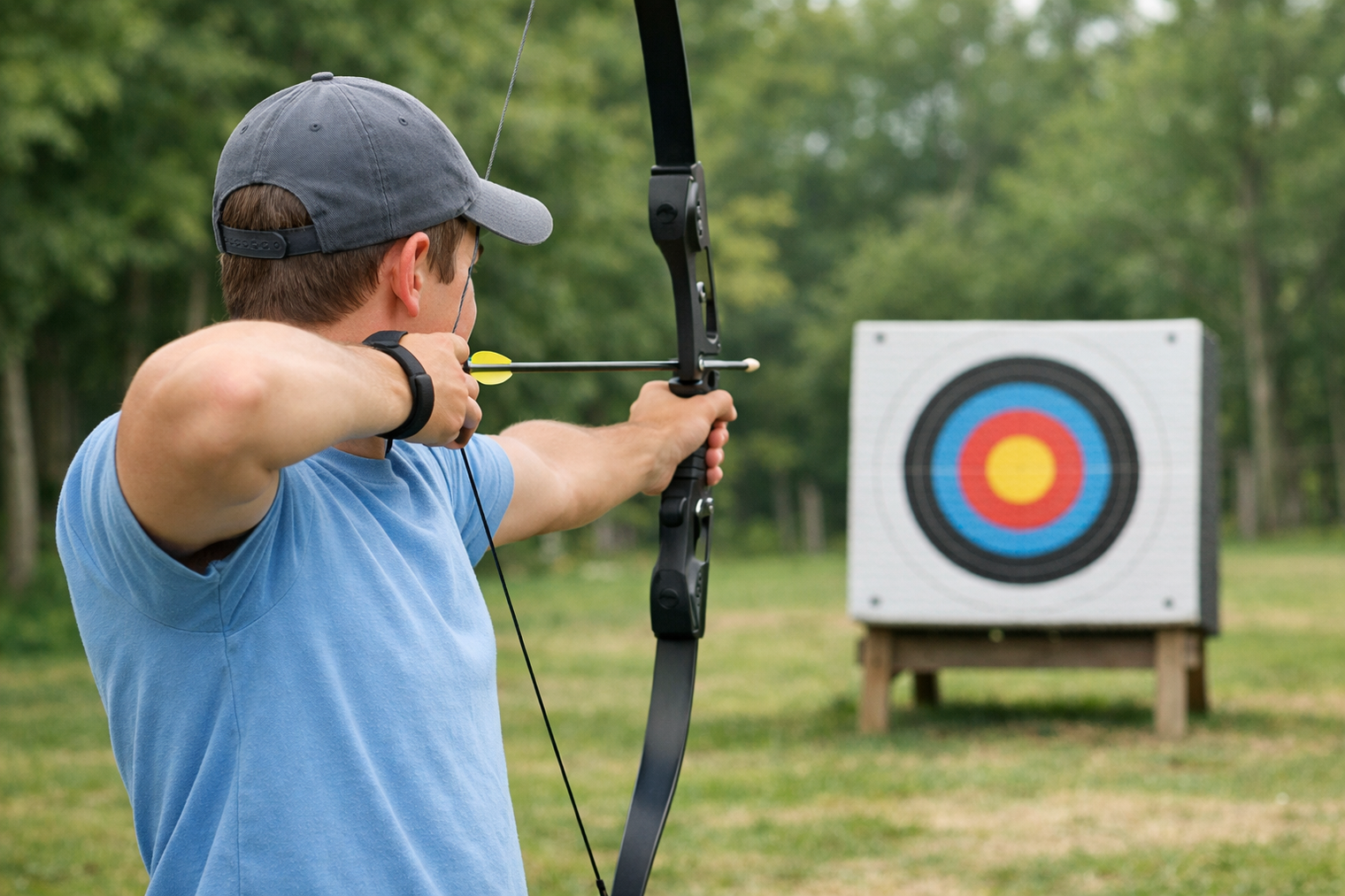
An anchor point is the consistent position where your draw hand meets your face at full draw. It might be the corner of your mouth, your cheekbone, or your chin — the specific location matters less than the fact that it is exactly the same on every single shot. Without a consistent anchor point, you have no reliable reference and your arrow will land somewhere different each time.
Pick one anchor point, practice it deliberately, and resist the urge to change it just because one shot felt different.
7. Learn to Aim — and Know When Not to Think About It
Beginners tend to focus intensely on aiming and then tighten up at the moment of release. Effective aiming is actually about building a process: draw, anchor, settle the sight or point-of-aim onto the target, and release smoothly without interrupting the motion. Over-thinking the shot during execution is a very common beginner trap. Let the process carry the shot.
For those shooting instinctive or barebow style, aiming is more intuitive and develops through repetition rather than a mechanical sight system — but the principle of a smooth, uninterrupted release still applies.
8. Arrow Selection Is More Important Than Most Beginners Realize
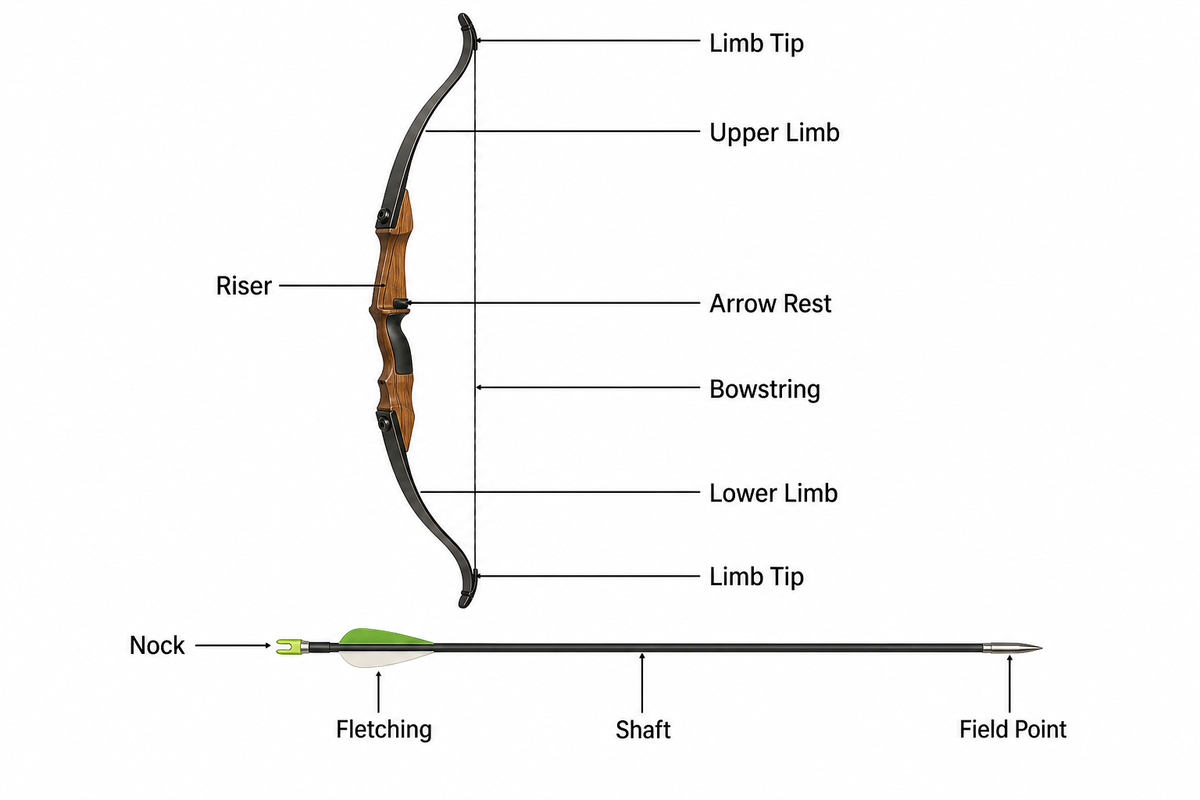
Arrows need to be matched to your bow's draw weight and your draw length. An arrow that is too light for your setup can be dangerous; one that is too heavy will simply underperform. Arrow length should be at least one inch beyond the arrow rest when the bow is at full draw — cutting arrows too short is a safety risk.
Spine stiffness, measured as a number, describes how much an arrow flexes when shot. A spine that does not match your draw weight will cause the arrow to fly erratically regardless of how good your form is. When buying arrows as a beginner, ask a knowledgeable retailer or instructor to help you select the right spine.
9. Your Equipment Needs a Home
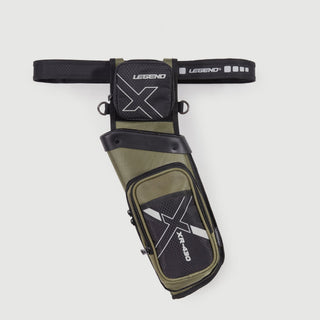
Loose arrows rolling around in a bag get damaged quickly and become difficult to organize. Using a proper arrow quiver keeps your arrows accessible, protected, and safely pointed in one direction. Hip quivers are popular for target archery; field quivers suit outdoor and 3D shooting. Getting into the habit of using one from the start also reinforces safe arrow handling.
If you are transporting arrows to a range or storing them at home, a hard case or arrow tube adds another layer of protection for your investment.
10. Lessons Are Worth More Than Better Gear
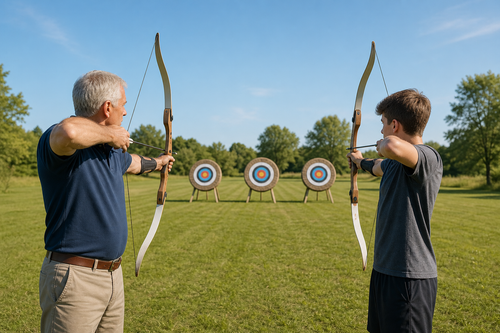
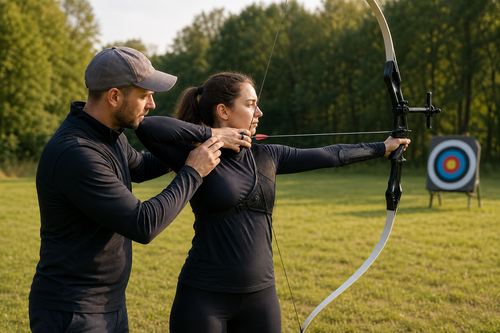
New archers often prioritize upgrading equipment before mastering fundamentals. A single lesson with a qualified instructor will do more for your accuracy than a new sight, a better stabilizer, or a more expensive bow. Certified instructors spot form errors that are nearly impossible to self-diagnose, and they prevent small habits from hardening into problems that take years to correct.
Most archery clubs and ranges offer beginner group sessions at a very reasonable cost. Take at least two or three before investing heavily in equipment.
Common Beginner Mistakes to Avoid
- Punching the trigger or anticipating the shot: Jerking the release before the sight picture is right causes low and inconsistent shots.
- Gripping the bow too tightly: A death grip torques the bow on release. Hold the grip with relaxed, open fingers.
- Drawing with just the arm: The back muscles — specifically the rhomboids and rear deltoids — should do the work of drawing, not the bicep.
- Shooting too far too soon: Start at short distances (10 to 15 yards) until your groupings are tight, then move back.
- Skipping the warm-up: Cold muscles and cold form produce bad shots and increase the chance of a strain.
- Ignoring follow-through: Your bow hand should remain up and your draw hand should move back naturally after the release. Dropping the bow arm early pulls shots low.
If You Plan to Shoot 3D Targets
3D foam targets introduce a great element of realism to practice and are common at clubs and outdoor ranges. Before you invest, it is worth understanding what to look for — this guide on buying a 3D foam target covers the key considerations so you choose one that holds up and suits your draw weight.
Frequently Asked Questions
Do I need to take lessons before I shoot my first arrow?
Strictly speaking, no — but lessons make everything faster and safer. Even a single beginner session with a certified instructor establishes correct form before bad habits have time to set in. It is significantly easier to learn something right the first time than to fix it later.
What draw weight should a complete beginner start with?
For recurve bows, most adult beginners do well in the 20 to 30 pound range. For compound bows with let-off, 40 to 50 pounds is common. The key is being able to draw smoothly and hold at full draw without shaking or straining. If you cannot do that, the weight is too high.
How do I know if my arrows are the right spine for my bow?
Arrow spine charts provided by arrow manufacturers give starting recommendations based on draw weight and arrow length. However, the most reliable method is to ask an experienced archer or a pro shop to help you spine-match your arrows to your specific setup before you buy.
How quickly can a beginner expect to improve in archery?
With consistent practice — two or three sessions per week — most beginners see meaningful improvement in grouping and consistency within four to eight weeks. Progress accelerates sharply when fundamentals like anchor point, grip, and back tension are established early and practiced correctly.
Getting Started With Confidence
Archery rewards patience and process over raw enthusiasm. The archers who progress fastest are not the ones who shot the most arrows in the first month — they are the ones who built reliable habits from the very beginning. Start with the fundamentals here, find a local club or qualified coach, and let your equipment grow with your skill level rather than ahead of it.