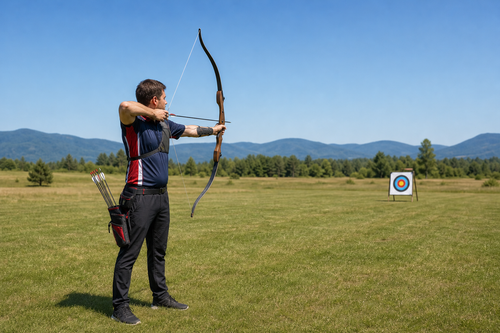
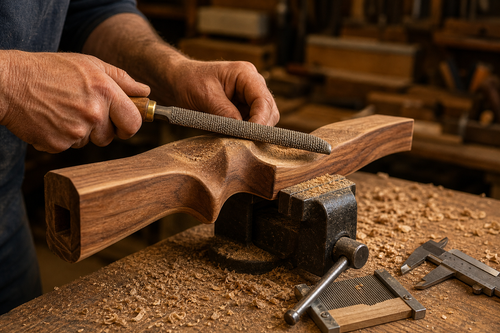
The recurve bow's story does not have one single invention date — it is a chain of re-inventions stretching from Bronze Age archers to the modern Olympic range. This guide walks that chain in order: the ancient and medieval timeline in brief, then the part of the story that gets skipped most often — how the recurve went from a battlefield weapon to a standardized Olympic discipline, and how its materials changed along the way. For the deep dive into the recurve's ancient Greek and Roman history, see Legend's glossary guide to the Greek recurve bow. For the etymology and the shape itself, see why it's called a recurve bow.
The Ancient and Medieval Timeline, in Brief
Composite recurve bows — limbs curved away from the archer, built from layered wood, horn and sinew — were already in widespread use across Central Asia, the Near East and Egypt by the second millennium BCE. The design spread independently across dozens of cultures over the following centuries, from Greek and Roman archers to the steppe empires and East Asia, and remained the dominant powerful-but-compact bow design through the medieval period in regions with dry climates suited to composite construction. That ancient and medieval chapter is covered in full, culture by culture, on the Greek recurve bow glossary page — this guide picks up where that one leaves off.
From Battlefield Obsolescence to Olympic Standard
The recurve's military relevance faded gradually as firearms took over from the 17th through 19th centuries, and archery re-emerged in that period as an organized sport rather than a weapon of war. Archery clubs and national associations formed across Britain, the United States and continental Europe through the 1800s, each with its own target distances, scoring and equipment rules.
That lack of a shared rulebook is why archery's Olympic history is intermittent rather than continuous. It appeared at the Games in 1900, 1904, 1908 and 1920 — but each edition used different, often nation-specific rules, and archery was dropped from the Olympic program afterward for exactly that reason. In 1931, national archery federations founded the International Archery Federation (now World Archery) to create one standardized international ruleset. It took until the 1972 Munich Games for that standardization to earn archery a permanent place back on the Olympic program, built around the recurve bow and the metric target round still used today.
The Materials Timeline: From Horn and Sinew to Carbon Fiber
The recurve's shape barely changed across that long gap, but what it was built from did. Horn-and-sinew composite construction, which required months of careful lamination and seasoning, gave way through the early-to-mid 20th century to fiberglass-laminated limbs pioneered by American bowmakers — a material that was more consistent, less climate-sensitive and far faster to produce. By the 1960s, three-piece "takedown" recurves with a separate riser and detachable limbs had become the competitive standard, replacing one-piece bows and making limb swaps and travel dramatically easier. Today's Olympic-style recurve limbs are typically built around a carbon or foam core faced with thin wood or carbon laminate, paired with a machined aluminum or carbon riser — a direct, if materially unrecognizable, descendant of the horn-and-sinew bows that started this story.
Common Misconceptions About Recurve Bow History
Even experienced archers sometimes carry inaccurate ideas about how the recurve bow developed. Here are a few worth correcting:
- Thinking the recurve is a European invention: The recurve shape originated in Asia and the Near East. European archery traditions leaned heavily toward the longbow, while Central and East Asian cultures pioneered recurve development.
- Assuming Olympic archery has run continuously since 1900: It appeared in four early Games, then was absent for 52 years until standardized international rules brought it back in 1972.
- Conflating recurve with compound: The compound bow was invented in 1966 by Holless Wilbur Allen in the United States — a modern innovation that uses a cam-and-cable system fundamentally different from the recurve's limb-tip geometry, and unrelated to the recurve's own history.
- Believing all ancient bows were recurves: Many cultures used simple self-bows (the longbow being the most famous example). The recurve design was a specific technological solution, not a universal default.
Frequently Asked Questions
Why was archery dropped from the Olympics after 1920?
Not because of declining interest, but because no two countries were shooting by the same rules — target distances, scoring and equipment all varied by nation. Without a standardized ruleset, the International Olympic Committee had no consistent way to run the competition, and archery was left off the program.
When did archery return to the Olympics for good?
In 1972, at the Munich Games, after the International Archery Federation (founded in 1931) had spent decades building a single international ruleset that every competing nation could shoot under. It has been on every Olympic program since.
When did recurve bows switch from horn and sinew to fiberglass?
The shift happened gradually in the early-to-mid 20th century. Fiberglass lamination offered more consistent performance than horn and sinew and did not require the months of climate-sensitive seasoning that composite construction demanded, which is why it became the standard material for competitive limbs well before the Olympic return in 1972.
Is the Olympic recurve bow today the same design the ancient Egyptians and Scythians used?
The core geometry — limb tips that curve away from the archer when unstrung — is the same principle. Everything else has changed: modern limbs use carbon or foam cores instead of horn and sinew, risers are machined metal or carbon instead of wood, and the bow separates into pieces for transport, which no ancient recurve could do.
The Bigger Picture
"When was the recurve bow invented" does not really have one answer — it has at least three: the Bronze Age, when the curved-limb principle first appeared; 1931, when a standardized ruleset made international competition possible; and 1972, when that standardization finally earned the recurve a permanent Olympic home. For archers today, the modern Olympic-style recurve bow carries all three of those moments in its design, even though almost nothing about its materials would be recognizable to the archers who shaped the first curved limb thousands of years ago.