Skip to content
 cust@legendarchery.com
 302 503 5767
 Westfield IN 46074


Archery is not one sport — it is a family of disciplines, each with its own bow, target format, ruleset, and physical demands. Whether you are picking up a bow for the first time or thinking about competing, understanding the different types of archery will help you choose a direction that suits your goals, budget, and lifestyle.
Why the Discipline You Choose Shapes Everything
The bow you buy, the arrows you shoot, the distances you practice at, and the community you join all flow from which archery format you pursue. A recurve archer training for club competition needs completely different equipment from someone who hunts whitetail deer or shoots 3D foam animals through the woods. Getting clear on the discipline first prevents costly equipment mismatches down the line.
It also affects how quickly you progress. Barebow and traditional styles demand a high degree of instinctive skill from early on. Olympic recurve builds excellent form fundamentals. Compound archery uses mechanical advantages that can make tight groups more accessible to newer shooters. None of these is the "best" — they are simply different tools designed for different experiences.
The Core Types of Archery Explained
Olympic Recurve
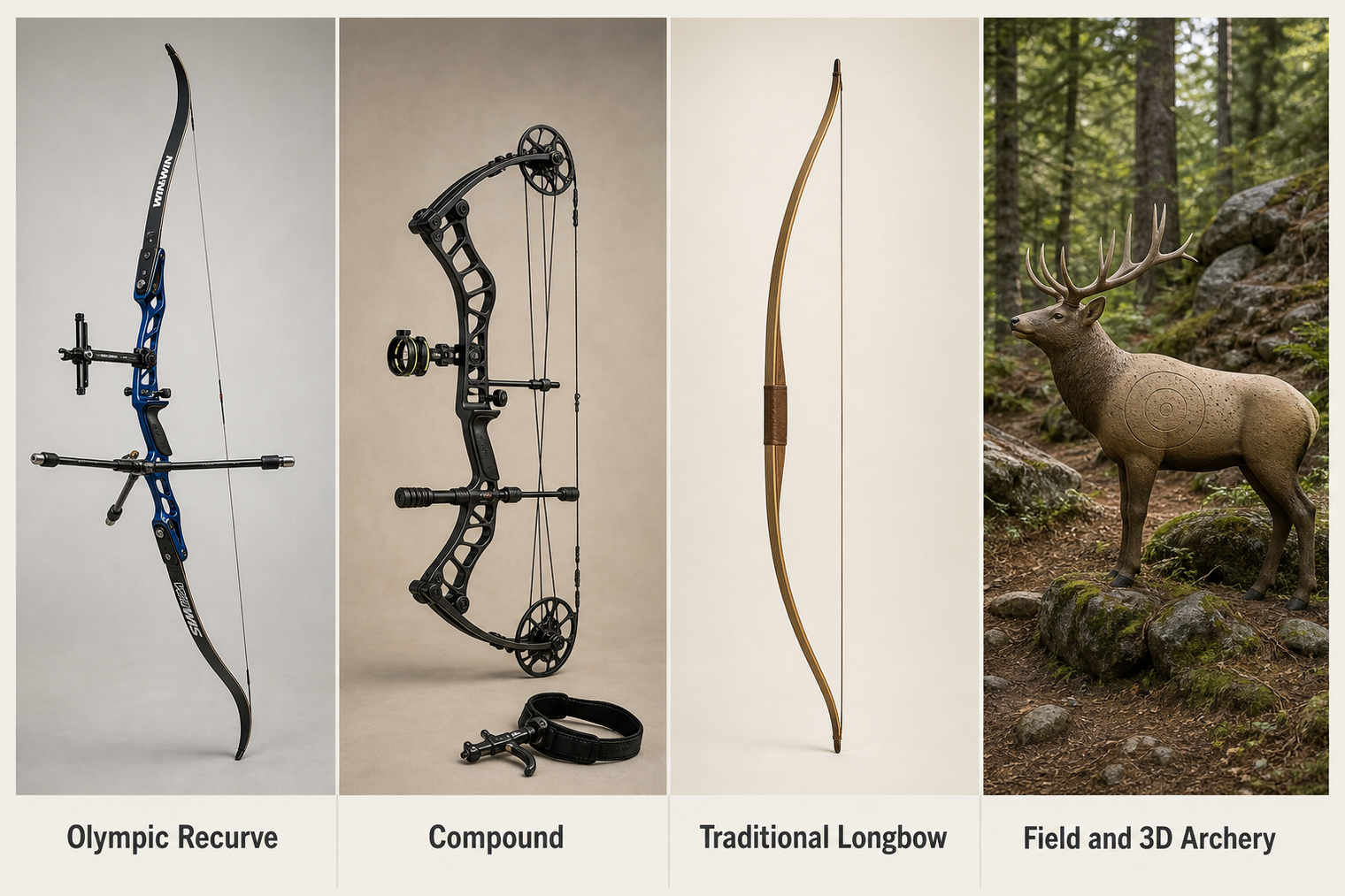
This is the format contested at the Olympic Games and the one most beginners encounter at clubs worldwide. Archers use a recurve bow with a sight, stabilisers, and a clicker, shooting at standardised round targets at distances ranging from 18 metres indoors to 70 metres outdoors at the elite level. The discipline rewards disciplined form, mental consistency, and repeatable technique. It is also one of the best formats for structured coaching and measurable improvement through scoring rounds.
Barebow Recurve
Barebow uses the same recurve limb and riser setup, but strips away the sight and most accessories. Archers aim using string walking or face walking techniques, relying on developed feel and reference points rather than optics. It sits between traditional and Olympic shooting in terms of technical approach, and it has a growing competitive scene through World Archery and national federations.
Compound Archery
Compound bows use a cam-and-cable system to reduce the holding weight at full draw, letting shooters hold aim longer without fatigue. At competitive level, compound archers typically use a magnified or dot sight and a mechanical release aid. Indoor compound shooting at 18 metres is extremely precise — top-level groups can be covered by a coin. Compound is also dominant in bowhunting, where the flat trajectory and power at short hunting distances make it highly effective.
Traditional Archery and Longbow
Traditional archery covers longbows and simple one-piece recurves shot without sights, stabilisers, or releases. The archer relies on instinctive or gap aiming — a felt sense of distance and arrow flight developed through thousands of repetitions. Longbow shooting, particularly in the English and Welsh tradition, has a historical and cultural dimension that many archers find deeply rewarding. Equipment is minimal, but the skill ceiling is high.
Field Archery
Field archery takes place over a course of typically 24 to 28 targets laid out across natural terrain — woodland, hillside, or uneven ground. Archers move from peg to peg and shoot at paper targets at unmarked or marked distances, often through trees or on steep angles. It rewards reading terrain, judging distance, and adapting form to awkward shooting positions. Both recurve and compound divisions compete at field events, and it is popular with those who find flat-range target shooting repetitive.
3D Archery
Similar to field archery in its outdoor, roving format, 3D archery uses foam animal replicas instead of paper faces. Scoring zones represent vital areas on the animal, and accuracy at variable distances matters more than raw power. It is particularly popular with bowhunters who want realistic practice, and the format has a strong social, casual side. Many archers start 3D shooting as weekend recreation before moving into structured competition.
Bowhunting
In regions where it is legally permitted, bowhunting is its own discipline with its own ethics, gear selection, and seasonal rhythms. Hunters typically use compound bows or traditional equipment, practise at realistic hunting ranges, and focus on shot placement under physical and emotional pressure. Equipment choices — broadheads, release aids, arrow weight — carry real-world consequences, which makes skill development a serious commitment. If you are exploring gear for this discipline, browsing outdoor archery supplies is a practical starting point for what you will need in the field.
Clout, Flight, and Specialist Formats
Beyond the mainstream disciplines, archery includes several specialist formats worth knowing. Clout archery involves shooting arrows at extreme high angles toward a ground-level flag target at distances over 100 metres — closer to artillery than target shooting in feel. Flight archery is purely about distance: the goal is to shoot an arrow as far as physically possible. Both formats have dedicated followings and their own equipment requirements.
Practical Guidance for Choosing Your Path
If you are new to the sport, the following framework helps narrow things down quickly:
- Access to a club or range: Olympic recurve and compound target archery are easiest to learn in a structured club environment with coaching. If a local club exists, start there regardless of format.
- Indoor vs outdoor preference: Target archery runs strong indoor winter leagues. Field and 3D are inherently outdoor pursuits. Consider your local climate and what you will actually commit to year-round.
- Budget: A beginner recurve setup is typically the most affordable entry point. Compound setups require a higher initial investment but offer significant performance-per-effort benefits.
- Hunting intent: If hunting is the goal, start with compound or traditional bowhunting setups specifically. Target gear does not translate directly.
- Competitive goals: Olympic recurve and compound both have well-developed competitive pathways through World Archery. Traditional and barebow competition exists but is less universally standardised.
Once you have settled on a discipline, investing in the right equipment from a reputable source matters. The Legend Archery shop carries equipment across multiple formats, which makes it easier to find gear matched to the style you have chosen rather than buying generically.
Common Mistakes Beginners Make When Exploring Archery Disciplines
- Buying equipment before choosing a discipline: Purchasing a bow before understanding what format you want to shoot is the most common and costly mistake. A compound bought for target shooting will not serve a field archer well without significant additions.
- Assuming all archery is the same: The physical technique, mental approach, and equipment of an Olympic recurve archer and a barebow traditional archer are quite different. Do not carry assumptions from one style into another.
- Ignoring draw weight: Every discipline has appropriate draw weight ranges for beginners. Shooting too heavy too early develops compensatory form habits that are difficult to correct later.
- Skipping structured learning: Even experienced shooters benefit from format-specific coaching when changing disciplines. Transferable skills exist, but so do conflicting habits.
- Overlooking the social and competitive community: The people around a discipline matter as much as the format itself. Visit events, join clubs, and try before you commit to gear investment.
How Understanding Different Disciplines Improves Your Archery
Archers who cross-train across disciplines often develop stronger fundamentals. A compound shooter who spends a season on barebow typically improves their understanding of anchor and reference points. A target archer who shoots a 3D course gains experience reading angles and judging distances that flat-range practice never provides. You do not have to specialise exclusively — but knowing what each discipline demands makes you a more complete archer overall.
For those who want to explore equipment options across formats, new archery products at Legend Archery are organised to help you find what fits your specific discipline and level.
Frequently Asked Questions
Which type of archery is best for a complete beginner?
Olympic recurve is often recommended as a starting point because it builds strong foundational technique, has widely available coaching, and scales well into competition. That said, if your main interest is hunting or outdoor shooting, starting in the discipline closest to your actual goal makes more practical sense.
Is compound archery considered cheating compared to traditional?
No. Each discipline competes within its own division and equipment class. Compound and traditional archery are simply different formats with different rules and skill sets. Comparing them is like comparing sprint cycling to mountain biking — both are valid, neither is superior.
Can I switch disciplines after I have already learned one?
Yes, and many archers do. Some technique transfers across styles, but each discipline has specific habits and methods that require deliberate relearning. Give yourself time to adapt rather than assuming your existing skills will translate perfectly.
What equipment do I actually need to get started with field archery?
At minimum, a bow suited to your draw length and weight, arrows matched to that bow's spine requirements, a tab or glove, and a quiver. Field archery does not require highly specialised gear at beginner level, though sights and stabilisers help as you progress into competition.
Conclusion
The types of archery available today cover an enormous range of experiences — from the precision of indoor target rounds to roving woodland courses and the deep tradition of longbow shooting. Choosing your discipline thoughtfully, understanding what it demands, and equipping yourself appropriately makes every subsequent step easier and more rewarding.