Skip to content
 cust@legendarchery.com
 302 503 5767
 Westfield IN 46074


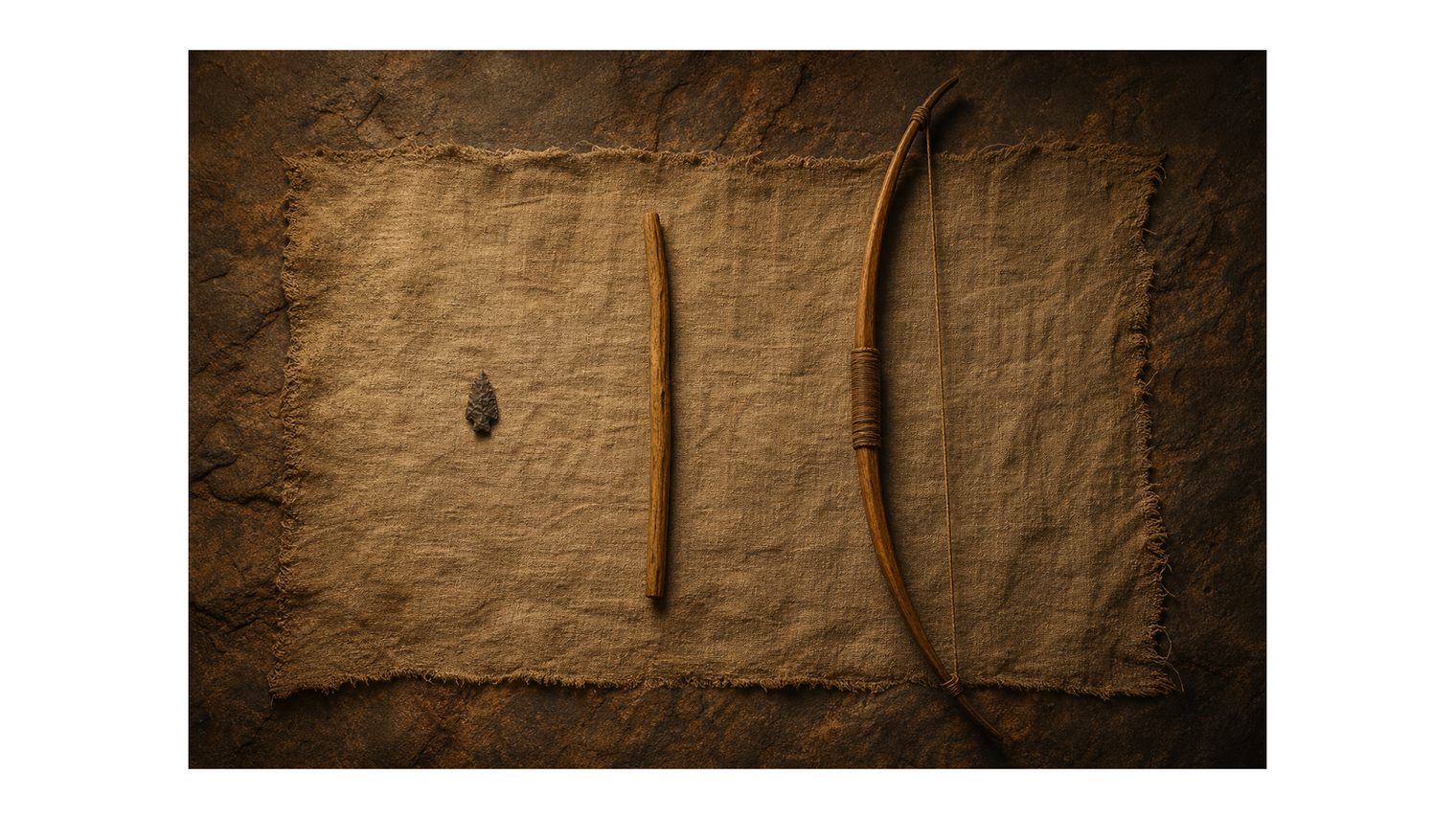
Just How Old Is the Bow and Arrow?
The short answer: extraordinarily old. Archaeological evidence suggests that bows and arrows were in use at least 70,000 years ago, with some researchers placing the origins even earlier. This makes the bow one of the longest-serving tools in human history — predating agriculture, writing, and the wheel. Understanding that timeline isn't just trivia. It fundamentally changes how you think about the equipment in your hands and the tradition you're part of.
Why the Origins of the Bow and Arrow Actually Matter
Most archers pick up a bow focused entirely on technique, gear, and accuracy. That's understandable. But knowing the deep history behind your equipment does something useful: it gives you perspective on how refined modern archery actually is, and how much of what we do today was slowly worked out over tens of thousands of years of trial and error by cultures across the globe.
The bow wasn't invented once and then spread outward. Evidence points to it being developed independently in multiple regions. That tells us something important — the bow and arrow solved a genuine problem so efficiently that separate human populations arrived at the same solution without contact. That kind of convergent innovation is rare, and it speaks to the fundamental elegance of the design.
For modern archers, this context is grounding. When you're learning to anchor consistently or choosing between a recurve bow and a longbow, you're participating in a practice that has been refined across dozens of cultures over an almost incomprehensible span of time.
The Archaeological Evidence: What We Actually Know
Pinning down a precise date is genuinely difficult. Wood, sinew, and feathers — the primary materials used in ancient bows and arrows — degrade quickly. What survives in the archaeological record tends to be the hardest materials: stone arrowheads, bone points, and occasionally fragments of preserved wood from unusually dry or cold conditions.
The Sibudu Cave Findings
One of the most significant discoveries came from Sibudu Cave in South Africa. Researchers found small stone points dating to approximately 64,000 BCE that show signs of hafting — meaning they were attached to shafts. Residue analysis revealed traces of adhesive, suggesting deliberate tool construction consistent with arrowheads rather than spear tips. These findings pushed the known timeline of projectile technology well beyond previous estimates.
The Ahrensburg Valley Arrows
In northern Germany, wooden arrow shafts were recovered from the Ahrensburg Valley, dated to around 10,000 BCE. These are among the oldest relatively complete arrows ever found, and they give us direct physical insight into how early archers constructed their ammunition — pine shafts, carefully straightened, with points attached at one end.
Ötzi the Iceman
Perhaps the most famous archery-related archaeological find is Ötzi, a naturally mummified human discovered in the Alps in 1991. Dated to around 3,300 BCE, Ötzi was carrying an unfinished yew longbow and a quiver containing 14 arrows — some finished, some not. The level of craftsmanship visible in his equipment shows just how sophisticated bow-making had become by the Copper Age. His arrows featured fletching, nocked ends, and stone or antler tips, structurally recognizable to any modern archer.
How the Bow Evolved Across Civilizations
Once established, bow technology didn't stay static. Different cultures adapted it to their specific environments, materials, and needs.
- Composite bows: Developed across Central Asia and the Middle East, composite bows combined wood, horn, and sinew to create shorter, more powerful bows — ideal for mounted archery on horseback. The Mongol composite bow remains one of the most studied examples of early engineering optimization.
- Longbows: Characteristic of Wales and England, the English warbow was made from a single stave of yew and reached lengths exceeding six feet. Its role in medieval warfare, particularly at Agincourt and Crécy, is extensively documented.
- Recurve designs: The recurved limb shape — where the tips curve away from the archer — appeared independently in multiple cultures. This geometry stores and releases energy more efficiently than a straight bow of the same length, a principle that underpins modern Olympic recurve design. You can see the direct lineage when browsing traditional recurve bows available today.
- Self bows: Single-piece bows carved from one type of wood were used globally, from the Pacific Northwest to sub-Saharan Africa. Materials were chosen based on regional availability — osage orange in North America, bamboo across Asia, ash across Europe.
Each adaptation reflected an engineering response to available resources and practical demands. That's not so different from how modern archers select equipment based on their discipline, draw length, and intended use.
From Survival Tool to Sport: The Transition
For most of human history, archery existed primarily in two contexts: hunting and warfare. The shift toward archery as a formalized sport began in earnest during the medieval period in Europe, where competitions were organized to maintain military readiness among civilian populations.
By the 17th and 18th centuries, as firearms made the bow obsolete in warfare, archery clubs emerged in Britain and Europe as social and recreational institutions. The sport gradually formalized, rules standardized, and by 1900, archery was included in the modern Olympic Games. It was removed, returned, and has remained a fixture since 1972.
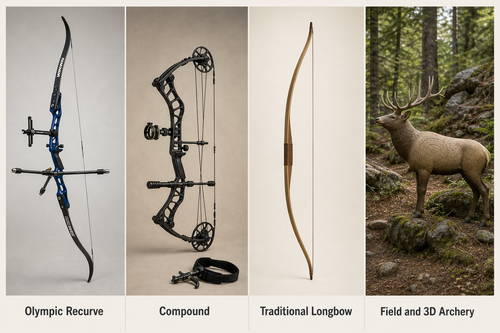
Today, the range of formats — Olympic recurve, barebow, traditional, field, and 3D — reflects centuries of accumulated practice finding new expressions. Introducing younger archers to this lineage early, even through youth bows designed for beginners, connects them to a tradition far older than most other sports.
Common Misconceptions About Archery's History
Even among enthusiastic archers, a few misunderstandings about the history tend to circulate:
- Assuming bows were invented in one place: Multiple independent inventions across different continents is the current archaeological consensus. There was no single origin point.
- Thinking older means more primitive: The composite bows used by Scythian horsemen around 700 BCE were sophisticated pieces of engineering. Age doesn't equal simplicity.
- Conflating spear-throwers with bows: The atlatl (spear-thrower) predates the bow and is a distinct technology. Confusing the two is a common error when reading older sources that weren't always precise in distinguishing projectile technologies.
- Assuming the longbow was the dominant global form: It was dominant in a specific time and region. Across the wider world and longer timeline, composite and recurve designs were at least as prevalent.
- Overlooking arrow development: The bow often gets all the attention, but arrow design — shaft straightness, fletching angle, point weight, nock fit — evolved in parallel and was equally critical to performance.
Frequently Asked Questions
How far back does the use of bows and arrows actually go?
The most widely cited evidence suggests at least 64,000 to 70,000 years, based on microliths and hafting residues found in South Africa. Some researchers argue the timeline may extend further, though the evidence becomes less direct. It's one of the oldest complex tools humans ever developed.
Did every ancient culture eventually develop the bow?
Not universally. Some cultures relied on other projectile technologies — spear-throwers, blowpipes, or throwing sticks — and never transitioned to the bow. The bow spread widely but wasn't a guaranteed evolutionary step for every population.
Why do modern recurve bows look similar to ancient ones?
Because the physics haven't changed. The recurved limb geometry was figured out thousands of years ago because it works. Modern materials — carbon fiber, synthetic limbs, precision risers — improve consistency and durability, but the underlying mechanical principle is ancient.
Is traditional archery the same as historical archery?
Not exactly. Traditional archery today is a modern sporting practice that draws inspiration from historical forms but isn't a strict historical reconstruction. Historical archery (or historical European martial arts archery) attempts closer fidelity to documented historical techniques. Both are legitimate practices with distinct communities.
Closing Thoughts
Few tools have accompanied humanity as long as the bow and arrow. From Sibudu Cave to Olympic stadiums, the core principle — storing energy in a flexible limb and transferring it to a projectile — has remained remarkably consistent. What has changed is the sophistication of materials, the specificity of design, and the context in which it's practiced. That continuity is worth knowing. It doesn't make you shoot better immediately, but it situates your practice inside something genuinely ancient — and that perspective tends to make archers more patient, more curious, and more serious about mastering the craft properly.