Skip to content
 cust@legendarchery.com
 302 503 5767
 Westfield IN 46074


Why Arrow Length Is More Than Just a Number
Knowing how long should your arrows be is one of the first practical questions every archer needs to answer. Get it wrong and you risk poor arrow flight, inconsistent groups, and in serious cases, a safety hazard if a short arrow falls off the rest at full draw. Get it right and everything downstream — spine selection, point weight, tuning — becomes much easier to manage.
The Foundation: Draw Length Comes First
Arrow length is built on your draw length. Before you can size an arrow, you need an accurate draw length measurement. The most reliable method is to have someone measure your full draw from the throat of the nock to a point just beyond the arrow rest or button — this gives you your actual arrow pass measurement.
A commonly used shortcut is the wingspan method: stand with arms stretched out flat, measure fingertip to fingertip, then divide by 2.5. This gives an approximate draw length in inches. It works well enough as a starting point but should be confirmed with a bow in hand, especially if your stance or anchor point is non-standard.
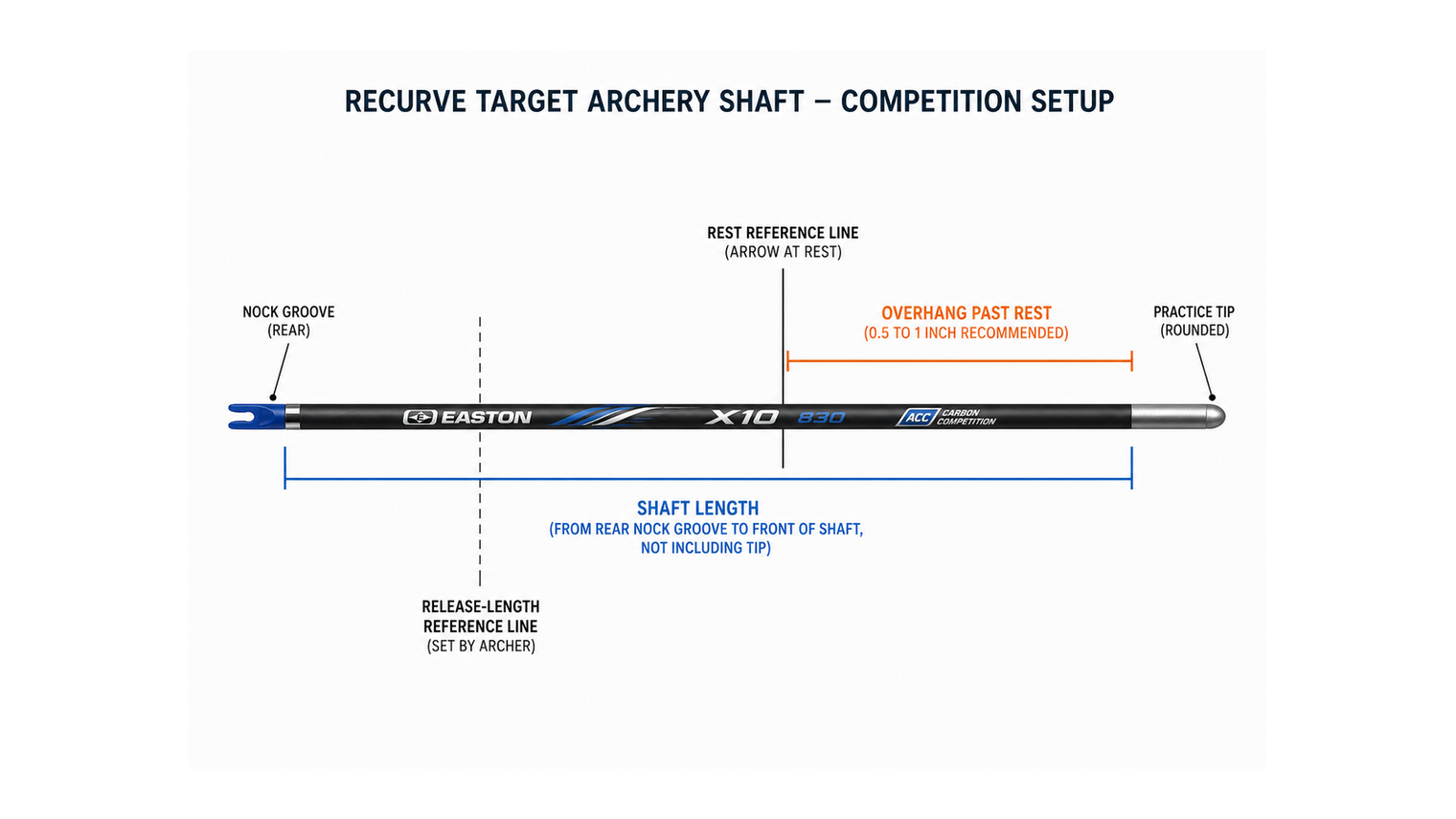
Once you have your draw length, most archers add between half an inch and one inch beyond the arrow rest when at full draw. This margin ensures the tip of the arrow stays safely on the rest throughout the draw cycle and gives a small buffer for technique variation. Some coaches recommend up to one and a half inches of overhang for new archers who are still developing a consistent anchor.
How Bow Type Affects the Calculation
Recurve Bows
On a recurve, arrows typically sit on a simple rest or a plunger-supported rest. There is minimal mechanical complexity, so the general rule of drawing length plus half to one inch applies cleanly. Recurve archers who shoot off the shelf may want a little more length for stability during the clicker phase if they use one.
Compound Bows
Compound setups often allow shorter arrows because the arrow rest is positioned differently and the bow is let-off at full draw, removing some of the hand pressure risk. Even so, most compound archers keep arrows at least half an inch past the arrow rest at full draw. Cutting arrows extremely short on a compound purely to reduce weight can compromise safety margins — it is not worth the trade-off unless you are an experienced tuner working with a certified technician.
Traditional Longbows
With longbows, where the arrow is typically shot off the hand or a simple shelf, archers frequently use longer arrows. A generous length gives more forgiveness for variation in draw length, which tends to be more variable in instinctive shooting styles. It also makes it easier to adapt arrows across different traditional setups.
Spine, Weight, and the Knock-On Effects of Length
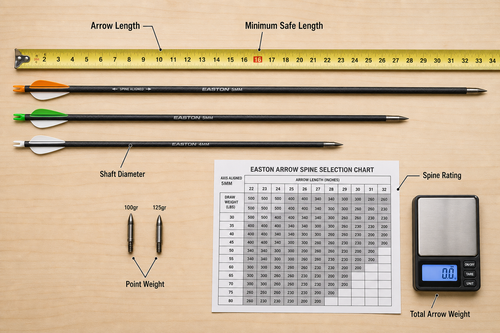
Arrow length and arrow spine are directly linked. As an arrow gets longer, it effectively becomes weaker (more flexible) in spine. Cutting an arrow shorter makes it stiffer. This means that if you change your arrow length significantly — even by an inch — you may need to revisit your spine selection to keep the arrow flying cleanly out of your bow.
This relationship is why arrow manufacturers publish spine charts that list recommended lengths alongside bow weight ranges. When you browse archery arrows and compare shaft specifications, you will notice that the spine rating assumes a particular arrow length. Deviating from that assumed length shifts the dynamic spine behaviour of the shaft.
Point weight is part of the same equation. A heavier point increases the forward of centre balance and can slightly compensate for an arrow that is marginally weak in spine. A lighter point does the opposite. These variables interact, which is why experienced tuners treat arrow length, spine, and point weight as a system rather than isolated choices.
Measuring an Arrow Correctly
Arrow length in archery is measured from the bottom of the nock groove — the notch where the string sits — to the end of the shaft, not including the point. This is a standardised measurement and what manufacturers refer to when listing arrow length. When you have arrows cut by a pro shop, confirm they are using this measurement convention.
If you are buying pre-cut arrows, match their listed length to your calculated requirement. If you are buying full-length shafts to be cut, add a few extra inches so the cutter has working room. Never cut an arrow and then realise it is now too short — there is no way back.
Common Mistakes to Avoid
- Cutting arrows too short too soon. Many beginners rush to match a friend's setup or copy an online build without measuring their own draw length first. Always measure yourself.
- Ignoring draw length changes. Young archers grow. Adults new to archery often settle into a slightly different draw length after a few months of consistent practice. Re-check your draw length periodically and reassess your arrows if it has changed noticeably.
- Forgetting that different bows may need different lengths. If you shoot more than one bow, do not assume the same arrow works across all of them without checking. Different riser designs and arrow rest positions can shift the required length.
- Prioritising speed over safety margin. Some archers cut arrows very short to shed weight and gain arrow speed. Unless you are an experienced archer with a very consistent draw length, maintaining a safe overhang past the rest is more important than marginal speed gains.
- Not accounting for insert depth. When using screw-in points, the insert sits inside the shaft and the point extends forward from the shaft tip. The overall assembly length is what matters for balance and dynamic spine behaviour, not just the bare shaft.
Material and Arrow Type Considerations
The material of your shaft can influence how you think about length. Aluminum arrows are easy to cut precisely and are forgiving for beginners working out their sizing for the first time. Carbon shafts require a proper carbon arrow cutter to avoid splintering, and cuts must be clean — rough edges weaken the shaft at the cut point. Carbon-aluminium hybrids and composite shafts follow the same principle.
Specialty shafts like barrelled arrows have a tapered profile that can affect how length interacts with spine behaviour, so always follow the manufacturer's guidance for those specifically rather than applying the standard rules directly.
Frequently Asked Questions
How do I figure out the right arrow length if I don't have a bow yet?
Use the wingspan method as a starting estimate: measure your full arm span in inches and divide by 2.5. This gives an approximate draw length. From there, add one inch for a safe starting arrow length. Once you have a bow, confirm this measurement at full draw before cutting any shafts.
Can I shoot arrows that are longer than I need?
Yes, within reason. An arrow that is slightly longer than required will fly well and is completely safe. Very long arrows can feel awkward and may pick up more drag, but for most recreational archers the difference is minor. A longer arrow is always preferable to one that is dangerously short.
Why am I getting inconsistent groups even though my arrows are the right length?
Arrow length is one piece of the puzzle. Inconsistent groups can also come from mismatched spine, inconsistent anchor point, release issues, or a bow that is out of tune. Length establishes the foundation, but good arrow flight requires all variables to work together.
Does arrow length change if I switch from a recurve to a compound?
Possibly. Compound bows often have a different arrow pass position compared to a recurve, and your draw length may also differ between the two setups. Always measure your draw length on the specific bow you are using and apply the standard calculation from that measurement.
Getting It Right From the Start
Arrow length is a simple measurement with real consequences for both safety and performance. Measure your draw length accurately, apply the standard half-inch to one-inch overhang guideline, and treat length as part of a broader arrow system that includes spine and point weight. If you are unsure, have a pro shop confirm your measurements before cutting anything — it takes minutes and removes the guesswork entirely.