Skip to content
 cust@legendarchery.com
 302 503 5767
 Westfield IN 46074


What Are the Easton ACE Arrows and Where Did They Come From?
The Easton ACE — short for A/C/E, which stands for Aluminum/Carbon/Extreme — is a hybrid target arrow that has been a fixture on international podiums for decades. If you follow Olympic or World Championship recurve results, you have almost certainly seen these arrows in the quivers of top-ranked shooters. Understanding the Easton ACE arrows history, spines, points, and nocks gives any serious target archer a clearer picture of why this shaft remains relevant today.
A Brief History of the ACE Arrow
Easton introduced the A/C/E in the 1990s as a direct evolution of their earlier A/C/C (Aluminum/Carbon/Competition) shaft. The goal was to push consistency and tolerances further than an all-aluminum or standard carbon construction could achieve at the time.
The key innovation was bonding a thin carbon fiber layer around an aluminum core. The aluminum core provides a precise, consistent inner diameter and gives the arrow its characteristic stiffness-to-weight characteristics. The carbon wrap adds compression strength and dramatically reduces the shaft's wall deformation during the power stroke. Together, these two materials produced a shaft that was straighter, more consistent in weight, and more forgiving of minor tuning imperfections than most alternatives available at the time.
Over the subsequent years, Easton refined the ACE spine range, updated the nock systems it ships with, and adjusted point compatibility recommendations to keep pace with evolving bow technology — particularly as recurve limb weights and draw lengths changed at the elite level.
Today the ACE sits in Easton's lineup as a premium target shaft, positioned between the entry-level X7 aluminum platform and the ultra-elite X10 carbon arrow. For many compound and recurve target archers shooting at 18 to 70 metres, it remains a highly practical choice that does not demand the full budget commitment of the X10.
How ACE Arrow Construction Works
To make sense of spine selection and tuning, it helps to understand the structural logic of the ACE.
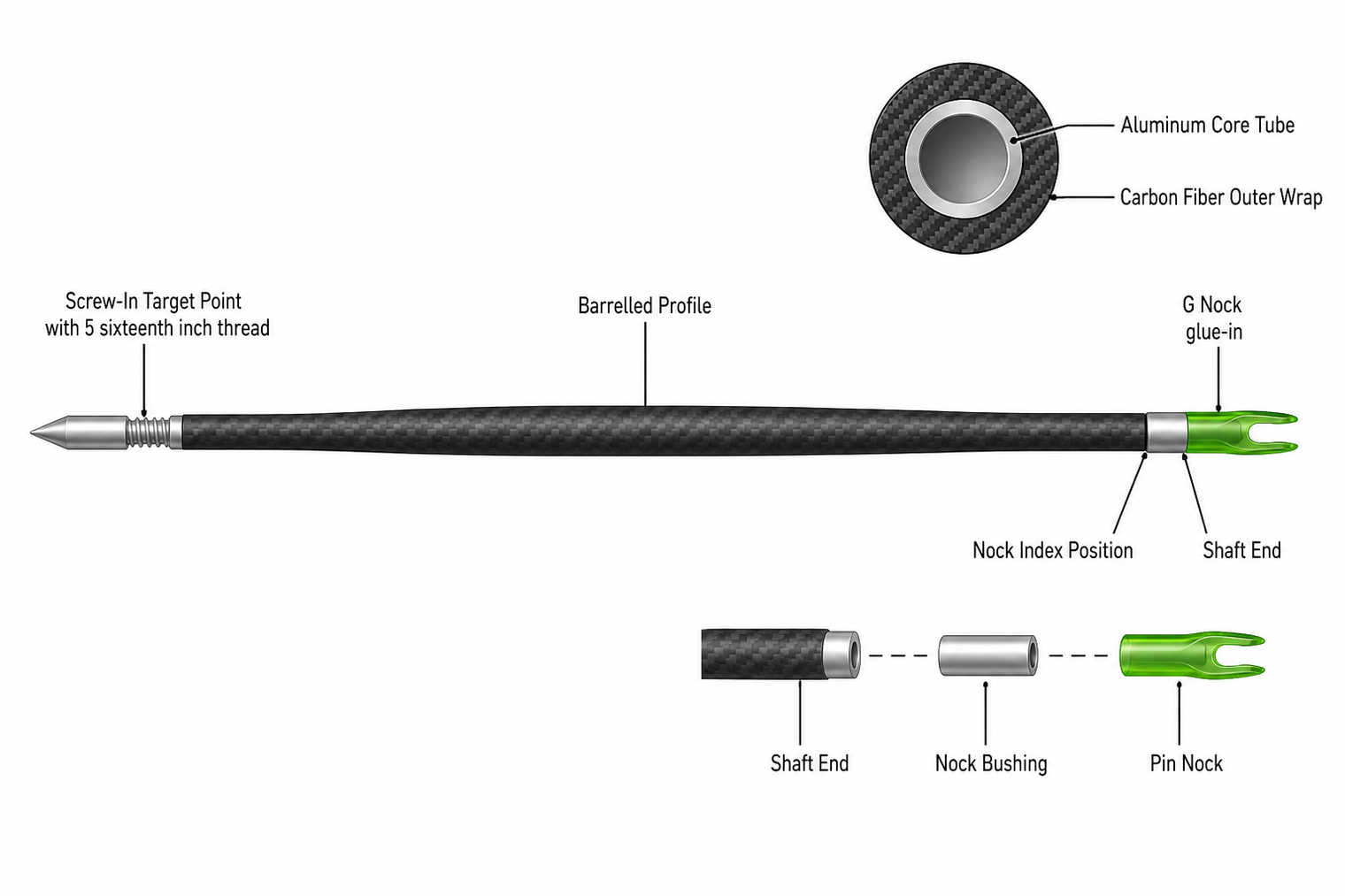
- Aluminum core tube: Provides the inner diameter consistency that controls nock fit and point fit. The aluminum also gives the shaft a predictable bending behaviour across its length.
- Carbon fiber outer wrap: Bonded under tension around the aluminum core. This layer resists ovalling and adds hoop strength without adding significant weight.
- Consistent weight: Each ACE shaft is produced to tight weight tolerances per batch. This matters for archers shooting multiple arrows in a round — identical flight characteristics depend on nearly identical shaft weights.
This construction is why the ACE is described as a barrelled arrow design in some contexts — the shaft has a slightly thicker mid-section profile compared to a straight-parallel carbon arrow. If you want to understand more about barrelled arrows and how barrel profile affects arrow flight, that concept is worth exploring separately.
Understanding ACE Spine Codes
Easton labels ACE spines with a three-digit code such as 620, 670, 720, 780, and so on. Unlike the ATA-standard 0.880-inch deflection measurement used for many carbon shafts, the ACE spine codes are Easton's own internal numbering. A lower number indicates a stiffer shaft; a higher number indicates a more flexible shaft.
Selecting the right ACE spine involves three main variables:
- Draw weight at your draw length: Not the bow's peak or stated limb weight alone — the actual draw force at the point you anchor.
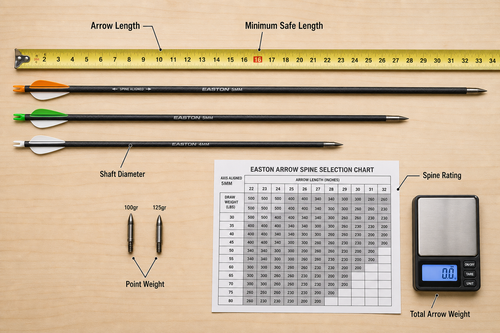
- Arrow length: The distance from the nock groove to the end of the shaft (not including the point). Longer arrows at the same spine code will behave weaker — effectively more flexible — than shorter cuts.
- Point weight: Heavier points increase the dynamic loading on the shaft during release, making the arrow behave as if it is weaker. Lighter points have the opposite effect.
Easton publishes a dedicated spine selection chart for the ACE. Always use the current version of that chart rather than relying on older resources, since point weight recommendations have been revised over the years as arrow rests and bow technology evolved.
Point Weights and What They Do to Flight
ACE arrows are most commonly used with screw-in points in the 80 to 120 grain range for recurve target shooting, and occasionally heavier for specific compound target distances. The point weight is not simply a matter of hitting the spine chart correctly — it also affects the arrow's front-of-centre (FOC) balance and how the arrow stabilises during flight.
A higher FOC value shifts the arrow's centre of mass forward of its geometric midpoint. This generally improves in-flight stability and reduces wind drift, which is why many outdoor target archers at 70 metres and beyond prefer a slightly heavier point than the minimum the spine chart permits.
For indoor distances — particularly 18 metres — some archers run lighter points to reduce penetration depth into foam targets and simplify arrow removal. The trade-off is a slightly lower FOC, which is less of a concern at short range.
Easton ACE points use a standard 5/16-inch thread. They are compatible with a range of third-party points as long as the thread standard and diameter match. Always verify point diameter compatibility with the ACE's outer diameter before ordering alternative points, since the ACE has a smaller outside diameter than a standard aluminium arrow. For a broader look at how points interact with different shaft types, including aluminum arrows, it is useful to understand why shaft diameter drives point sizing decisions.
ACE Nock Systems: G Nocks, Pin Nocks, and Fit
Nock choice on the ACE affects both reliability and tuning. Easton has supplied different nock systems with the ACE across its production history, and understanding the current options prevents a common and frustrating mistake.
- G Nock (glue-in): The original and still widely used system. The G nock glues directly into the end of the ACE shaft. The fit must be correct — neither sloppy nor forced. A loose G nock will move on the string unpredictably; an over-tight one risks splitting the end of the shaft.
- Pin Nock with nock bushing: A two-piece system where a small aluminium or composite bushing is installed in the shaft end, and the nock clips onto the bushing pin. This system allows nock replacement without re-gluing and is popular with archers who want to swap nock orientations quickly during tuning sessions.
- Nock alignment: On a fletched arrow, the nock index position determines which vane or feather clears the rest at full draw. On bare shaft arrows used for tuning, nock index still matters because a twisted nock alters how the shaft contacts the rest. Always check nock seating with a nock alignment tool before fletching.
One practical note: when replacing G nocks on ACE shafts, use only the correct Easton G nock sized for the ACE. Universal nock packs from other manufacturers may list the ACE as compatible, but the fit tolerance can differ enough to cause nock pop-off or inconsistent index position.
Common Mistakes Archers Make with ACE Arrows
- Using an outdated spine chart: Easton has updated ACE spine recommendations over the years. Using a chart from a forum post or old catalogue can put you on the wrong spine for your current setup.
- Ignoring actual draw length when calculating spine: Many archers use their bow's stated draw length rather than measuring their true draw length with a long draw arrow. Even a half-inch difference can shift you between spine codes.
- Mixing point weights within a set: Buying points in bulk from different batches without weighing them individually can introduce weight variation that affects group consistency, especially at longer distances.
- Forcing nocks: Glue-in nocks that require significant force to seat are too small for that shaft batch. The pressure can stress the carbon-aluminum bond at the shaft end.
- Cutting ACE shafts with the wrong tool: The carbon wrap requires a high-speed rotary cutter designed for carbon shafts. A standard aluminium arrow cutter will fray the carbon layer and compromise the shaft end, affecting both nock seating and potential crack propagation.
- Skipping bare shaft tuning: Even a well-selected spine still benefits from bare shaft paper tuning or walk-back tuning. The ACE's consistency makes it an excellent shaft for fine-tuning because it removes shaft variability as a confounding factor.
Frequently Asked Questions
What does the ACE name actually stand for?
ACE stands for Aluminum/Carbon/Extreme, referencing the shaft's hybrid construction — an aluminium core bonded with a carbon fiber outer layer. The naming convention follows Easton's earlier A/C/C (Aluminum/Carbon/Competition) shaft that preceded it.
Why do the ACE spine numbers go upward as the shaft gets weaker?
Easton's ACE spine codes are internal designation numbers rather than a direct stiffness measurement. A lower code (such as 570) indicates a stiffer shaft; a higher code (such as 900) indicates a more flexible one. This is the opposite of the ATA deflection measurement used for many other carbon shafts, where a larger number means a stiffer shaft. Always check which convention a chart is using before applying it to your selection.
Can you use ACE arrows for field archery or 3D, or are they only for target?
The ACE is designed and optimised for target archery at measured distances. Its thin outer diameter and relatively premium cost make it a poor choice for field or 3D use where arrows regularly impact hard terrain, stumps, or foam targets with stone or wood backing. Most archers shooting field or 3D courses prefer a more robust carbon shaft that can absorb glancing impacts without risking shaft integrity.
How do I know if my ACE nock fit is correct without a gauge?
A correctly fitting G nock should seat with firm hand pressure and remain in place when you hold the shaft vertically and let the nock hang freely. It should not require tools to install, and it should not drop out or shift when the shaft is shaken. If you are uncertain, compare the fit against a known-good nock on a shaft from the same batch before fletching the full set.
Final Thoughts
The Easton ACE has earned its reputation through decades of consistent performance at the highest levels of target archery. Getting the most out of these shafts means pairing the correct spine for your actual draw parameters, selecting an appropriate point weight for your distance and FOC goals, and fitting nocks with the care the system requires. For anyone exploring the broader world of archery arrows, the ACE is a useful reference point for understanding how construction materials and component choices interact to affect arrow flight.