Skip to content
 cust@legendarchery.com
 302 503 5767
 Westfield IN 46074


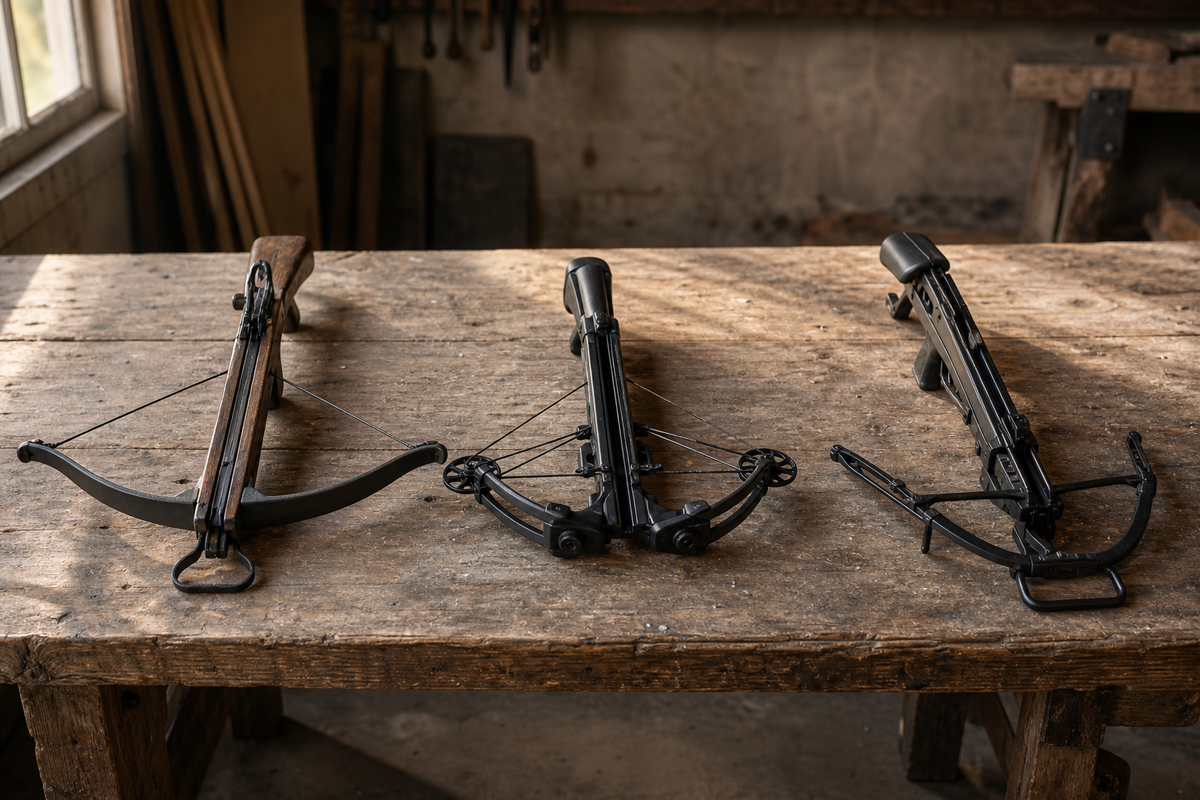
Walk into any archery shop and you will quickly notice that crossbows are not all built the same way. The differences go well beyond aesthetics — each design has a distinct limb configuration, draw mechanism, and performance profile that makes it better suited to certain shooters and situations. Understanding the main crossbow types before you buy saves you from costly mismatches and helps you shoot more confidently from day one.
Why Crossbow Design Matters More Than Most Buyers Realise
Many first-time buyers focus almost entirely on speed ratings or price tags. What actually determines whether a crossbow feels right in your hands is the underlying design: how the limbs are oriented, how the cocking mechanism works, and how the bow balances when you mount it. These factors affect everything from draw weight and noise level to portability and maintenance requirements. Getting this foundation right means your crossbow will work with your physiology and your intended use — not against it.
The Main Crossbow Types and What Sets Them Apart
Recurve Crossbows
The recurve is the oldest and most mechanically straightforward design still widely used today. Its limbs curve away from the shooter at the tips — the same principle used in traditional recurve bows — and the string sits directly on the rail without a system of cables and pulleys.
- Simplicity: Fewer moving parts means less to go wrong and easier field maintenance.
- Wider rail: The limbs extend outward significantly, making recurve crossbows wider from tip to tip than compound designs of similar power.
- Heavier draw: Because there is no let-off mechanism, the full draw weight must be managed manually, which can be demanding for shooters with limited upper-body strength.
- Best for: Archers who value simplicity, lower long-term maintenance costs, and a traditional shooting experience.
Compound Crossbows
Compound crossbows use a system of cams, pulleys, and cables — borrowed directly from vertical compound bow engineering — to create mechanical advantage through the draw cycle. This allows a relatively short power stroke to generate high arrow velocities, and the cam system provides let-off so that holding the bow at full draw requires significantly less effort than the peak draw weight suggests.
- Compact width: Cam systems allow shorter, stiffer limbs, resulting in a narrower overall profile that is easier to manoeuvre in tight spaces.
- Higher velocity potential: The cam-and-cable system typically delivers more energy per unit of draw weight than a recurve configuration.
- More components: Cables and cams require periodic inspection, timing checks, and eventual replacement.
- Best for: Hunters and competitive shooters who prioritise speed, compactness, and forgiveness during the hold.
Reverse-Draw Crossbows
In a reverse-draw configuration, the limbs face the opposite direction — toward the shooter rather than away. The string is pulled rearward and the riser sits further forward on the stock. This unusual geometry shifts the centre of gravity back toward the shooter's grip and creates a longer power stroke within a shorter overall footprint.
- Balance: The rearward weight distribution makes the crossbow feel lighter at the front end, reducing fatigue during long sessions or extended carries.
- Longer power stroke: A longer stroke can contribute to smoother acceleration and, in some designs, reduced vibration at the shot.
- Learning curve: The reversed limb orientation can look unfamiliar, and some shooters find the balance takes adjustment, especially when transitioning from a conventional design.
- Best for: Shooters who spend long hours in the field and want a naturally balanced crossbow that minimises arm fatigue.
Pistol and Mini Crossbows
These compact, handheld designs are a category of their own. They are much smaller than full-size shoulder-mounted crossbows, intended for close-range target practice, plinking, or as entry-level introductions to crossbow mechanics. They are generally not suited to hunting or serious competition, but they serve a genuine role in familiarising younger or newer archers with crossbow handling and bolt flight without the intimidating size and draw weight of a full-size model.
Matching Crossbow Type to Archer and Use Case
There is no universally superior design. The right choice depends on several intersecting factors:
- Physical ability: Shooters with shoulder injuries or limited grip strength should prioritise designs with cocking aids or lower peak draw weights. Compound and reverse-draw designs with rope cocking devices or integrated cranks can make cocking significantly more manageable.
- Shooting environment: Dense woodland hunting calls for a narrower profile — compound and reverse-draw designs have the edge here. Open-range target shooting makes width less of a concern.
- Budget for maintenance: Recurve designs have fewer serviceable parts and lower long-term maintenance costs. Compound systems may need cable and cam service at regular intervals.
- Experience level: Beginners often do well starting on a mid-weight recurve crossbow with a basic scope, then moving to a compound once they understand crossbow fundamentals. That said, a compound with lighter draw weight can equally suit a careful beginner.
- Intended use: Hunting, 3D target shooting, field archery, and casual backyard practice each place different demands on the bow. A crossbow built for hunting will often be heavier and faster than one designed for relaxed target work.
If you are setting up a new crossbow for the first time, it is also worth thinking early about carry and storage. A well-fitted crossbow case protects your investment during transport and keeps your optics and accessories safe between sessions.
Common Mistakes When Choosing Between Crossbow Designs
- Chasing the highest speed rating: Faster is not always better. High-velocity crossbows often have stiffer draws, more vibration, and louder shots. Match the speed to what your use case actually demands.
- Ignoring overall weight and balance: A crossbow that feels manageable on the shop floor can become exhausting after an hour in the field. Always assess how the bow balances in a shooting position, not just how it feels when lifted off a rack.
- Underestimating the importance of bolt compatibility: Different crossbow configurations call for different bolt lengths and spine ratings. Using the wrong bolts is both a safety issue and an accuracy problem. Make sure you understand what your chosen design requires before buying ammunition in bulk. You can learn more about this through Legend's guide to the crossbow bolt.
- Skipping the cocking mechanism question: Many buyers pick a bow based on looks alone and only realise later that the draw weight exceeds what they can consistently and safely manage. Always consider whether you need a rope cocker, crank, or integrated cocking aid before committing to a draw weight.
- Overlooking aftermarket support: Some crossbow designs — particularly budget imports — have limited parts availability. If a cam, cable, or string fails, you want to be able to source a replacement without waiting weeks.
Frequently Asked Questions
What are the main differences between a recurve and compound crossbow?
A recurve crossbow uses flexible limbs and a single string with no cams or cables, making it simpler to maintain but typically wider and heavier to draw. A compound crossbow uses a cam-and-cable system to create mechanical advantage, resulting in a narrower profile, higher potential velocity, and let-off during the hold — but with more components that need periodic servicing.
Which crossbow type is best for a complete beginner?
There is no single correct answer, but beginners generally benefit from choosing a crossbow with a draw weight they can manage comfortably and consistently — whether that is a lighter recurve or a mid-draw compound with a rope cocking aid. Starting lighter and building familiarity with safe crossbow handling, cocking, and de-cocking procedures matters more at the beginner stage than chasing performance numbers.
Is a reverse-draw crossbow harder to use than a standard design?
The handling mechanics of a reverse-draw crossbow are very similar to conventional designs once you are in a shooting position. The reversed limb orientation can look strange initially, but the improved balance — weight naturally centred toward the grip — often makes it feel more intuitive after a short period of adjustment, particularly for shooters who fatigue quickly with front-heavy bows.
Do different crossbow types require different accessories?
Broadly, yes. Bolt length, scope rail type, and quiver mounting points can vary between designs. Recurve crossbows are typically wider, which affects case selection. Always verify that scopes, cocking aids, and quivers are compatible with your specific model before purchasing. Legend Archery carries a range of crossbow accessories suited to various crossbow configurations.
Conclusion
Recurve, compound, and reverse-draw crossbows each represent a distinct engineering philosophy with genuine trade-offs. Knowing what those trade-offs are — and how they map onto your strength, shooting environment, and intended use — puts you in a far stronger position than buying on speed ratings or appearance alone. Take time to handle different designs where possible, ask questions about maintenance, and think ahead to how you will transport and store the bow. The right design is the one that fits your actual archery life, not just the one that looks fastest on a spec sheet.