Skip to content
 cust@legendarchery.com
 302 503 5767
 Westfield IN 46074


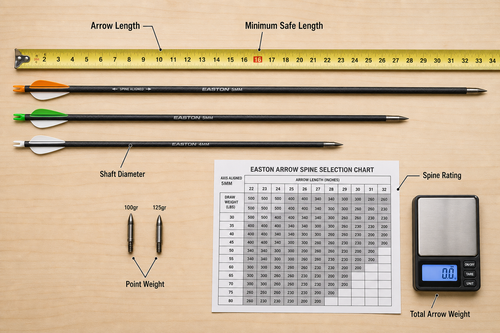
Most beginner archers focus almost entirely on the bow and treat arrows as an afterthought. That's a mistake. The arrow is the projectile doing the actual work — and understanding how it's built, how it flexes, and why those details matter will immediately improve your consistency on the range. This guide covers everything a new archer needs to know before buying or shooting arrows.
The Core Concepts Behind Every Arrow
Before getting into parts and materials, there are two concepts that underpin almost every decision you'll make about arrows: spine and weight.
Spine refers to how much an arrow bends under load. When you release a bowstring, the arrow doesn't fly perfectly straight — it flexes around the riser in a wave pattern known as the archer's paradox. If the arrow is too stiff or too flexible for your bow's draw weight, that flex is mistimed and the arrow veers off course. Spine is measured as a deflection value: a lower number means a stiffer shaft.
Arrow weight is measured in grains (gr) and matters for both safety and performance. Heavier arrows retain energy better at longer distances and are gentler on the bow limbs. Lighter arrows fly faster but can be harsher on equipment if they're too light for the bow being used. Most manufacturers publish a minimum arrow weight for each bow, and staying above that threshold is not optional — it's a safety consideration.
Together, spine and weight form the foundation of arrow selection. Get those right first, and the rest of the choices become much easier.
Main Parts of an Arrow and What They Do
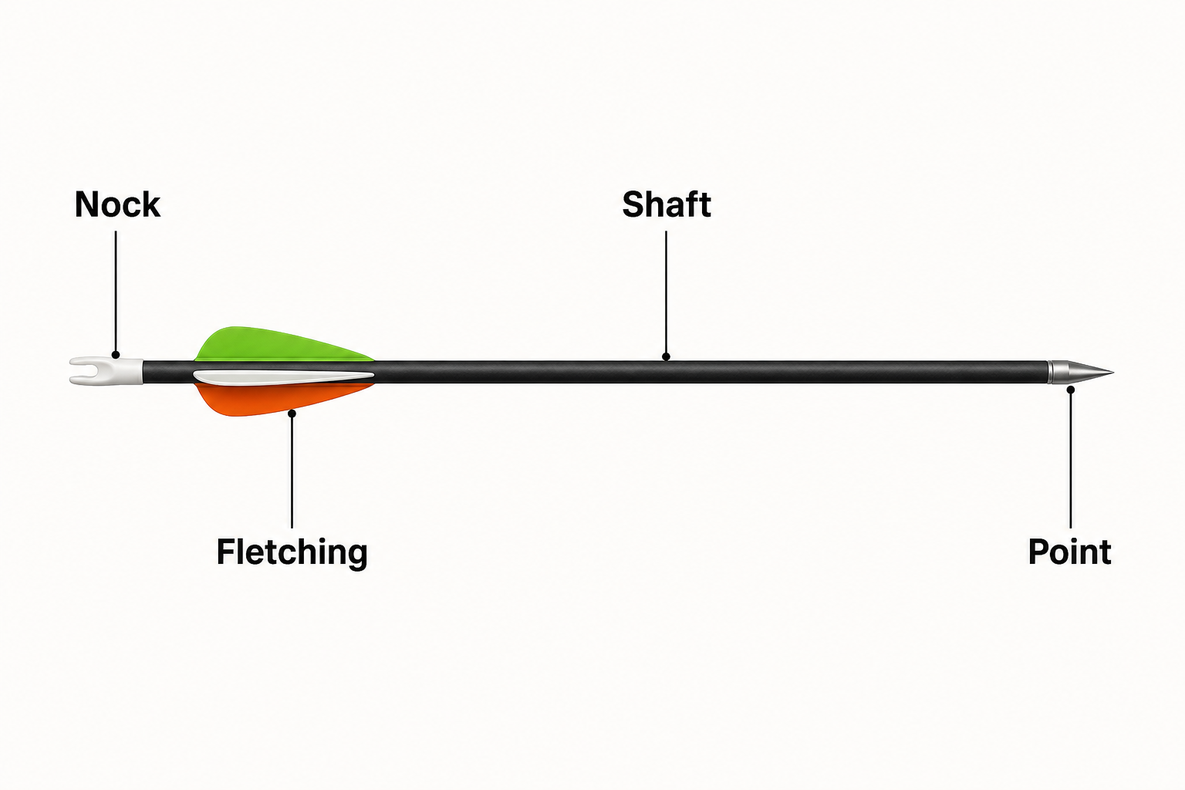
A standard arrow has four main components. Each one plays a specific role in how the arrow flies and performs.
The Shaft
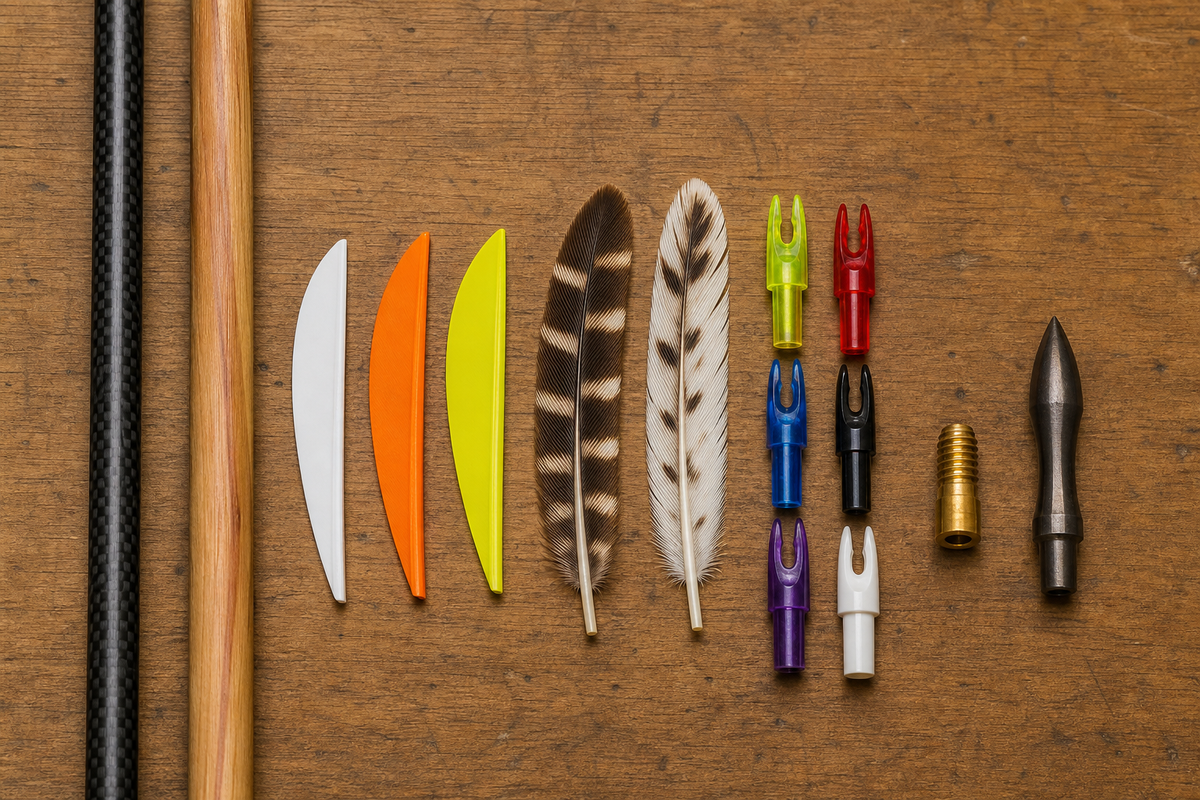
The shaft is the main body of the arrow. It determines the spine, overall weight, and durability. Shafts come in several materials:
- Carbon: Lightweight, consistent, and durable. The most popular choice for recreational and competitive archers alike.
- Aluminum: Slightly heavier than carbon but very uniform in diameter, which makes them forgiving to shoot. A solid choice for beginners learning form. Aluminum arrows are also generally more affordable and easier to straighten after impact.
- Carbon-aluminum hybrids: Combine a carbon outer layer with an aluminum core for high-end performance, mostly used in target competition.
- Wood: Traditional material, primarily used in longbow and traditional archery. Requires careful matching and regular inspection for warping.
The Nock
The nock is the small plastic fitting at the rear of the arrow that clips onto the bowstring. It keeps the arrow seated correctly on the string before and during the shot. A worn or cracked nock can cause erratic arrow flight or, more dangerously, cause the arrow to slip off the string unexpectedly. Always inspect nocks before shooting and replace them if they feel loose or show visible damage.
The Fletching
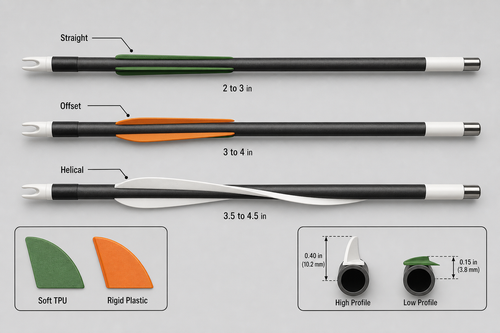
Fletching — the vanes or feathers near the rear of the shaft — stabilises the arrow in flight by creating drag that keeps the back of the arrow trailing. Most modern arrows use plastic vanes, which are durable and weather-resistant. Traditional archers often prefer feather fletching because it collapses on contact with an arrow rest, reducing interference. The size, angle, and configuration of the fletching all affect how quickly the arrow stabilises and at what cost to speed.
The Point
The point (or tip) is what hits the target. Different point types are designed for different purposes:
- Field points: Used for target and range practice. Conical shape, easy to pull from targets.
- Broadheads: Used in bowhunting. Feature cutting blades designed to create a wound channel.
- Blunt tips: Flat or rubber-tipped points used for small game or practice. Blunt arrows are also commonly used in certain training contexts where penetration needs to be minimised.
- Judo points: Field points with small spring arms that stop the arrow from disappearing into grass or undergrowth.
Point weight affects the arrow's balance point (forward of centre, or FOC), which in turn influences stability in flight. Heavier points push the FOC forward, generally improving in-flight stability.
Common Beginner Mistakes
Understanding the parts is one thing. Knowing where new archers go wrong with them is just as important.
- Buying arrows before knowing draw length: Arrow length must be matched to your draw length. An arrow that's too short is genuinely dangerous — it can fall off the rest and be driven into the bow hand. An arrow that's too long simply costs you efficiency. Measure your draw length first.
- Ignoring spine charts: Every reputable shaft manufacturer publishes a spine selection chart that cross-references draw weight and arrow length. New archers often skip this step and pick arrows based on price or appearance. Mismatched spine is one of the most common reasons for inconsistent groups.
- Mixing arrows of different weights or spines: Shooting a mixed set looks harmless but makes it nearly impossible to diagnose grouping problems. If one arrow always flies differently, you can't tell if the issue is form, equipment, or that arrow specifically. Use a matched set.
- Not accounting for point weight in spine selection: Adding a heavy broadhead or field point changes the effective spine of the arrow. Most spine charts assume a specific point weight — usually 100 grains. If you're using 125-grain or 150-grain points, you'll need to adjust your selection accordingly.
- Neglecting arrow inspection: Carbon shafts can develop micro-cracks from hard impacts that aren't visible to the naked eye but compromise structural integrity. The flex test — gently flexing the shaft along its length and listening for cracking sounds — is a simple check that should be done regularly.
How Arrow Choice Affects Your Performance
Once you understand the fundamentals, it becomes clear how much influence the arrow has over your results at the target.
A correctly spined arrow leaves the bow cleanly and stabilises quickly. A poorly matched arrow fishtails or porpoises — moving left-to-right or up-and-down in flight — before it reaches the target. At short distances like 10 or 15 metres, this may not be obvious. At 30 metres or beyond, you'll see groups spread significantly in one plane, which is a tell-tale sign of a spine issue.
Arrow length and FOC also interact with your bow's arrow rest and pressure point. Small changes in where the shaft contacts the rest can open or close groups by several centimetres. This is why tuning — adjusting the bow to work with a specific arrow — is a necessary step for any archer who wants consistent performance, not just occasional good shots.
If you're still exploring what type of arrow suits your setup and discipline, the archery arrows overview at Legend Archery covers the main categories in practical detail.
Frequently Asked Questions
What does "arrows 101" actually cover?
The phrase is used informally to describe foundational arrow knowledge: understanding spine, arrow components, materials, how to select the right arrow for a bow, and the basic physics of how an arrow behaves in flight. It's the starting point before getting into more technical topics like arrow tuning or competition-specific setups.
Why does getting arrows right matter so much for beginners?
Because even perfect form can't compensate for the wrong arrow. A mismatched spine will produce inconsistent results regardless of how well you shoot. New archers often blame their technique when the equipment is actually the problem. Sorting out the arrow first removes a major variable and helps you learn more efficiently.
What's the most common mistake beginners make when buying arrows?
Buying based on price or aesthetics rather than draw weight and draw length. The second most common mistake is not consulting the shaft manufacturer's spine chart. Both are easy to avoid if you take ten minutes to measure your draw length and match it to the bow's actual draw weight at that length — not the bow's peak weight.
How do you actually get better at understanding arrows?
Shoot the same matched set consistently, keep notes on your groups, and don't change multiple variables at once. If you suspect a spine issue, consult a spine chart or ask an experienced coach or pro shop technician to review your setup. Hands-on experience combined with structured feedback is far more useful than reading alone.
Putting It Together
Arrows are not interchangeable accessories — they're precision tools that need to match your bow, your draw, and your shooting style. Start with draw length and draw weight, consult a spine chart, and choose a shaft material that suits your budget and discipline. Inspect your arrows regularly and shoot a matched set. Those fundamentals, applied consistently, will take you further than almost any upgrade to your bow hardware.