Skip to content
 cust@legendarchery.com
 302 503 5767
 Westfield IN 46074


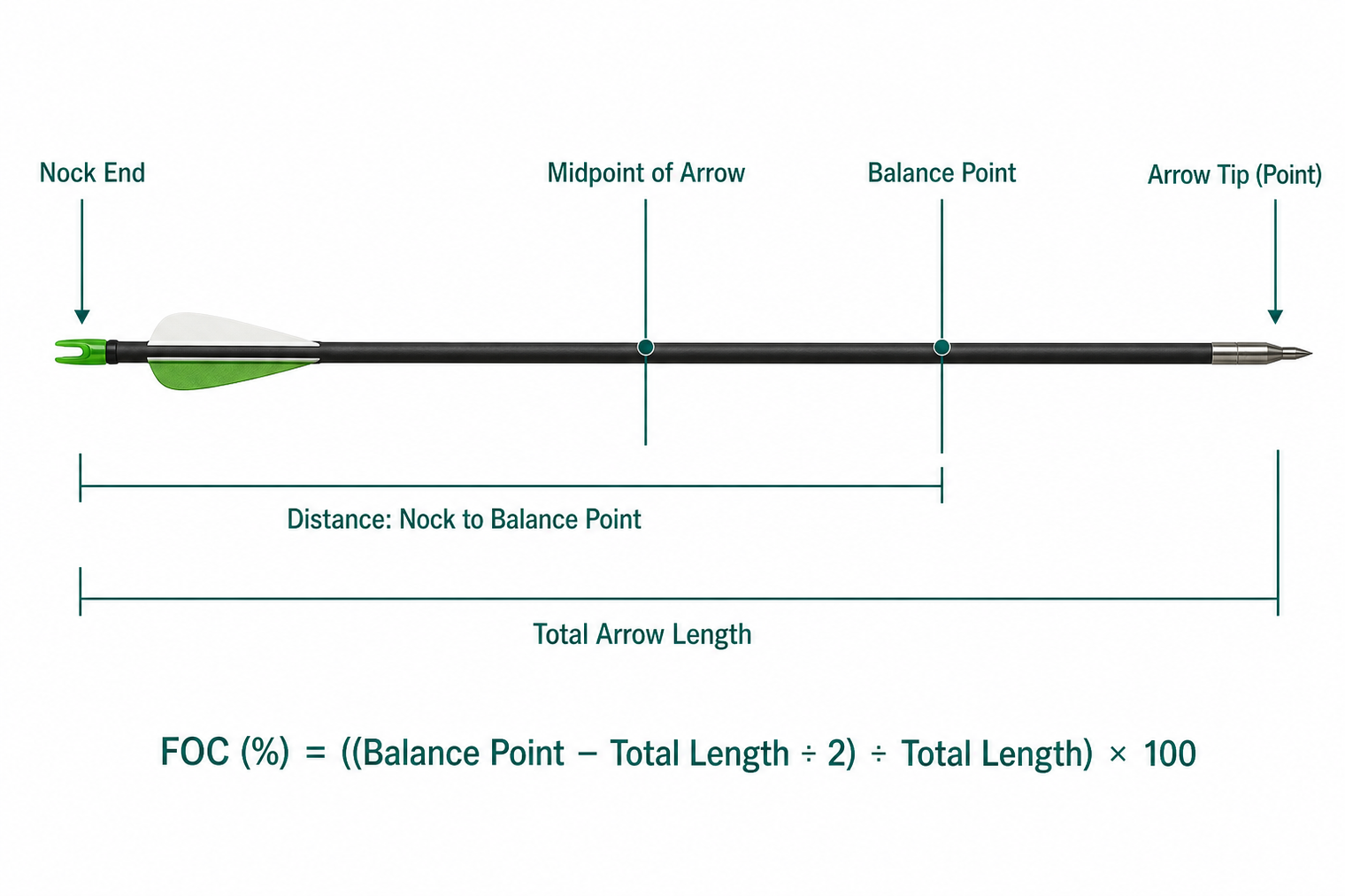
Front of center — commonly abbreviated as FOC — refers to the position of an arrow's balance point relative to its total length. When an arrow's weight is distributed toward the front, it flies more predictably. When that balance is off, groups open up and tuning becomes a puzzle. Understanding FOC is one of the most practical things an archer can learn.
Why FOC Actually Matters for Arrow Flight
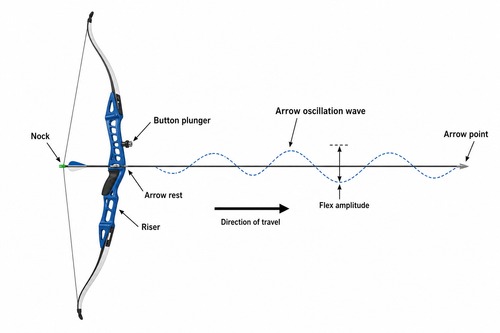
An arrow is not a rigid projectile like a bullet. Once it leaves the bow, it flexes, oscillates, and recovers — a process often called the archer's paradox. For that recovery to happen cleanly and consistently, the arrow needs more weight toward the tip than toward the nock end.
A forward-weighted arrow self-corrects during flight. The heavier front resists deflection while the lighter rear — the end where the arrow nock and fletching sit — trails behind like a weathervane. This keeps the point aimed in the direction of travel rather than yawing sideways.
If the balance point is too far back, the arrow becomes unstable after leaving the string. Wind drift increases, groups scatter, and no amount of sight adjustment will fix the root cause. FOC is fundamentally a flight stability issue, not just a theoretical measurement.
How to Calculate Your Arrow's FOC
The calculation is straightforward once you understand the two measurements involved:
- Total arrow length — measured from the bottom of the nock groove to the end of the shaft (not including the point).
- Balance point location — the spot where the fully assembled arrow balances horizontally on a single finger or narrow edge.
The formula is:
FOC (%) = ((Balance point from nock end − Total length ÷ 2) ÷ Total length) × 100
For example: if your arrow is 28 inches long and the balance point is 18 inches from the nock end, the calculation looks like this:
- Half the arrow length = 14 inches
- Balance point minus half length = 18 − 14 = 4 inches
- 4 ÷ 28 × 100 = approximately 14.3% FOC
Always use the fully assembled arrow — with point, nock, and fletching installed — because each component shifts the balance point.
What FOC Range Should You Aim For?
There is no single correct number. The ideal range depends on your shooting discipline, bow type, and intended use.
- Target archery (recurve and compound): Most archers perform well in the 10–15% range. This provides stable flight without sacrificing arrow speed significantly.
- Bowhunting: Many hunters prefer 15–19% or higher. A heavier front transfers more energy on impact and helps the arrow drive through resistance.
- 3D and field archery: Moderate FOC around 10–15% is common, balancing flat trajectory with enough stability for varied distances.
- Traditional archery: Instinctive shooters often use higher FOC to compensate for less consistent arrow release mechanics.
Very high FOC (above 25–30%) can cause the arrow to nose-dive at longer distances, trading stability for a steep angle of descent. Higher is not always better.
What Changes Your Arrow's FOC
Several components directly influence where the balance point falls. Knowing which ones to adjust gives you a practical toolkit for tuning.
Point Weight
The single most effective lever. Switching from a 75-grain point to a 100-grain or 125-grain point shifts the balance point forward noticeably. This is usually the first adjustment archers make when they want to increase FOC.
Shaft Weight and Length
A heavier or longer shaft adds mass behind the balance point, reducing FOC. A shorter or lighter shaft — with the same point — increases it. Cutting shafts is a one-way process, so measure carefully before trimming.
Fletching and Nock Weight
Heavier arrow feathers or oversized vanes add rear weight and reduce FOC. Lighter or smaller fletching keeps more weight toward the front. The nock itself contributes very little, but in precision tuning, even small rear-end additions are worth noting.
Insert Weight
Weighted inserts or outserts placed inside the shaft just behind the point are a common method for increasing FOC without switching to a heavier point entirely. This is particularly useful for archers who want to maintain a specific point profile for a particular target or hunting scenario.
Common Mistakes Archers Make with FOC
- Measuring without all components installed. A bare shaft gives you a meaningless number. Always test with the complete setup.
- Assuming higher FOC is always better. Excessive front-weighting can cause poor grouping at distance as the arrow drops steeply.
- Ignoring FOC when changing point weight for a different purpose. Many archers swap points for broadhead practice or hunting season without rechecking their FOC or spine match.
- Chasing FOC while ignoring spine. FOC and spine work together. An arrow with great FOC but mismatched spine will still fly poorly.
- Skipping re-tuning after a component change. Even a fletching swap can shift the balance enough to warrant a paper tune or walk-back check.
Practical Steps to Improve Your Arrow Setup
If your arrows are flying inconsistently and your bow is properly tuned, walking through an FOC check is a logical next step.
- Assemble the arrow completely, exactly as you shoot it.
- Find the balance point by resting the arrow on a fingertip and sliding it until it sits level.
- Measure from the nock groove to the balance point, then run the FOC formula.
- If the result is below your target range, increase point weight or try a heavier insert.
- If the result is too high and you're seeing nose-diving at distance, reduce point weight or try a slightly heavier shaft.
- After any change, re-check your arrow spine compatibility before shooting at full draw.
Keeping a written record of each setup — shaft model, point weight, insert weight, fletching type — saves time when you need to reproduce a result or troubleshoot a problem later. A purpose-built arrow tube with holder helps you transport and organize multiple matched sets without mixing them up between sessions.
Frequently Asked Questions
How do I know if my FOC is causing flight problems?
Common signs include fishtailing during flight, inconsistent groups that don't respond to sight adjustment, or arrows that drift noticeably in light wind. A low FOC reading — below 7–8% for most setups — is a likely contributor worth investigating.
Does FOC matter for barebow and traditional archers as much as compound shooters?
It often matters more. Traditional and barebow archers typically shoot with less draw-cycle forgiveness, so arrow stability on release has a bigger influence on consistency. Many experienced traditional archers deliberately set up toward the higher end of the FOC range for this reason.
What mistakes do beginners most often make when learning about arrow FOC?
The most common is measuring the bare shaft rather than the fully built arrow. The second most common is increasing FOC without checking whether the shaft spine still matches the bow draw weight — a heavier point requires a stiffer spine to compensate.
Can I use FOC to fix an arrow that kicks out on release?
FOC helps with in-flight stability, but tail-kick on release is usually a spine problem, a pressure button issue, or a form issue. Adjusting FOC alone won't fix a spine mismatch. Address spine compatibility first, then fine-tune FOC for flight quality.
A Quick Summary
What is arrow front of center, in practical terms? It is a measurement of weight distribution that determines how stable your arrow is once it leaves the bow. Getting it into the right range for your discipline — typically 10–15% for target shooting and higher for hunting — is one of the more effective and underused tuning adjustments available to archers at any level. Start with the formula, measure your current setup, and adjust point or insert weight before reaching for more expensive solutions.