Skip to content
 cust@legendarchery.com
 302 503 5767
 Westfield IN 46074


Bad archery habits tend to develop quietly. You might shoot for weeks without noticing that a small flaw in your grip or anchor is costing you three inches at thirty yards. The good news is that most accuracy problems trace back to a handful of repeatable errors — and once you know what to look for, they are straightforward to correct. This guide covers the five errors that show up most often across beginner and intermediate archers, with practical fixes for each one.
Why Form Errors Are So Hard to Self-Diagnose
Archery is a sport where cause and effect are separated by time and distance. You release the arrow, watch it fly, and try to work backwards from where it lands. That feedback loop makes it easy to blame your equipment when the real issue lives in your technique. A consistent coach or a training partner with a camera is worth more than any accessory upgrade for this exact reason. That said, knowing the most likely culprits puts you ahead of the process.
The 5 Most Common Archery Mistakes
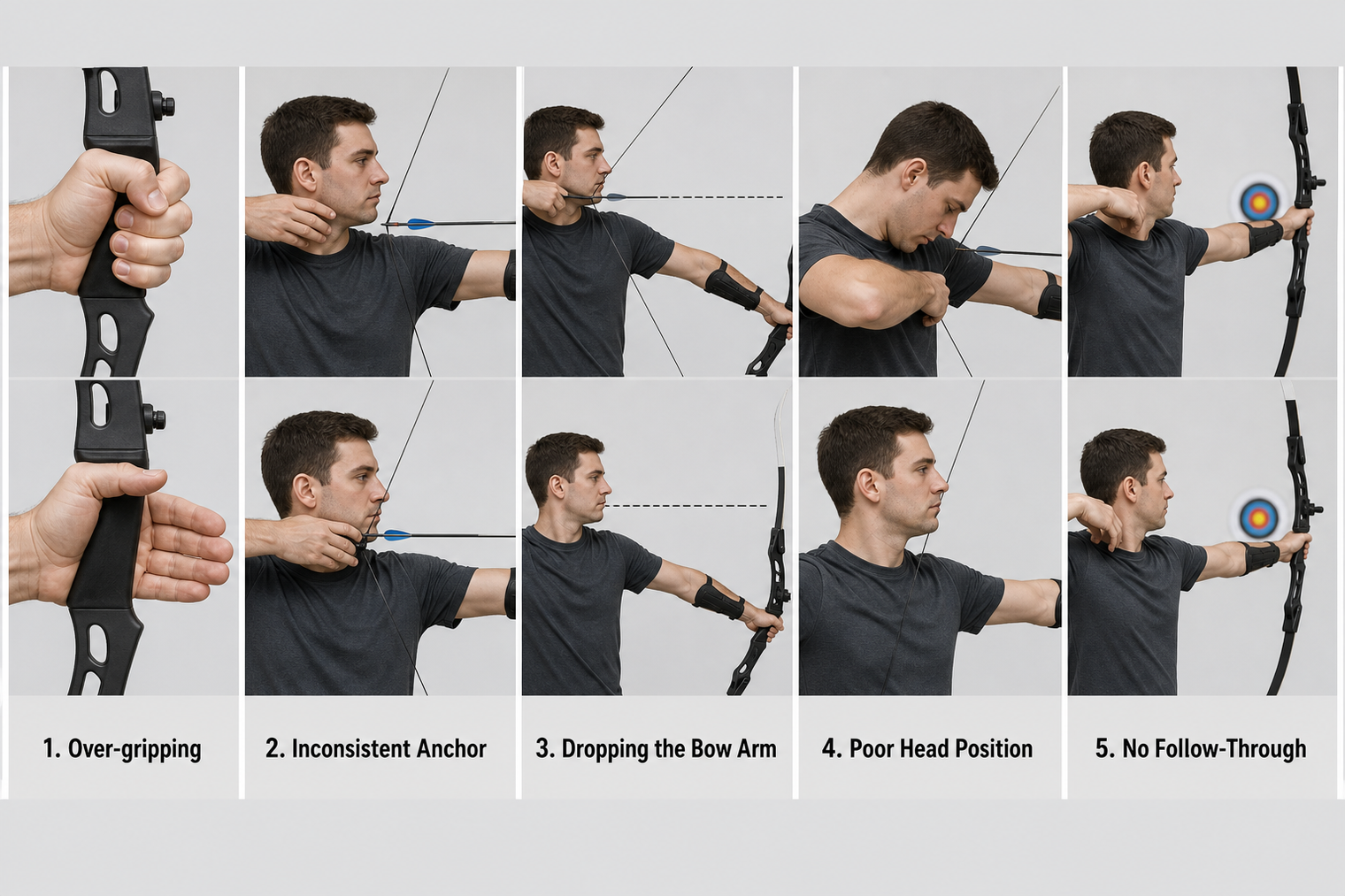
1. Gripping the Bow Too Tightly
This is the single most widespread error across all experience levels. When you squeeze the grip, the tension in your hand transfers torque to the riser at the moment of release. The result is a bow that rocks or twists through the shot, sending arrows left or right of the point of aim — and the direction shifts depending on whether you are left or right handed.
The fix is a relaxed, open bow hand. The grip should rest along the thumb pad and the lower part of the palm, with your fingers curled loosely or extended forward. Your bow arm elbow should be rotated slightly outward to avoid string slap, but the hand itself should feel almost passive. Many archers find it helpful to consciously think about pointing their fingers at the target rather than wrapping them around the grip.
2. Inconsistent Anchor Points
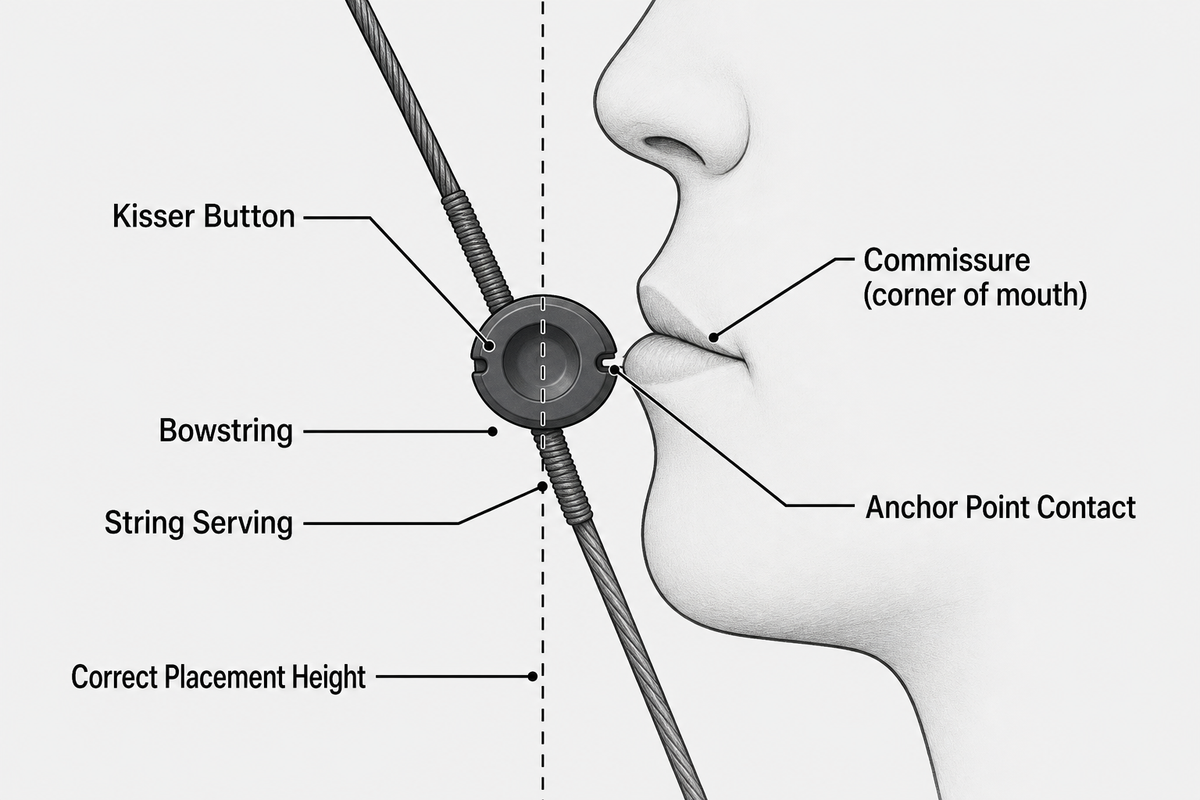
Your anchor point is the position where your draw hand makes contact with your face at full draw. If that position shifts even a few millimetres between shots, your arrow leaves at a slightly different angle each time. Over thirty or forty metres, that small angular difference becomes a very large spread on the target.
Consistent anchoring requires at least two reference points — most archers use the corner of the mouth or the chin as one reference, and the string touching the nose or cheek as a second. Compound shooters often add a kisser button or a nose button to the string to add a third contact point. The goal is to arrive at the same position every single shot without having to think about it consciously.
3. Punching the Trigger or Anticipating the Release
Target panic is a broader topic, but the core symptom is flinching, jabbing the trigger, or collapsing the draw at the moment of release. This usually develops when an archer becomes over-focused on the outcome of the shot rather than the process of executing it. The brain anticipates the noise and the recoil, and the body fires early to get it over with.
For compound shooters, a back-tension release aid or a hinge release can interrupt the learned flinch reflex by requiring a different activation mechanic. For recurve and traditional archers, a deliberate focus on back muscle engagement — pulling through the shot rather than releasing to it — tends to produce a cleaner, surprise release. Blank bale practice with eyes closed is a useful drill for both disciplines.
4. Poor Head and Neck Position
Tilting or dropping the head to meet the string is extremely common, particularly among archers who are still developing their anchor. It feels natural to bring your face to the string, but a head that tilts even slightly changes your eye alignment relative to the sight or arrow shelf. It also introduces neck tension that can affect how you hold at full draw.
The correct approach is to bring the string to the face rather than the face to the string. This is a subtle mental cue but it produces very different muscle behaviour. Keeping your chin level and your neck tall during the draw cycle tends to produce more repeatable head positioning. If you find your string is consistently out of reach at a neutral head position, your draw length may be set too long.
5. Dropping the Bow Arm at Release
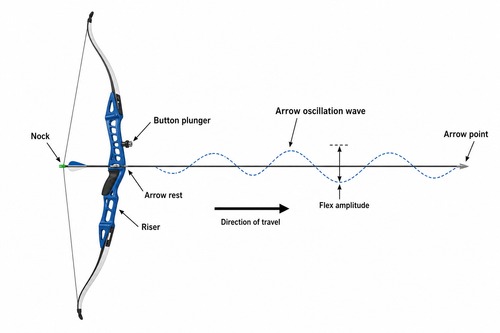
Watching where your arrow goes is entirely natural. The problem is that most archers begin to lower their bow arm before the arrow has actually left the string. Modern arrows travel slower than most people imagine, and any movement in the bow arm during the brief window between release and arrow departure affects the shot.
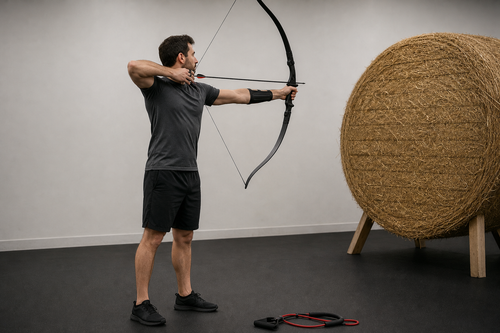
Follow-through — keeping the bow arm raised and the sight on target until the arrow reaches the target — is a discipline, not an optional polish. A useful cue is to hold your bow arm up long enough to call the shot: to identify exactly where the sight pin or arrow tip was at the moment of release. If you cannot do that, your bow was moving. Drills that exaggerate the follow-through, such as keeping the bow raised for a full three seconds after release, help build the habit.
How Equipment Fit Contributes to These Errors
It is worth noting that some of these mistakes are partly driven by equipment that does not fit the archer. A draw length that is too long forces the head forward to reach the anchor. A grip that is too thick for your hand naturally encourages over-gripping. A draw weight that is too heavy for your current strength encourages collapse and punching at the release.
Before investing significant time drilling around a technique problem, it is worth verifying that your equipment is actually sized and configured for your body. If you are building out a new setup or replacing worn components, browsing a well-stocked archery shop with knowledgeable staff makes it much easier to get the fit right from the start.
It is also interesting to note how rarely these fundamentals show up correctly in popular media — if you want a lighter read on that topic, the Legend Archery blog has a breakdown of 5 big archery mistakes in film and television that highlights just how far Hollywood technique strays from real shooting form.
Building Better Habits Over Time
Correcting ingrained habits takes repetition under the right conditions. A few principles that experienced coaches return to consistently:
- Drill one thing at a time. Trying to fix your grip, anchor, and follow-through simultaneously usually means fixing none of them. Isolate a single variable for a practice session and commit to it.
- Use short distances. Moving back to five or ten metres when working on form removes the pressure of hitting the target at distance and lets you focus on execution.
- Film yourself. A phone propped on a tripod gives you an objective view of your shot cycle that feels impossible to see from inside the experience.
- Track shot counts, not just scores. Progress in form work often shows up as improved consistency before it shows up as improved scores. Watch your grouping pattern, not just where the group lands.
- Get periodic feedback. Even experienced archers benefit from an occasional session with a qualified coach. Habits that feel fixed can quietly drift back over time.
Frequently Asked Questions
Why do these particular mistakes come up so often across different types of archers?
Most of them are rooted in the same thing: the brain trying to manage an outcome rather than execute a process. Flinching, dropping the bow arm, and gripping too hard are all responses to anticipation. Anchor inconsistency and head position issues tend to emerge from rushing the draw cycle or working with equipment that does not fit well. These are human tendencies, not beginner-only problems — you see them at every level.
How do I know if my accuracy problem is technique or equipment?
Start by shooting from a very short distance — five metres or less — with a target you cannot miss. If your groups are still inconsistent, the issue is almost certainly technique. If the groups are tight but in the wrong place, it is more likely a tuning or sight adjustment issue. Separating these two questions early saves a lot of time and money.
Can these mistakes come back even after you have corrected them?
Yes, and this catches a lot of archers off guard. A technique problem that feels completely fixed can resurface under competition pressure, after a long break, or when you increase your draw weight. Regular blank bale work and periodic video review help catch drift before it becomes a fully re-established habit.
Is there a drill that addresses more than one of these errors at once?
Blank bale shooting — shooting at a plain target from very close range with no focus on score — is probably the most useful all-round drill. It removes the outcome pressure that drives flinching and anticipation, and it lets you focus entirely on grip, anchor, and follow-through simultaneously because the result of each shot is almost irrelevant.
Final Thought
Most archers plateau not because they lack talent but because a small number of repeatable errors go unaddressed for too long. Identifying which of these five mistakes is affecting your shooting — and working on it deliberately — will produce more measurable improvement than changing your arrows, your bow, or your sight. Start with your hands and your anchor, and work outward from there.